
The 0.23 miles of glory that is Virginia State Route 79


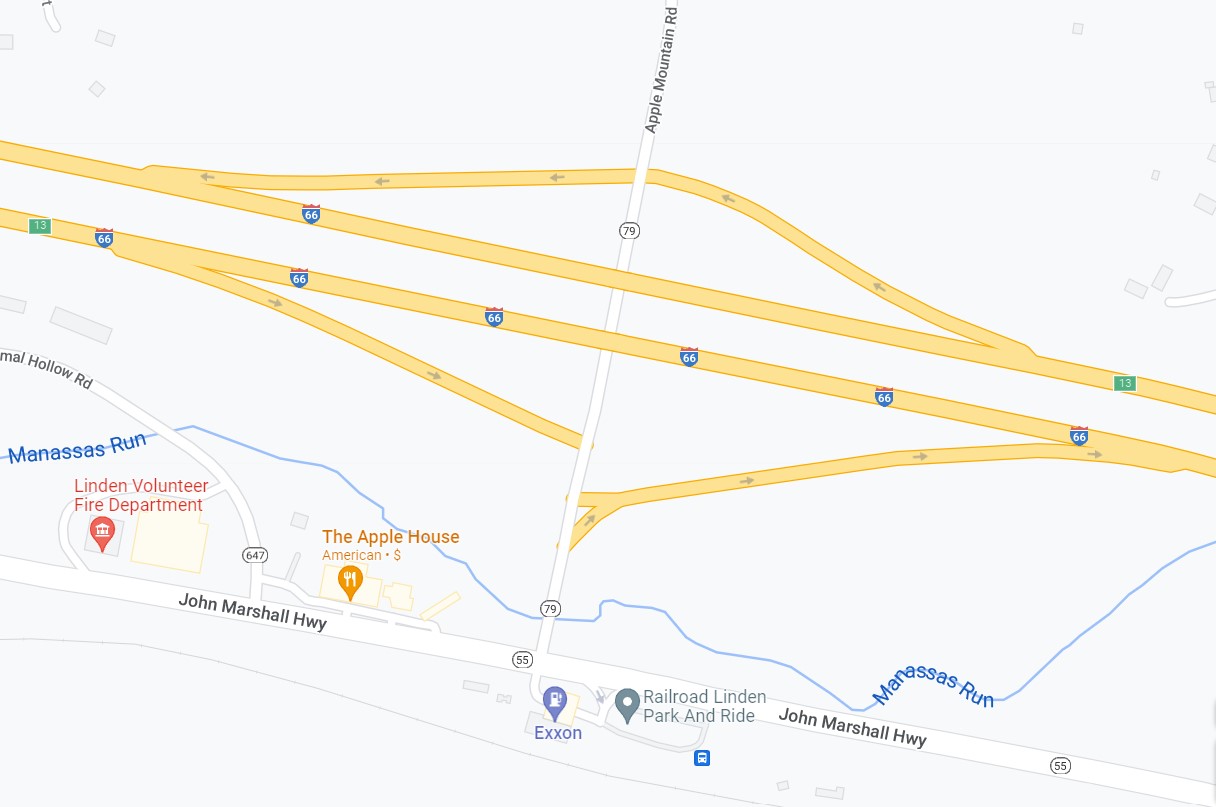
Virginia State Route 79 is a 0.23-mile Primary State Highway which serves to connect Interstate 66 and Virginia State Route 55 near the community of Linden.  Virginia State Route 79 is located in Warren County along Apple Mountain Road.  Despite only being 0.23 miles long the alignment of Virginia State Route 79 is a signed access point to Shenandoah National Park.  A large Park & Ride lot can be found at the southern terminus of Virginia State Route 79.  


Part 1; the history of Virginia State Route 79

Modern Virginia State Route 79 appears as aligned between Route 55 to Route I-66 in the 2003 Virginia Route Index Book


According to vahighways.com the current iteration of Virginia State Route 79 is the third time the number has been assigned.  Vahighways.com references the current iteration of Virginia State Route 79 as likely having been added during 1980 as a connecting route between Interstate 66-Virginia State Route 55.  Vahighways.com notes the short distance of the current Virginia State Route 79 as being unusual for a Primary State Highway and suggests a more appropriation designation would have been Virginia State Route 55Y.  

The current Virginia State Route 79 appears to have been added as part of the construction of Interstate 66 between US Route 340 east to US Route 17 near Delaphane.  The US Route 340-US Route 17 segment of Interstate 66 was completed by August 1979.  Apple Mountain Road was part of the construction of Interstate 66 in the US Route 340-US Route 17 corridor at what is now Exit 13.

Despite the unusually short length of Virginia State Route 79 is not the shortest Primary State Highway.  A complete list of Primary State Highways in Virginia under one mile can be found below:


Part 2; a drive on Virginia State Route 79

From Interstate 66 westbound traffic can access Virginia State Route 79 via Exit 13.  All signage from Interstate 66 westbound displays Virginia State Route 79 co-signed as "To Viriginia State Route 55."  Traffic departing Interstate 66 onto Virginia State Route 79 is advised it can be used to access Skyline Drive of Shenandoah National Park.  


Virginia State Route 79 terminates at Virginia State Route 55 at a Park & Ride lot located behind an Exxon station.  


From Virginia State Route 55 eastbound Virginia State Route 79 northbound is co-signed as "To Interstate 66."


Comments

Popular posts from this blog

Cajon Pass; Cajon Pass Toll Road, National Old Trails Road, US Route 66/91/395 and Interstate 15

This past weekend I spent some time in Cajon Pass traversing the many historic road alignments. Cajon Pass is located in San Bernardino County, California along the San Andreas Fault.  Cajon Pass  serves the boundary line between the Mojave Desert, the San Gabriel Mountains, San Bernardino Mountains and San Bernardino Valley.  Cajon Pass is historically one of the most traveled transportation corridors in American California and presently is served by four rail lines, Interstate 15 and California State Route 138. While Cajon Pass is known mostly for carrying US Route 66 it has carried numerous other signed highways that have had a significant impact on regional and national road travel.  While this is my best attempt to compile everything from the best sources I could find into one single transportation history blog regarding road travel in Cajon Pass I suspect as time goes on this article will be frequently updated.  If you have any information that you ...

Pardee Dam Road

Pardee Dam is a 358-foot-high concrete structure located near Campo Seco at the Calaveras County and Amador County Line.  Pardee Dam impounds the Mokelumne River which forms the namesake Pardee Reservoir.  Pardee Dam was completed during 1929 and is part of the East Bay Municipal Utility District.  Pardee Dam is accessed by the namesake Pardee Dam Road which crosses the structure via the one-lane road seen as the blog cover photo.   Part 1; the history of Pardee Dam Road The closest community to Pardee Dam is that of Campo Seco on the Calaveras County side of the Mokelumne River.  Campo Seco was founded in 1850 by Mexican Miners who worked placer claims in Oregon Gulch during the height of the California Gold Rush.  Campo Seco would reach a population of about three hundred by 1860 spurred by the numerous mining claims in the area.  Main Street of Campo Seco flowed directly into the Campo Seco Turnpike which had been authorized by the California L...

The last 1956-63 era California Sign State Route Spade?

Along southbound California State Route 170 (the Hollywood Freeway Extension) approaching the Hollywood Freeway/Ventura Freeway interchange a white California State Route 134 Sign State Route Spade can be observed on guide sign.  These white spades were specifically used during the 1956-63 era and have become increasingly rare.  This blog is intended to serve as a brief history of the Sign State Route Spade.  We also ask you as the reader, is this last 1956-63 era Sign State Route Spade or do you know of others?  Part 1; the history of the California Sign State Route Spade Prior to the Sign State Route System, the US Route System and the Auto Trails were the only highways in California signed with reassurance markers.  The creation of the US Route System by the American Association of State Highway Officials during November 1926 brought a system of standardized reassurance shields to major highways in California.  Early efforts to create a Sign State Route ...