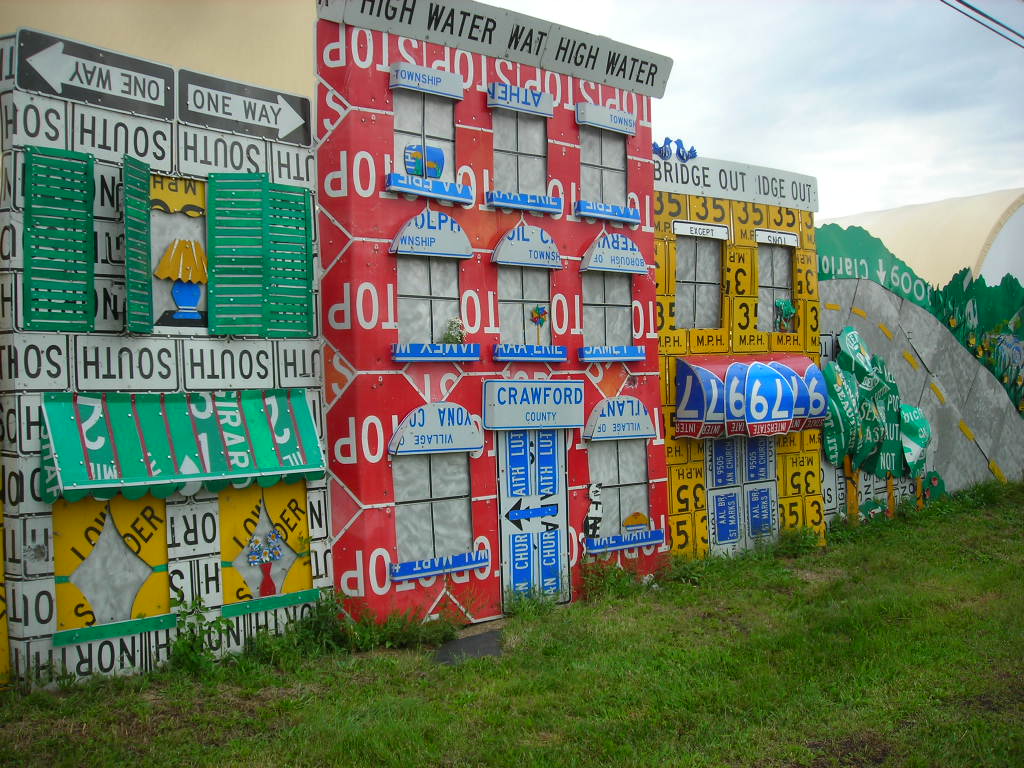
Meadville's PennDOT Road Sign Scultpture Garden

The PennDOT Road Sign Scultpture Garden in Meadville, Pennsylvania is a joint public art project between PennDOT and Allegheny College that began in 2002 to give a distinct look to Meadville's gateway from the west. Using recycled signs and tires, it is truly one of a kind. The sign garden is located at a Meadville PennDOT residency at US 6, US 19 and US 322's junction with PA 102, east of Interstate 79 and west of downtown Meadville. I've had a few occasions to check out the sign sculpture garden myself and I fully endorse recycling signs in this manner. It's a nice little stop to stretch your legs. I took the following pictures in September 2007.

One of the first parts of the project, and what you'll notice first if you are coming from the west, is the Signs and Flowers part of the art exhibit. This is also next to where you would likely park your car if you wanted to stop and take a look around.


It's a flower garden... of signs.

Blooming sign flower.

Blooming sign flower.

There's also a wall of signs called the Read Between the Signs mural that is alongside the highway as well which is worth checking out. 1200 feet of signs in all from what I'm told.

Gives you a little perspective on how tall the signs are.

And how long the sign wall goes on for.

Up, up and away!

Ferris Wheel.

Do 6!

Signs in the weeds.

Signs about town.


Some other articles about the sign garden...
http://sites.allegheny.edu/news/2014/09/24/kaleidoscope-public-art-abounds-in-meadville/
http://uncoveringpa.com/penndot-road-sign-sculpture-garden-meadville
https://pittsburghorbit.com/2015/08/26/the-meadville-penndot-road-sign-sculptures-part-2-the-flower-garden/

Also, see my complete set of photos from the sign garden on Flickr.

Comments

penndot hours said…
The penndot hours oversees highway programs and transportation issues in Pennsylvania's Common Wealth. Additionally, it deals with issues related to rural transportation, railroads, ports, and waterways. Most of Penndot's employees are involved in restoration, maintenance, and expansion of the state highway system. In addition, it has started focusing on intermodal transportation, which is very effective eat way to increase both public and commercial transportation. The department is also responsible for registering motor vehicles and issuing driver's licenses.

Popular posts from this blog

Did Caltrans just kill the G26 cutout US Route shields?

The US Route System was formally created by the American Association of State Highway Officials during November 1926.  Through the history of the system the only state to which has elected to maintain cutout US Route shields has been California.  The G26 series cutout US Route shields have become a favorite in the road enthusiast hobby and are generally considered to be much more visually pleasing than the standard Federal Highway Administration variant.  However, the G26 shield series appears to have been killed off on January 18, 2026, when Caltrans updated their Manual of Uniform Traffic Control Devices.  This blog will examine the history of the US Route shield specifications in California and what is happening with the 2026 changes.  The blog cover photo is facing towards the terminus of California State Route 136 and at a G26-2 specification US Route 395 shield.  In the background Mount Whitney can be seen in the Sierra Nevada range.   ...

Three Points Road (Los Angeles County)

Three Points Road is a rural cutoff route which connects Pine Canyon Road (Los Angeles County Route N2) and California State Route 138 near Neenach of Antelope Valley.  Originally the community of Three Points (named for the junction Pine Canyon, Oakdale Canyon and Oakgrove Canyon) was served by 265th Avenue West.  The modern three-mile-long corridor of Three Points Road was developed by 1950 to serve as a softer transition to California State Route 138.  Part 1; the history of Three Points Road Three Points Road is named in reference to the community near the extinct Neenach Volcano known as Three Points.  Three Points itself is a reference to three canyons it sits in the middle of: Pine Canyon, Oakgrove Canyon and Oakdale Canyon.  Three Points was homesteaded by the Laffery family in 1892.  Nearby Gookins Lake was named after one of the Laffery family members.   Three Points (blue pin) can be seen at the intersection of Pine Canyon Road (now Los...

Hawaii Route 50

Hawaii Route 50 is the longest Sign Route on the island of Kauai at 32.6 miles.  The entirety of Hawaii Route 50 is overlaid atop Kaumualii Highway from Lihue west to the Pacific Missile Range Facility at Barking Sands. Hawaii Route 50 is one of the original 1955-era State Highway designations on Kauai.  Much of the Kaumualii Highway corridor was constructed during the sugar plantation boom of the late Hawaiian Kingdom.  The first tee beam bridge in Hawaii would be constructed along the Kaumualii Highway in 1911 at the Hanapepe.  Much of this highway would be modernized to two-lane standards through the 1930s and 1940s. This page is part of the Gribblenation Hawaii Roads series.  A compellation of all Hawaii-related media from both Gribblenation and RoadwayWiz can be found by clicking  here .  Part 1; the history of Hawaii Route 50 and Kaumualii Highway Hawaii Route 50 is the longest highway on Kauai at 32.6 miles.  The highway begins at Rice Str...