
Damaged from Irene, Mohawk Trail Finally Reopens

Due to significant damage caused by Tropical Storm Irene in late August, a portion of MA Route 2 connecting the towns of North Adams, Florida, Savoy, and Charlemont in northern Berkshire and Franklin counties was closed. Because MA 2 (Mohawk Trail) is a major connecting route between the communities in the area, it was imperative to reconstruct the damaged portion of the roadway in a quick fashion. Construction had to be done from the base up. As a result, this section of MA 2 has finally reopened to traffic, effective December 15, 2011. This is one of the final stretches of roadway that has reopened to traffic after being damaged from the remnants of Hurricane Irene.


http://www.flickr.com/photos/massdot/sets/72157627932012320/

MA 2 construction photos from MassDOT on Flickr.
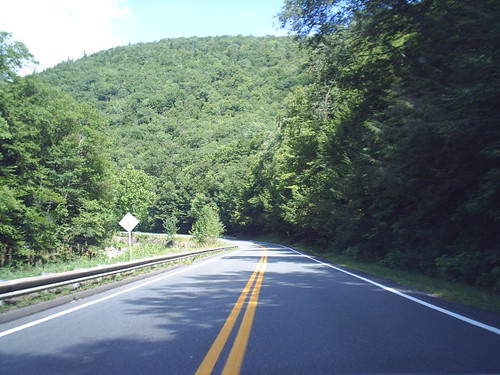


2005 Doug Kerr photo from the aforementioned stretch of roadway.

Comments

Popular posts from this blog

Did Caltrans just kill the G26 cutout US Route shields?

The US Route System was formally created by the American Association of State Highway Officials during November 1926.  Through the history of the system the only state to which has elected to maintain cutout US Route shields has been California.  The G26 series cutout US Route shields have become a favorite in the road enthusiast hobby and are generally considered to be much more visually pleasing than the standard Federal Highway Administration variant.  However, the G26 shield series appears to have been killed off on January 18, 2026, when Caltrans updated their Manual of Uniform Traffic Control Devices.  This blog will examine the history of the US Route shield specifications in California and what is happening with the 2026 changes.  The blog cover photo is facing towards the terminus of California State Route 136 and at a G26-2 specification US Route 395 shield.  In the background Mount Whitney can be seen in the Sierra Nevada range.   ...

Ghost Town Tuesday; Nichols, FL

A couple years ago I spent a lot of spare time exploring phosphate mining ghost towns in the Bone Valley of Polk County, Florida.  One ghost town in particular called Nichols on Polk County Route 676 west of Mulberry caught my eye due to a relative lack of documentation on ghosttowns.com. Nichols was created in 1905 during the early phosphate mining boom in the Bone Valley region.  For the time Nichols was unusual since it had company housing in the Nichols Mine site and private residences outside the gate.  Nichols is only about two miles west of Mulberry which probably made it a somewhat reasonable commute even by the wonky standards of the early 20th Century.  Most of the Bone Valley region was relatively remote which made commuting or homesteading impractical which is why there are so many ghost towns in the area.  The company housing section of Nichols was phased out and abandoned by 1950. The Nichols town site is largely abandoned and could "possibl...

Old Wards Ferry Road

Old Wards Ferry Road is an approximately 3.6-mile portion of the original alignment of Wards Ferry Road located near the city of Sonora, California.  As currently configured this older alignment begins at modern Wards Ferry Road near Curtis Creek and terminates in Sonora at Sanguinetti Road.  The Olds Wards Ferry Road corridor is largely defined by the single lane 1914-era arch concrete bridge at Curtis Creek. Wards Ferry Road is one of the oldest road corridors in Tuolumne County having been set up as a ferry crossing by Joesph Ward during 1850.  Wards Ferry Road was once the primary connecting highway between the communities of Big Oak Flat and Sonora.  Wards Ferry Road is most well-known from the largely one-lane wide alignment through Murderer's Gulch where it crosses the Tuolumne River via heavily graffitied 1971 Wards Ferry Bridge.  Pictured as the blog cover is the 1897 Wards Ferry Bridge as it was during 1951.  The 1897 Wards Ferry Bridge was built ...