Old US 2 Bridge - New Sharon, Maine

In the Franklin County town of New Sharon in central Maine was a bridge that was on a former alignment of US 2 through New Sharon. At the time of the bridge's demolition in February 2014, the New Sharon Bridge was the last known surviving pin-connected highway truss throughout the entire state of Maine. Built in 1916 by New York's Croton Bridge Company, the New Sharon Bridge spanned over the Sandy River. A couple of friends and I visited the old bridge in early September 2004. At the time, it was meant to be a temporary bridge closure.

Looking at the old truss bridge from the east.
A view of the modern bridge that carries US 2, ME 27 and ME 134 over the Sandy River.
The Sandy River looking south as seen from the bridge. This is what a lot of interior Maine looks like in the summer.

Looking east from the bridge. You can notice the steel deck and that the bridge was probably a bottleneck during its heyday. The bridge leads to a mostly dirt path.

New Sharon as seen looking west from the bridge. As you can see, a barricade has been around for a while.

The weight limit of the bridge is 3 tons, but someone took the liberty of changing the limit.

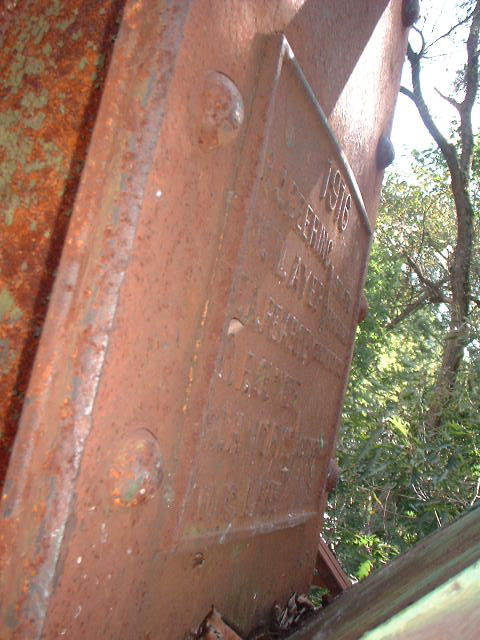
A plaque on the base of the bridge about when it was built. Looks like the bridge was built by the Croton Bridge Company in 1916.

Can't make out this plaque as well, maybe it is honoring the bridge builders or perhaps a few trustees.

Sign stating that the bridge is closed, temporarily. Unfortunately, it is now closed permanently as the bridge was demolished in 2014, some ten years after I took this photo.


Sources and Links:
Bridgehunter - New Sharon Bridge


Comments

Anonymous said…
The name of the bridge company was in fact the Groton Bridge Company of Groton, NY.

Popular posts from this blog

Did Caltrans just kill the G26 cutout US Route shields?

The US Route System was formally created by the American Association of State Highway Officials during November 1926.  Through the history of the system the only state to which has elected to maintain cutout US Route shields has been California.  The G26 series cutout US Route shields have become a favorite in the road enthusiast hobby and are generally considered to be much more visually pleasing than the standard Federal Highway Administration variant.  However, the G26 shield series appears to have been killed off on January 18, 2026, when Caltrans updated their Manual of Uniform Traffic Control Devices.  This blog will examine the history of the US Route shield specifications in California and what is happening with the 2026 changes.  The blog cover photo is facing towards the terminus of California State Route 136 and at a G26-2 specification US Route 395 shield.  In the background Mount Whitney can be seen in the Sierra Nevada range.   ...

Hawaii Route 50

Hawaii Route 50 is the longest Sign Route on the island of Kauai at 32.6 miles.  The entirety of Hawaii Route 50 is overlaid atop Kaumualii Highway from Lihue west to the Pacific Missile Range Facility at Barking Sands. Hawaii Route 50 is one of the original 1955-era State Highway designations on Kauai.  Much of the Kaumualii Highway corridor was constructed during the sugar plantation boom of the late Hawaiian Kingdom.  The first tee beam bridge in Hawaii would be constructed along the Kaumualii Highway in 1911 at the Hanapepe.  Much of this highway would be modernized to two-lane standards through the 1930s and 1940s. This page is part of the Gribblenation Hawaii Roads series.  A compellation of all Hawaii-related media from both Gribblenation and RoadwayWiz can be found by clicking  here .  Part 1; the history of Hawaii Route 50 and Kaumualii Highway Hawaii Route 50 is the longest highway on Kauai at 32.6 miles.  The highway begins at Rice Str...

Ghost Town Tuesday; Nichols, FL

A couple years ago I spent a lot of spare time exploring phosphate mining ghost towns in the Bone Valley of Polk County, Florida.  One ghost town in particular called Nichols on Polk County Route 676 west of Mulberry caught my eye due to a relative lack of documentation on ghosttowns.com. Nichols was created in 1905 during the early phosphate mining boom in the Bone Valley region.  For the time Nichols was unusual since it had company housing in the Nichols Mine site and private residences outside the gate.  Nichols is only about two miles west of Mulberry which probably made it a somewhat reasonable commute even by the wonky standards of the early 20th Century.  Most of the Bone Valley region was relatively remote which made commuting or homesteading impractical which is why there are so many ghost towns in the area.  The company housing section of Nichols was phased out and abandoned by 1950. The Nichols town site is largely abandoned and could "possibl...