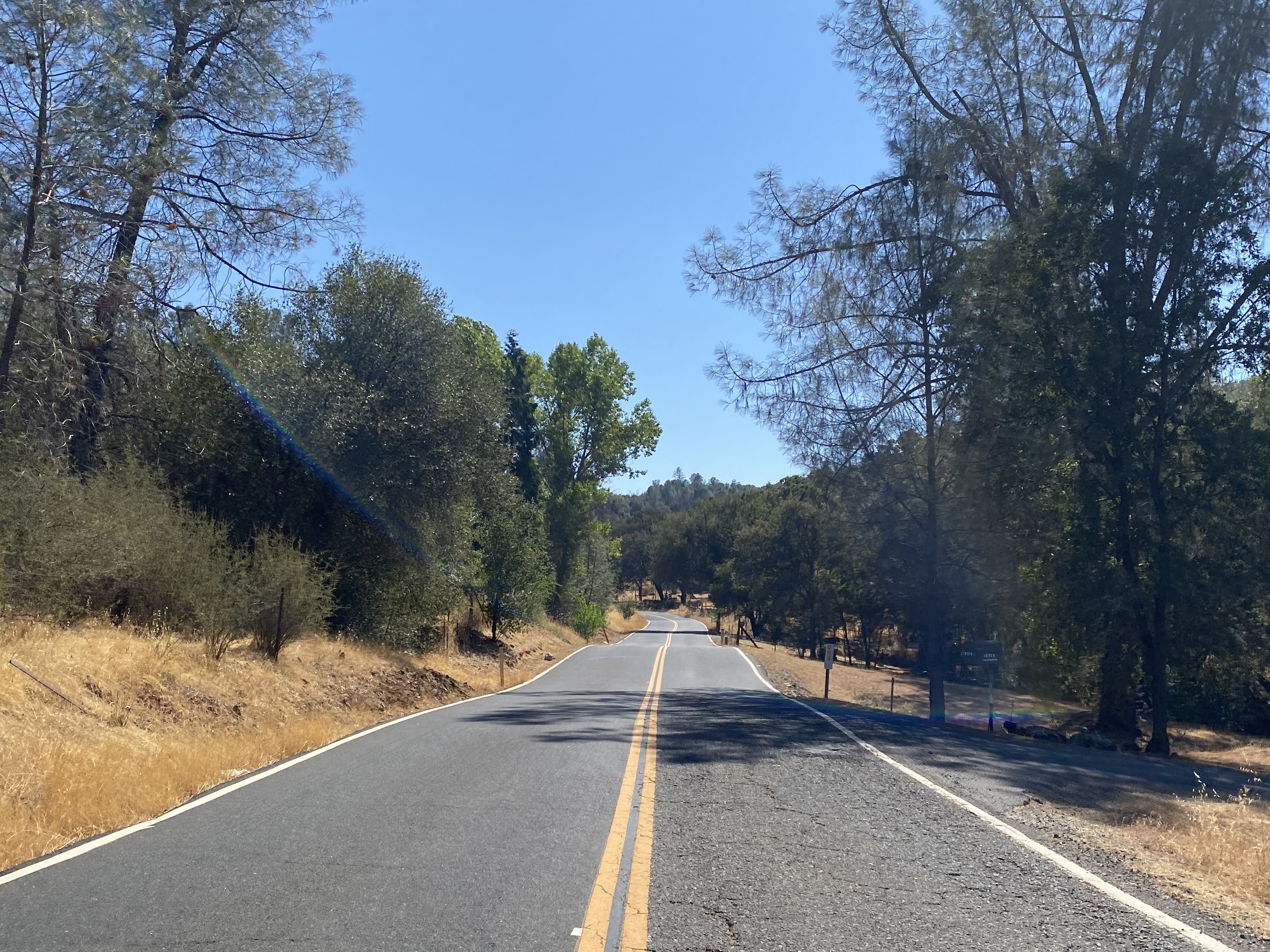
Pool Station Road


Pool Station Road is 12.6-mile rural highway located in the Sierra Nevada foothills of Calaveras County.  The corridor connects from California State Route 49 near downtown San Andreas south to California State Route 4 near Copperopolis.  

Pool Station Road is named after a stage station which was located on Reeds Turnpike (now California State Route 4) between Copperopolis and Altaville.  The corridor was developed during the 1920s to permit highway access to the Calaveras Cement plant.  Despite being located in the Sierra Nevada foothills much of Pool Station Road is winding and features numerous large dips in terrain.  


Part 1; the history of Pool Station Road

The name of Pool Station Road is a reference to Pool Station.  Pool Station was located along the Goldrush era Reeds Turnpike between Copperopolis and Altaville (now part of Angels Camp).  The station was located approximately where Pool Station Road has a southern terminus at California State Route 4.

Pool Station Road is a modern highway corridor which was meant to facilitate access to the Calaveras Cement plant.  Calaveras Cement incorporated in 1925 and was based out of a plant located on Pool Station Road.  The company is most well-known for supplying cement to the construction site of Pardee Dam.  

Pool Station Road can be seen connecting from California State Route 49 in downtown San Andreas and extending south California State Route 4 near Copperopolis on the 1935 Division of Highways map of Calaveras County.  Part of early Pool Station Road is shown along what is now Church Hill Road in San Andreas. 


Calaveras Cement would construct a 5.5-mile short line railroad from their plant to quarries located east of Calaveritas.  This short line railroad would be converted into private road usage during the 1990s and now known as cement plant road. 

Calaveras Cement would be sold in 1959 and again in 1979.  The company would be shuttered in 1983 due to being unable to compete with foreign cement prices and a high cost to modernize their plant.  Despite the shuttering of Calaveras Cement the road to the quarry remains private and inaccessible to the public. 


Part 2; a drive on Pool Station Road

Modern Pool Station Road begins at California State Route 49 north of downtown San Andreas. 


Southbound Pool Station Road intersects Cement Plant Road approximately one mile south of California State Route 49.  The ruins the Calaveras Cement Plant can be found west of the intersection.  


Pool Station Road crosses San Antonio Creek.


Pool Station Road becomes a winding mountain road and continues south to a bridge over South Fork Calaveras River.  


The remaining balance of Pool Station Road south of the South Fork Calaveras River is a winding mountain road which features numerous dips and fast curves.  The roadway ends at California State Route 4 near Copperopolis.  


Comments

Popular posts from this blog

Crescent City Connection (New Orleans, LA)

The Crescent City Connection is a massive dual-span steel truss bridge that spans the lower Mississippi River at downtown New Orleans, about 95 river miles upstream from the mouth of the great river at the Head of Passes Light. If counted as a single bi-directional highway bridge, the parallel spans combine to form the single busiest bridge on the Mississippi River and its importance as a linchpin in the region’s transportation network cannot be overstated. While there have been various schemes over the years to construct bridges downriver from Algiers Point, this bridge has been the southernmost bridge on the Mississippi River since its initial construction in the 1950s. The years immediately following the end of World War II were a transformational period in the history of New Orleans. Already one of the great economic and cultural centers of the American Deep South, it was recognized at this time that major changes and improvements to the city’s transportation infrastructure would b...

Old US Route 99 through Tipton, Tulare, and Tagus Ranch

This summer I had a look into the alignment history of US Route 99 through the Tulare County communities of Tipton, Tulare, and Tagus Ranch.  While this slab below might seem like much it is one of the few remaining reminders of how US Route 99 was during the 1920s in Tulare County. This blog is part of the larger Gribblenation US Route 99 Page.  For more information pertaining to the other various segments of US Route 99 and it's three-digit child routes check out the link the below. Gribblenation US Route 99 Page Part 1; the history of US Route 99 in Tipton, Tulare, and Tagus Ranch Tipton and Tulare were both founded in 1872 as sidings of the Southern Pacific Railroad.  The Southern Pacific Railroad laid the groundwork for development of southern San Joaquin Valley.  Previous to the Southern Pacific Railroad travel via wagon or foot in Central California tended to avoid San Joaquin Valley in favor of the Stockton-Los Angeles Road.  The Stockton Los Ange...

Winnemucca to the Sea Highway

The Winnemucca to the Sea Highway was conceived as an idea to establish a continuous, improved route branching from what was then US Highway 40 (now I-80) in Winnemucca, Nevada to the Pacific Coast in Crescent City, California . This highway was to span 494 miles as it crossed through deserts, mountains and forests on its way to the Pacific Ocean. Community leaders from points along this proposed highway formed the Winnemucca to the Sea Highway Association, which worked with state and local governments to obtain funding for the planning, construction and upgrade of the highway. The original proposal was to create one highway, numbered 140, which was to be applied to the complete route as the parent major US highway was coast-to-coast US-40, the Victory Highway. However, this idea never fully came to fruition. Currently, a traveler driving on the Winnemucca to the Sea Highway actually follows seven different highway numbers, which are US 95, NV 140, OR 140, US 395, OR 62, I-5, US 19...