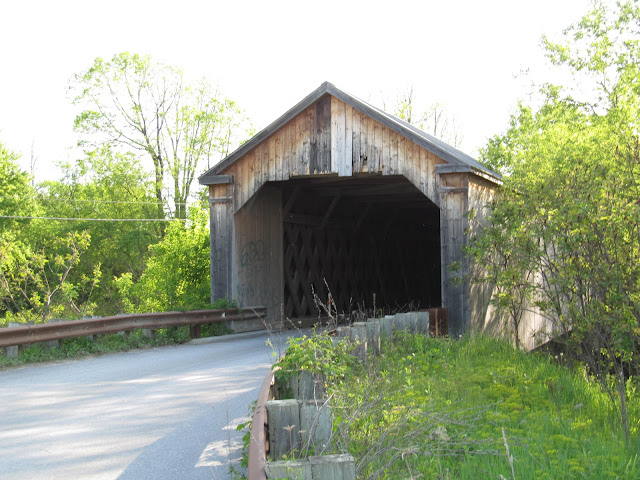
Sanderson Covered Bridge - Brandon, Vermont


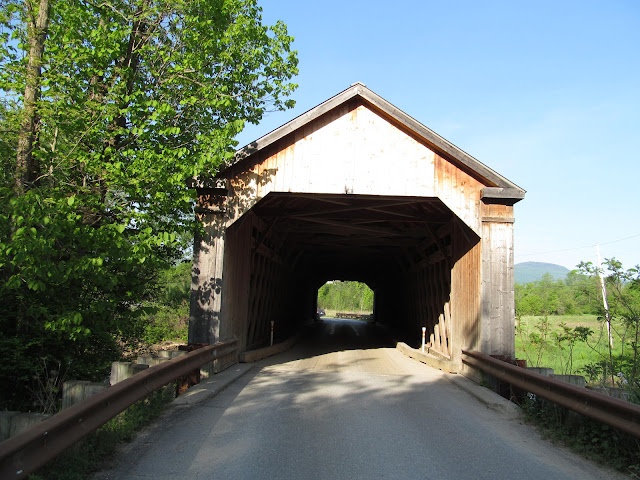
The Sanderson Covered Bridge is located on Pearl Street in Brandon, Vermont and is the second covered bridge to be located at this location. The bridge was named for the Sanderson family, who has been in ownership of a nearby family farm since 1825. The current covered bridge was built in a Town lattice truss design by builders Blow and Cote of Morrisville, Vermont in 2003 at a cost of $830,000. The modern day bridge spans 121 feet over the Otter Creek and is the only covered bridge that remains within the Town of Brandon.

The original covered bridge was built in 1838. While it has been rumored by some historians that famed covered bridge builder Nicholas Powers built the first Sanderson Covered Bridge, the true builder of the bridge is unknown. In 1989, the bridge had been closed to traffic and a temporary steel bridge was placed alongside the covered bridge. Due to the high cost of an archeological survey that was required before a permanent bridge could be constructed, it was decided to dismantle the original covered bridge and rebuild the bridge using new materials. However, the new bridge does contain a few truss lattice members, chord members and roof beams that were salvaged from the original bridge.

Today, the Sanderson Covered Bridge takes up a quiet slice of countryside just southwest of the village center of Brandon. Fans of the opera will find the Barn Opera located near the covered bridge. Others will find the covered bridge is part of a nice drive through rural portions of Rutland County, Vermont.


How to Get There:


Sources and Links:
Vermont Covered Bridge Society - Sanderson Covered Bridge (Replacement)
Brandon Area Chamber of Commerce - Covered Bridge Tour Southern Route
Bridgehunter.com - Sanderson Covered Bridge 45-11-02 #2
The Travels of Tug 44 - Sanderson Covered Bridge
Vermont Covered Bridge Society - Sanderson Covered Bridge Repairs - 2002/2003

Comments

Popular posts from this blog

2018 Mojave Road Trip Part 2; The deadly desert highway (California State Route 127 and Nevada State Route 373)

After leaving Barstow via Old Highway 58 my next destination was in Death Valley.  To access Death Valley from rural San Bernardino County required a trek on north on Interstate 15 to California State Route 127 which becomes Nevada State Route 373 at the state line. Along I-15 I encountered the road sign oddity that is Zzyzx Road about eight miles south of Baker.   Zzyzx Road is a four mile road that used to go to the Zzyzx Mineral Springs and Health Spa.   The spa was founded in the 1940s and the owner made up the name "Zzyzx" to claim it was the last word in the English Language.  The spa has been shut down since the 1970s and is now part of a Desert Studies Center for California State University. The southern terminus of CA 127 in Baker is located at I-15 exit 246.  CA 127 is a 91 mile north/south highway which runs to the Nevada State Line in Inyo County.  CA 127 is called Death Valley Road from I-15 northward.  South of CA 127 ...

Finding the Pre-Emption Road of New York State

  The Pre-Emption Road (or rather a series of roads named Pre-Emption Road) follows a survey line called the Pre-Emption Line, drawn in the early days of the United States. The story begins with Massachusetts and New York having competing land claims to modern day Western New York State that have their roots in colonial charters granted by the British. After the Revolutionary War ended, this land became the frontier of the nation and its settlement became a priority for the new American government. During this era, there were a lot of competing land claims that needed to be settled. It was no different with the land claims between New York State and Massachusetts. On November 30, 1786, Massachusetts and New York sent representatives to Hartford, Connecticut to resolve their competing land claims. In less than three weeks, the representatives had reached a compromise. Massachusetts would receive pre-emption rights, meaning the right to sell the land after the Indian title ...

What's In a Name?: When the Roads Really Do Tell a Story

  Our tagline on the Gribblenation blog is "because every road tells a story". Some roads tell different stories than others. Along our travels, we may see historic markers that tell us a little story about the roads we travel or the places we pass by. Some historic markers are more general, as to telling us who lived where or what old trail traversed between two towns. During my travels across New York State and other states or provinces, I pass by many historic markers, some with interesting or amusing references to roads. I wanted to highlight a few of the markers I've seen along my travels around the Empire State and help tell their stories. Those stories may be as specific as explaining the tales of a tree that was used to help measure a distance of eight miles from Bath to Avoca in Steuben County, as referenced on the Eight Mile Tree historical marker above. They may also help point the way along historical roads first used centuries ago, or may help tell a local l...