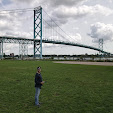
Chalmette-Lower Algiers Ferry (Chalmette, LA)

The newest of the Mississippi River ferry services in the greater New Orleans region, the Chalmette-Lower Algiers Ferry takes vehicles and pedestrians between the southern terminus of LA Highway 47 in Chalmette and Patterson Drive in southeastern Algiers in the city of New Orleans. Like its neighboring ferries, this crossing requires the payment of a toll and ferries depart from each landing every 30 minutes on most days.

The ferry service at this location was initiated in 1969 and has changed little over the years. The ferry's most profitable and useful years were those immediately after its opening, as the communities on the east bank of the Mississippi River in St. Bernard Parish considered this crossing to be a relief route for the often-congested Greater New Orleans Bridge (it had not yet been renamed "Crescent City Connection"), as that bridge had not yet seen the massive expansion of the 1980s that would modernize that crossing. Throughout the 1970s and 80s, it was often the case that the fastest route between the Westbank communities and those of St. Bernard Parish involved crossing the river either here in Chalmette or at the next ferry crossing downriver in Belle Chasse.

In the years since the completion of the Crescent City Connection parallel span in 1988 and the additional improvements to the city's expressway system that were largely built simultaneously, traffic volume at this ferry dropped substantially, however it's still a useful, scenic piece of the cross-river puzzle for traffic unwilling to navigate downtown New Orleans in order to cross the Mississippi River.

The following pictures were taken during my westbound crossing of the Chalmette Ferry in January 2017. Click on each photo to see a larger version.


The following pictures were taken in November 2023 and showcase the Lower Algiers approach to the ferry landing on Patterson Drive. Click on each photo to see a larger version.

Dashcam video of the westbound trip over the Chalmette-Lower Algiers Ferry was filmed in January 2017 for the 'roadwaywiz' YouTube channel and is available for viewing at the link below:


How To Get There:

Bridges, Crossings, and Structures of the Lower Mississippi River
Next Crossing upriver: Canal Street-Algiers Point Ferry (New Orleans, LA)
Next Crossing downriver: Belle Chasse-Scarsdale Ferry (Belle Chasse, LA)
Return to the Bridges of the Lower Mississippi River Home Page
__________________________________________________

Comments

Popular posts from this blog

Grand Loop Road of Yellowstone National Park

  Grand Loop Road is a 140 mile loop highway which traverses the interior of Yellowstone National Park.  Grand Loop Road connects all of the major attractions and geological features of Yellowstone National Park along with the entrance roads.  Grand Loop Road is a seasonal highway and despite some conjecture never has been part of the US Route System.   Part 1; the history of Grand Loop Road The majority of history pertaining to Grand Loop Road was taken from the below National Park Service article: Historic Roads - Yellowstone National Park (U.S. National Park Service) (nps.gov) Yellowstone was declared the first National Park of the United States on March 1st, 1872.  The first real highway to access Yellowstone National Park came in 1873 when a tolled facility was constructed from Bozeman, Montana via Yankee Jim Canyon to Mammoth Hot Springs.  Numerous attempts were made to fund construction of roadway infrastructure during the early years of Yellows...

The last 1956-63 era California Sign State Route Spade?

Along southbound California State Route 170 (the Hollywood Freeway Extension) approaching the Hollywood Freeway/Ventura Freeway interchange a white California State Route 134 Sign State Route Spade can be observed on guide sign.  These white spades were specifically used during the 1956-63 era and have become increasingly rare.  This blog is intended to serve as a brief history of the Sign State Route Spade.  We also ask you as the reader, is this last 1956-63 era Sign State Route Spade or do you know of others?  Part 1; the history of the California Sign State Route Spade Prior to the Sign State Route System, the US Route System and the Auto Trails were the only highways in California signed with reassurance markers.  The creation of the US Route System by the American Association of State Highway Officials during November 1926 brought a system of standardized reassurance shields to major highways in California.  Early efforts to create a Sign State Route ...

California State Route 70; the Feather River Highway

From 2017 through to early 2019 I drove the majority of the California State Route 70; the Feather River Highway from CA 89 southwest to CA 99. CA 70 is an approximately 178.5 mile state highway which starts at US 395 near the Nevada State Line and travels west through the Feather River Canyon to CA 99.  CA 70 is often referred to as the Feather River Highway" given it's close association with the river.  Historically CA 70 was previously signed as US 40A and CA 24.  The Legislative Routes prior to the 1964 California Highway Renumbering that made up the current route of CA 70 are as follows: -  Legislative Route Number 21 from US 395 westward to Oroville. -  LRN 87 from Oroville south to Marysville. -  LRN 232 from Marysville to the current junction with CA 99.  CA 70 was even dual signed with CA 99 into Sacramento on what was LRN 232 for a time. The change from US 40A/LRN 21/LRN 87/LRN 232 can be seen by comparing the 1963 State Highway Ma...