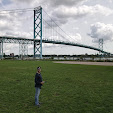
Belle Chasse-Scarsdale Ferry (Belle Chasse, LA)

The southernmost reaches of the Mississippi River downriver from greater New Orleans can only be crossed by way of remote & lightly-trafficked ferries and this service, which connects the communities of Belle Chasse and Scarsdale in northern Plaquemines Parish, is the northernmost of the two cross-river ferries in Louisiana’s southernmost parish. Like its neighboring ferries, this crossing requires the payment of a toll and ferries depart from each landing every 30 minutes on most days.

A commercial ferry service was established at this location in 1959. Since 2013, the ferry has been the southernmost crossing of the Mississippi River open to most commercial vehicles. These vehicles were barred indefinitely from the downriver Pointe à la Hache Ferry at the time and this ferry crossing took on somewhat greater importance as a result. The eastern ferry landing leads to LA Highway 39, which follows the east bank of the river southward toward Pointe à la Hache and northward toward St. Bernard Parish and greater New Orleans. LA Highway 3137, known as English Turn Road – a former alignment of the east bank highway, also begins at the eastern landing and follows the river for a short distance northward. The western ferry landing leads to LA Highway 23 (sometimes known as Belle Chasse Highway), which follows the west bank of the river northward into greater New Orleans and southward toward Venice and the mouth of the Mississippi River.

This ferry route is located near a popular anchorage point for ocean-going vessels seeking to travel upriver on the Mississippi River through and beyond New Orleans. On any given day, travelers on the ferry will be able to view the line of anchored ships in the river awaiting passage to their destinations inland. This ferry is also located near the so-called “English Turn”, a prominent 120-degree bend in the Mississippi River, named for a chance encounter in 1699 between the initial French explorers to the area and a competing British exploration party. The French party, led by Jean-Baptiste Le Moyne de Bienville, who would go on to establish the permanent settlement of New Orleans in 1718, were successful in convincing the British party to abandon their exploration of the area out of concern that their French rivals had already laid claim to the area.

The following pictures were taken during my eastbound crossing of the Belle Chasse Ferry in January 2018. Included in this set are pictures of English Turn Road (LA Highway 3137). Click on each photo to see a larger version.

Dashcam video of the eastbound trip over the Belle Chasse Ferry was filmed in January 2018 for the 'roadwaywiz' YouTube channel and is available for viewing at the link below:


How To Get There:

Bridges, Crossings, and Structures of the Lower Mississippi River
Next Crossing upriver: Chalmette-Lower Algiers Ferry (Chalmette, LA)
Next Crossing downriver: Pointe a la Hache Ferry (Pointe a la Hache, LA)
Return to the Bridges of the Lower Mississippi River Home Page
__________________________________________________

Comments

Popular posts from this blog

Abandoned Fowler Avenue in Clovis, California

Originally Fowler Avenue in the city of Clovis had a brief discontinuation approaching Herndon Avenue.  Fowler Avenue traffic heading northbound was required to detour briefly onto westbound Herndon Avenue.  During 2001 this discontinuation was removed when Fowler Avenue was reconfigured to access the Sierra Freeway (California State Route 168) via an interchange.  This led to a segment of the original alignment of Fowler Avenue just south of Herndon Avenue to be abandoned.  Despite a shopping center opening over part of the original Fowler Avenue alignment in 2016 much of the abandoned roadway remains.   The history of the abandoned original alignment of Fowler Avenue in Clovis The original alignment of California State Route 168 departed downtown Clovis eastbound along Tollhouse Road.  This original alignment did not interact with Fowler Avenue at the Herndon Avenue intersection.  Fowler Avenue north of Tollhouse Road ran north to Herndon Avenue...

May 2023 Ontario Trip (Part 3 of 3)

  Over the years, I have made plenty of trips to Ontario, crisscrossing the southern, central and eastern parts of the province. Living in Upstate New York, it's pretty easy to visit our neighbor to the north, or is that our neighbor to the west? Ottawa is one of my favorite cities to visit anywhere in the world, plus I've discovered the charm of Kingston, the waterfalls of Hamilton (which is on the same Niagara Escarpment that brings us Niagara Falls), the sheer beauty of the Bruce Peninsula, and more. But I hadn't explored much of Cottage Country. So I decided to change that, and what better time to go than over Memorial Day weekend, when the daylight is long and I have an extra day to explore. On the third and final day of my trip, I started in Huntsville and made my way through Muskoka District and Haliburton County, passing by many lakes along the way. I stopped in towns such as Dorset, Haliburton and Bancroft before making a beeline down to Belleville and then over th...

What's In a Name?: When the Roads Really Do Tell a Story

  Our tagline on the Gribblenation blog is "because every road tells a story". Some roads tell different stories than others. Along our travels, we may see historic markers that tell us a little story about the roads we travel or the places we pass by. Some historic markers are more general, as to telling us who lived where or what old trail traversed between two towns. During my travels across New York State and other states or provinces, I pass by many historic markers, some with interesting or amusing references to roads. I wanted to highlight a few of the markers I've seen along my travels around the Empire State and help tell their stories. Those stories may be as specific as explaining the tales of a tree that was used to help measure a distance of eight miles from Bath to Avoca in Steuben County, as referenced on the Eight Mile Tree historical marker above. They may also help point the way along historical roads first used centuries ago, or may help tell a local l...