
North Carolina's two new future Interstates 42 and 87 - one signed, one not yet

It hasn't taken North Carolina long to start putting up signs announcing the new Interstate Highways Corridors in the Eastern half of the state.  Future Interstate 42 signs are already up along US 70 from Clayton to New Bern.  Two weeks ago, I grabbed this shot on US 70 East at the start of the Clayton Bypass once you get on the highway from Interstate 40.
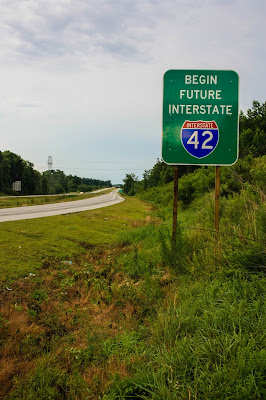

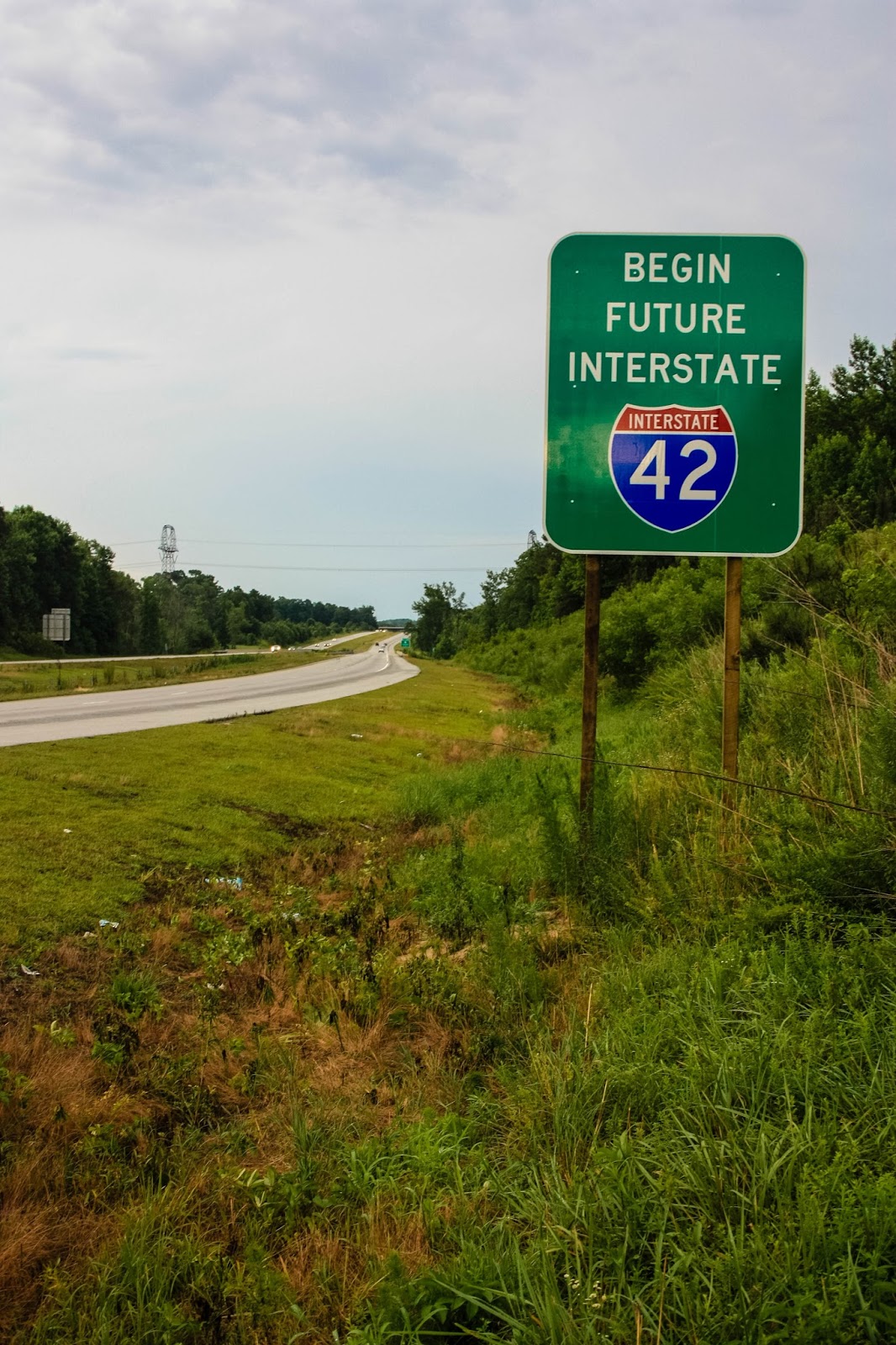
Signs for Future Interstate 87 aren't just ready yet.  For the past three weeks - these sign posts stand tall and alone on US 64 just east of Interstate 95 in Rocky Mount.

Now, this delay may be because NCDOT is wanting to erect the new signs and update the Future Interstate 495 signs at the same time; or who knows maybe a write-in campaign to protest the I-87 designation to the FHWA worked!

Comments

Steve Sobol said…
People seriously are complaining about the I-87 designation?
Bob Malme said…
Mostly the Roadgeek community due to either the duplication of the number, that it's more an east-west route than north-south, or both. The hold up on installing the I-87 signs may be due to the existence of I-495/Future I-495 along the corridor from Raleigh to I-95 and the need to get the FHWA and AASHTO to sign off on the decommissioning of that route before any other route number can be put up.
Anonymous said…
Yo interstate 87 end in Harlem nyc how gping have that in nc they need look for another number

Popular posts from this blog

May 2023 Ontario Trip (Part 3 of 3)

  Over the years, I have made plenty of trips to Ontario, crisscrossing the southern, central and eastern parts of the province. Living in Upstate New York, it's pretty easy to visit our neighbor to the north, or is that our neighbor to the west? Ottawa is one of my favorite cities to visit anywhere in the world, plus I've discovered the charm of Kingston, the waterfalls of Hamilton (which is on the same Niagara Escarpment that brings us Niagara Falls), the sheer beauty of the Bruce Peninsula, and more. But I hadn't explored much of Cottage Country. So I decided to change that, and what better time to go than over Memorial Day weekend, when the daylight is long and I have an extra day to explore. On the third and final day of my trip, I started in Huntsville and made my way through Muskoka District and Haliburton County, passing by many lakes along the way. I stopped in towns such as Dorset, Haliburton and Bancroft before making a beeline down to Belleville and then over th...

Abandoned Fowler Avenue in Clovis, California

Originally Fowler Avenue in the city of Clovis had a brief discontinuation approaching Herndon Avenue.  Fowler Avenue traffic heading northbound was required to detour briefly onto westbound Herndon Avenue.  During 2001 this discontinuation was removed when Fowler Avenue was reconfigured to access the Sierra Freeway (California State Route 168) via an interchange.  This led to a segment of the original alignment of Fowler Avenue just south of Herndon Avenue to be abandoned.  Despite a shopping center opening over part of the original Fowler Avenue alignment in 2016 much of the abandoned roadway remains.   The history of the abandoned original alignment of Fowler Avenue in Clovis The original alignment of California State Route 168 departed downtown Clovis eastbound along Tollhouse Road.  This original alignment did not interact with Fowler Avenue at the Herndon Avenue intersection.  Fowler Avenue north of Tollhouse Road ran north to Herndon Avenue...

Hot Springs Drive (Tulare County Mountain Road 56)

Hot Springs Drive is an approximately twenty-mile rural highway in the Sierra Nevada foothills of Tulare County.  The Hot Springs Drive corridor begins at Old Stage Road at Fountain Springs and extends eastward to Parker Pass Road near California Hot Springs.  Hot Springs Drive is carried by Tulare County Mountain Road 56 and acts as an extension of Avenue 56 (Tulare County Route J22).   What is now California Hot Springs originated as the Deer Creek Hot Springs Resort in 1882.  The resort on Deer Creek was originally served by a Control Road which required traffic alternate at different times of the day.  The modern California Hot Springs resort would incorporate in 1905 following an ownership change.  The Control Road corridor was replaced by Hot Springs Drive around 1915 which intended to serve increasing amount of automotive traffic to California Hot Springs.  Much of the resort would later burn in 1968 but was rebuilt in the 1980s. ...