Boca Road Bridge


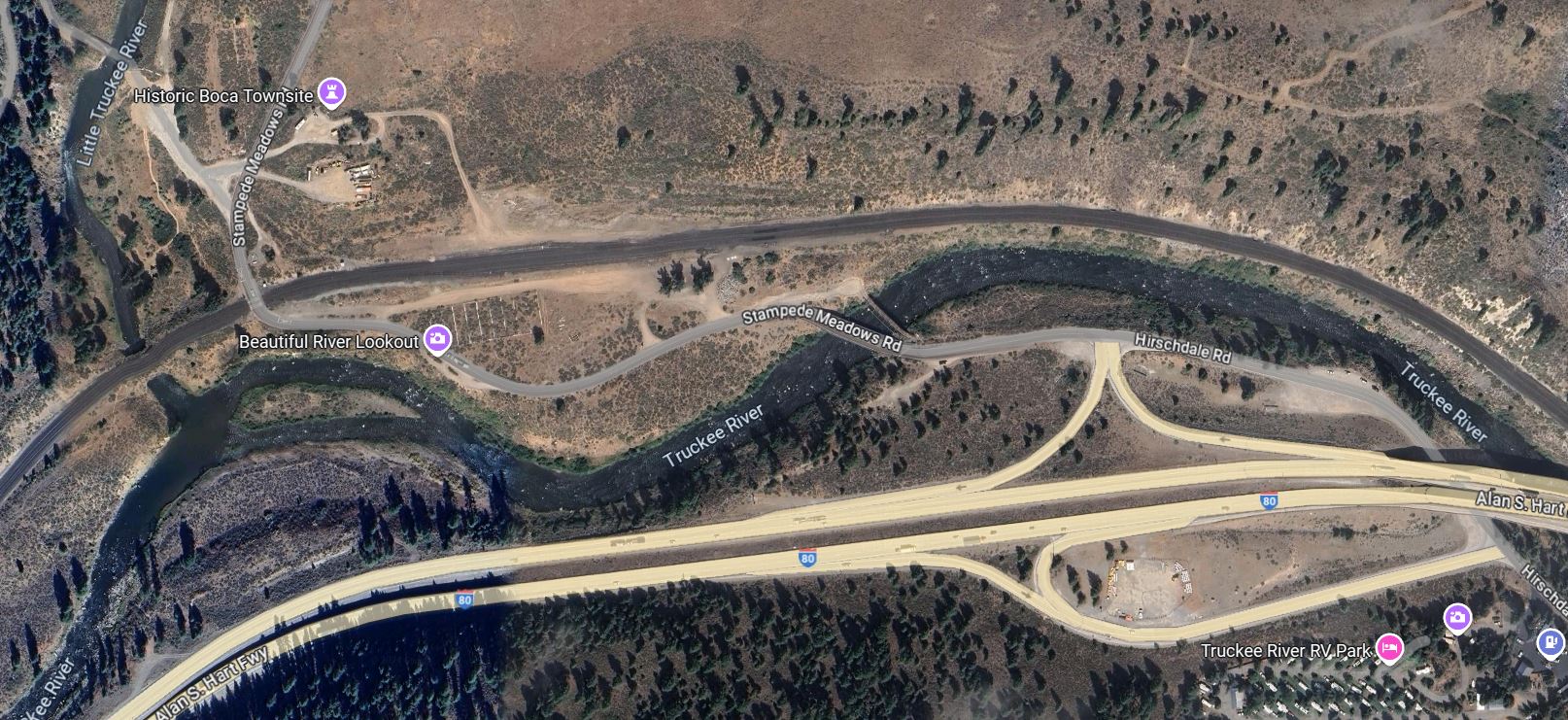
The Boca Road Bridge is an abandoned wooden deck truss span located on the Truckee River near the former site of Boca siding.  The span was completed in 1926 prior to US Route 40 being built through the Truckee River Canyon.  Boca siding was plotted during the 1860s on the Dutch Flat & Donner Lake Road during the construction of the Central Pacific Railroad.  Boca siding was demolished in portions from the late 1920s through 1939 to make way for the site of Boca Dam.  


Part 1; the history of Boca siding and the Boca Road Bridge

Boca was founded in 1866 as Central Pacific Camp #17. The site was plotted as a railroad siding and renamed as Boca in 1868. The siding was home to a mill and icehouse which was connected to Truckee via Boca Road (now mostly under the Boca Reservoir).

Boca Road is a segment of what was the Dutch Flat & Donner Lake Wagon Road. Said corridor was developed as a frontage of the Central Pacific Railroad during construction of the line in the 1860s. Despite a roadway following the railroad through Truckee River Canyon overland traffic preferred the Dog Valley Grade east of Truckee. The Dog Valley Grade would be incorporated into the Lincoln Highway in 1913.

Boca can be seen on the Dutch Flat & Donner Lake Road on the 1882 Bancroft's map of California.


Boca can be seen in detail on the 1893 United States Geological Survey map of Truckee. A bridge over the Truckee River can be seen carrying Boca Road east of the siding site towards Hirschdale.


Nevada County contracted construction firm Rocca & Caletti to build of the Boca Road Bridge in 1925 (courtesy Dana Scanlon of the A Tahoe and Northern Nevada History Facebook group). The span was ultimately completed during 1926 and was not dissimilar to other truss designs with wooden road decks seen in the 1920s. The previous structure along Boca Road at the Truckee River can be seen below in a Wiki Media Image (year unknown).


The 1919 Third State Highway Bond Act added an addition to Legislative Route Number 38 (LRN 38) which defined a new segment of State Highway intended to replace the Dog Valley Grade and serve Boca:

"A certain highway Nevada and Sierra counties, running as follows: From a point in the town of Truckee where the present state highway branches at the subway under the Southern Pacific tracks going toward Lake Tahoe, continuing through the town of Truckee, crossing Prosser Creek and over what is known as the "Dog Valley Grade" as far as the state line about 1 mi NW of Verdi, Nevada..."

LRN 38 east of Truckee appears as a planned highway bypassing the Dog Valley Grade on the 1920 California Highway Commission Map


The Nothern Lincoln Highway can be seen using the Dog Valley Grade from Truckee east to Verdi on the 1920 Clason Roads of California and Nevada Map.  


The Victory Highway was formally organized during 1921 as a coast-to-coast highway aligned from New York to San Francisco.  The Victory Highway Association lived on after the creation of the US Route System and became the US Route 40 Association in 1938.  

The June 1924 California Highways & Public Works noted the initial grading LRN 38 between Truckee along the Truckee River to Boca was underway.  


The August 1924 California Highways & Public Works noted LRN 38 between Truckee-Boca was in the process being graded.  


The October 1924 California Highways & Public Works stated numerous contracts were underway on LRN 38 from Truckee east to the Nevada State Line. 


The June 1925 California Highways & Public Works noted surveys were underway to find the final location of LRN 38 within Truckee.  

The initial draft of the US Route System was approved by the Secretary of Agriculture during November of 1925.  The US Route System within California was approved by California Highway Commission with no changes recommended by January 1926.  The alignment of US Route 40 east of Sacramento was planned to follow the existing Northern Branch of the Lincoln Highway and Victory Highway over LRN 3, LRN 17, LRN 37 and LRN 38 to the Nevada state line at Verdi. 


Thusly US Route 40 appears on the 1925 Rand McNally Map of California east of Sacramento to Verdi.  Conceptual US Route 40 is shown following the Dog Valley Grade east of Truckee.

The May 1926 California Highways & Public Works noted LRN 38 in the Truckee River Canyon between Truckee and the Nevada state line as having been fully graded.  The new segment of LRN 38 is stated to have a planned opening on June 10, 1926, as a bypass to the Dog Valley Grade. 


The completion of LRN 38 east of Truckee to Verdi by way of the Truckee River Canyon was featured in the June 1926 California Highways & Public Works.  The 19.1 mile long "Truckee River Highway" was dedicated on June 10, 1926, by California Governor Friend Richardson.  


The US Route System was formally approved by the American Association of State Highway Officials (AASHO) on November 11, 1926.  The approval of the US Route System formally brought US Route 40 into existence east of Sacramento to the Nevada State Line.  Notably US Route 40 east of Sacramento to the Nevada State Line was referred to as the Victory Highway in numerous official documents into the 1930s.  US Route 40 from the outset of the US Route System was aligned through the Truckee River Canyon east of Truckee to Verdi.  

During the late 1920s the advent of modern refrigeration industry led to a decline in Boca.  Much of the siding facility and icehouse was demolished before the end of the decade.  The remaining structures were demolished in 1939 to make way for Boca Dam.  Construction would lead to Boca Road being realigned over the dam structure.  

US Route 40 can be seen running past Boca on the south side of the Truckee River on the 1940 United States Geological Survey map of Truckee.  The Boca Road Bridge is shown connecting directly to US Route 40.  


The current bridge carrying Hirschdale Road to Boca appears to have been constructed during the 1950s concurrent to Interstate 80 in the Truckee River Canyon.  The structure appears on the 1977 United States Geological Survey map of Truckee.  


Part 2; a visit to the Boca Road Bridge and Boca Siding

The Boca Road Bridge can be found north of Interstate 80 Exit 194. The structure is easy to find next to the Hirschdale Road Bridge.


The Boca Road Bridge can be accessed on foot and is still be crossed by pedestrian traffic. The cobblestone footings of the span reveal no date of construction.


The site of Boca siding is west of the Boca Road Bridge and easily identified by the numerous tall trees lining the railroad tracks.


Comments

Popular posts from this blog

Abandoned Fowler Avenue in Clovis, California

Originally Fowler Avenue in the city of Clovis had a brief discontinuation approaching Herndon Avenue.  Fowler Avenue traffic heading northbound was required to detour briefly onto westbound Herndon Avenue.  During 2001 this discontinuation was removed when Fowler Avenue was reconfigured to access the Sierra Freeway (California State Route 168) via an interchange.  This led to a segment of the original alignment of Fowler Avenue just south of Herndon Avenue to be abandoned.  Despite a shopping center opening over part of the original Fowler Avenue alignment in 2016 much of the abandoned roadway remains.   The history of the abandoned original alignment of Fowler Avenue in Clovis The original alignment of California State Route 168 departed downtown Clovis eastbound along Tollhouse Road.  This original alignment did not interact with Fowler Avenue at the Herndon Avenue intersection.  Fowler Avenue north of Tollhouse Road ran north to Herndon Avenue...

May 2023 Ontario Trip (Part 3 of 3)

  Over the years, I have made plenty of trips to Ontario, crisscrossing the southern, central and eastern parts of the province. Living in Upstate New York, it's pretty easy to visit our neighbor to the north, or is that our neighbor to the west? Ottawa is one of my favorite cities to visit anywhere in the world, plus I've discovered the charm of Kingston, the waterfalls of Hamilton (which is on the same Niagara Escarpment that brings us Niagara Falls), the sheer beauty of the Bruce Peninsula, and more. But I hadn't explored much of Cottage Country. So I decided to change that, and what better time to go than over Memorial Day weekend, when the daylight is long and I have an extra day to explore. On the third and final day of my trip, I started in Huntsville and made my way through Muskoka District and Haliburton County, passing by many lakes along the way. I stopped in towns such as Dorset, Haliburton and Bancroft before making a beeline down to Belleville and then over th...

What's In a Name?: When the Roads Really Do Tell a Story

  Our tagline on the Gribblenation blog is "because every road tells a story". Some roads tell different stories than others. Along our travels, we may see historic markers that tell us a little story about the roads we travel or the places we pass by. Some historic markers are more general, as to telling us who lived where or what old trail traversed between two towns. During my travels across New York State and other states or provinces, I pass by many historic markers, some with interesting or amusing references to roads. I wanted to highlight a few of the markers I've seen along my travels around the Empire State and help tell their stories. Those stories may be as specific as explaining the tales of a tree that was used to help measure a distance of eight miles from Bath to Avoca in Steuben County, as referenced on the Eight Mile Tree historical marker above. They may also help point the way along historical roads first used centuries ago, or may help tell a local l...