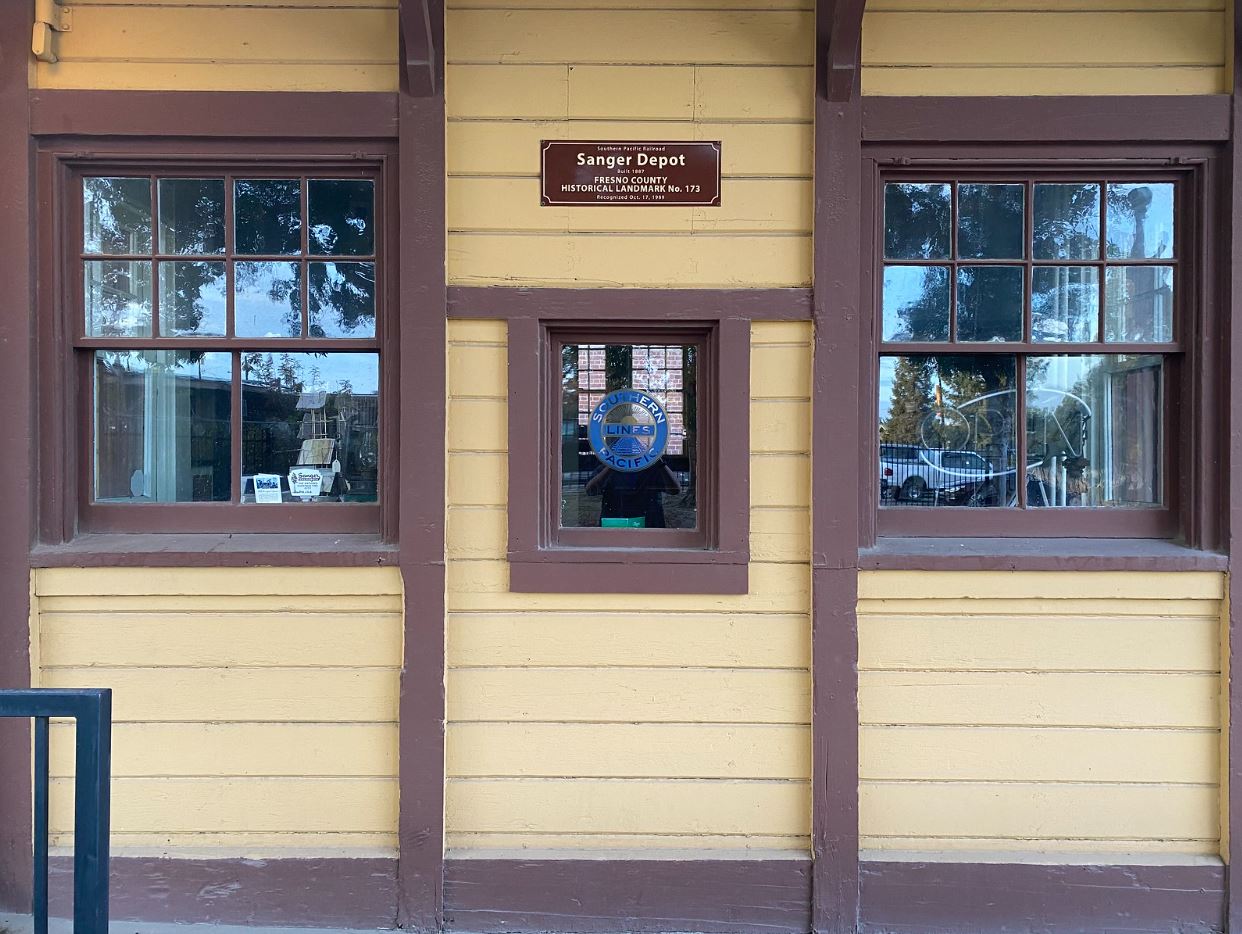
Sanger Depot


Sanger Depot located in the namesake city in San Joaquin Valley of California.  The depot was constructed in 1887 as part of the Southern Pacific Railroad's East Side Line.  The depot building was relocated in 1977 to 1710 7th Street where it became a city museum.  The original location of Sanger Depot at 7th Street and L Street can be seen below on the 1947 United States Geological Survey map of Sanger.


Part 1; the history of Sanger Depot

The site of Sanger was plotted by the Southern Pacific Railroad in 1886 during construction of their East Side Line through San Joaquin Valley.  Sanger Depot was constructed in 1887 at what would become the site of 7th Street and L Street.  The Southern Pacific Railroad would begin to subdivide and plot the town site of Sanger in 1888.  

The East Side Line (alternatively Stockton-Tulare Railroad) branched east from main San Joaquin Valley line in Fresno towards Porterville.  The East Side Line consolidated with the main line at Famoso in Kern County.  

The East Side Line can be seen passing through Sanger on the 1923 United States Geological Survey map.  The site of Sanger Depot can be seen at the southeast corner of 7th Street and L Street.  A large siding facility can be seen branching east from L Street along Annadale Avenue.  


The siding facility in Sanger is no longer present on the 1947 United States Geological Survey map.


Sanger Depot was eventually closed and purchased by the Tanney brothers.  The depot was discovered to be the oldest building in Sanger and was denoted to the Sanger Historic Society.  The building was relocated to 7th Street and Hoag Avenue where it would reopen as a museum in December 1977.  


Part 2; the past and present sites of Sanger Depot

The below photos are from 7th Street and L Street where Sanger Depot was originally located on the Southern Pacific Railroad.  The street blade at the intersection still is an embossed porcelain design.  The Hotel Sanger Building still displays a vintage neon sign on the marque.  


Sanger Depot can be now found at 1710 7th Street approximately six blocks of where it was originally located.  The depot marque lists the distance from San Francisco and New Orleans. 


Comments

Popular posts from this blog

2018 Mojave Road Trip Part 2; The deadly desert highway (California State Route 127 and Nevada State Route 373)

After leaving Barstow via Old Highway 58 my next destination was in Death Valley.  To access Death Valley from rural San Bernardino County required a trek on north on Interstate 15 to California State Route 127 which becomes Nevada State Route 373 at the state line. Along I-15 I encountered the road sign oddity that is Zzyzx Road about eight miles south of Baker.   Zzyzx Road is a four mile road that used to go to the Zzyzx Mineral Springs and Health Spa.   The spa was founded in the 1940s and the owner made up the name "Zzyzx" to claim it was the last word in the English Language.  The spa has been shut down since the 1970s and is now part of a Desert Studies Center for California State University. The southern terminus of CA 127 in Baker is located at I-15 exit 246.  CA 127 is a 91 mile north/south highway which runs to the Nevada State Line in Inyo County.  CA 127 is called Death Valley Road from I-15 northward.  South of CA 127 ...

Finding the Pre-Emption Road of New York State

  The Pre-Emption Road (or rather a series of roads named Pre-Emption Road) follows a survey line called the Pre-Emption Line, drawn in the early days of the United States. The story begins with Massachusetts and New York having competing land claims to modern day Western New York State that have their roots in colonial charters granted by the British. After the Revolutionary War ended, this land became the frontier of the nation and its settlement became a priority for the new American government. During this era, there were a lot of competing land claims that needed to be settled. It was no different with the land claims between New York State and Massachusetts. On November 30, 1786, Massachusetts and New York sent representatives to Hartford, Connecticut to resolve their competing land claims. In less than three weeks, the representatives had reached a compromise. Massachusetts would receive pre-emption rights, meaning the right to sell the land after the Indian title ...

What's In a Name?: When the Roads Really Do Tell a Story

  Our tagline on the Gribblenation blog is "because every road tells a story". Some roads tell different stories than others. Along our travels, we may see historic markers that tell us a little story about the roads we travel or the places we pass by. Some historic markers are more general, as to telling us who lived where or what old trail traversed between two towns. During my travels across New York State and other states or provinces, I pass by many historic markers, some with interesting or amusing references to roads. I wanted to highlight a few of the markers I've seen along my travels around the Empire State and help tell their stories. Those stories may be as specific as explaining the tales of a tree that was used to help measure a distance of eight miles from Bath to Avoca in Steuben County, as referenced on the Eight Mile Tree historical marker above. They may also help point the way along historical roads first used centuries ago, or may help tell a local l...