
Madera County Road 201 (the former Millerton-Fresno Flats Road through O'Neals)


Madera County Road 201 is an approximately one third mile long roadway which passes the heart of the mountain community of O'Neals.  The corridor was part of the nineteenth century Millerton-Fresno Flats Road which served the mines and logging mills which now comprise the Sierra Nevada foothills of Madera County.  During the automotive era the highway would be designated as North Fork Road and later Road 200.  Road 200 was realigned onto a bypass of O'Neals during the early 1980s which led to original highway being renumbered as Road 201.  


Part 1; the history of the Millerton-Fresno Flats Road through O'Neals

O'Neals is located several miles south of the former mining town of Fine Gold along the Millerton-Fresno Flats Road.  Mining claims were staked at Fine Gold during the Mariposa War during 1850. The community was never very large but became a stopping point on the stage road between the original Fresno County seat at Millerton and Fresno Flats (now Oakhurst). The stage road eventually bypassed Millerton when the Fresno County seat was moved to Fresno in 1874.

The Fine Gold Post Office can be seen on the Fresno-Fresno Flats Road on the 1882 Bancroft's Map of California. Post Office Service would be relocated to nearby O'Neals in 1887. O'Neals was located at a more opportune location on the Fresno-Fresno Flats Road as it connected to two nearby spur roads to the Fresno-Yosemite Road. The southern spur connected to Bates Station whereas the north spur permitted access to nearby Coarsegold. The community had been founded by local merchant Charles O'Neals who also was the first Postmaster. Charles O'Neals established his store on land holding he had purchased in 1878. During 1893 Madera County would be formed from what was Fresno County north of the San Joaquin River.


O'Neals can be seen along the Fresno-Oakhurst Road (formerly Fresno Flats) on the 1912 United Geological Survey Map of Mariposa.  The highway north of O'Neals would come to be known as "North Fork Road" during the early automotive era and eventually would be renamed as "Road 200" when Madera County assumed the numeric grid convention.  


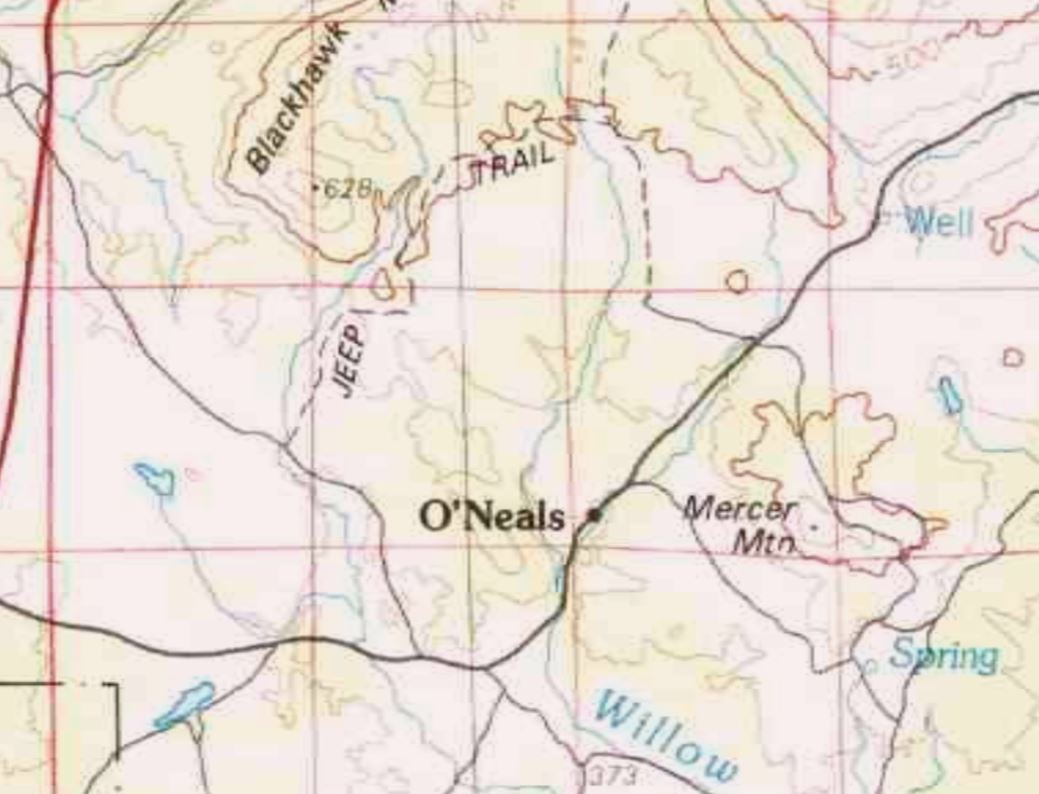
Road 200 can be seen passing through O'Neals for the last time on the 1980 United States Geological Survey Map of Shaver Lake.  Road 200 would appear realigned onto the current bypass whereas the original alignment was shown as Road 201 on the 1981 United States Geological Survey Map of O'Neals.  


Part 2; a drive on Madera County Road 201

Southbound Road 201 can be accessed from Road 200.  Signage indicating Road 201 passes through O'Neals is lacking from the modern bypass.


Road 201 southbound passes through the heart of O'Neals and loops back to Road 200.  The roadway is lined by numerous local businesses, the community Post Office as well as homes.  


Comments

Popular posts from this blog

Petroleum Club Road (former California State Route 33 and US Route 399 past the Lakeview Gusher)

Petroleum Club Road is an approximately 5.3-mile rural highway located in the Sunset Oil Field of western Kern County.  This corridor was constructed as a frontage road of the Sunset Railroad and would be the site of the Lakeview Gusher in 1910.  Petroleum Club Road was the original alignment of California State Route 33 and US Route 399 between 1934-1938.  In 1938 the West Side Highway was constructed west of Lakeview Gusher and still serves as the current alignment of California State Route 33.   Part 1; the history of Petroleum Club Road Petroleum Club Road is the original highway which linked the oil communities of Maricopa and Taft.  Both cities were developed around the early boom of the Sunset Oil Field.  The early Sunset Oil Field can be seen centered along Cienega Canyon Road southwest of Buena Vista Lake in Township 11 North, Range 23 West on the 1898 Kern County Surveyors map .  In 1901 Post Office Service would be established at the Su...

Kuakini Highway (former Hawaii Route 11 in Kailua-Kona)

Kuakini Highway east of Palani Road in Kailua-Kona is the original alignment of Hawaii Route 11.  The highway upon being commissioned in 1955 began at the Palani Road (then Hawaii Route 19) and followed Kuakini Highway southeast towards Holualoa.  Hawaii Route 11 was shifted to an extension of Queen Kaahumanu Highway during the late 1970s which bypassed downtown Kailua-Kona.   This page is part of the Gribblenation Hawaii Roads series.  A compellation of all Hawaii-related media from both Gribblenation and RoadwayWiz can be found by clicking  here .  Part 1; the history of Hawaii Route 11 and Kuakini Highway in Kailua-Kona Hawaii Route 11 is part of Mamalahoa Highway (the Hawaii Belt Road) and is the longest Hawaiian State Route at 121.97 miles.  The highway begins at the mutual junction of Hawaii Route 19 and Hawaii Route 190 in Kailua-Kona.  From Kailua-Kona the routing of Hawaii Route 11 crosses the volcanic landscapes of southern side of ...

Did Caltrans just kill the G26 cutout US Route shields?

The US Route System was formally created by the American Association of State Highway Officials during November 1926.  Through the history of the system the only state to which has elected to maintain cutout US Route shields has been California.  The G26 series cutout US Route shields have become a favorite in the road enthusiast hobby and are generally considered to be much more visually pleasing than the standard Federal Highway Administration variant.  However, the G26 shield series appears to have been killed off on January 18, 2026, when Caltrans updated their Manual of Uniform Traffic Control Devices.  This blog will examine the history of the US Route shield specifications in California and what is happening with the 2026 changes.  The blog cover photo is facing towards the terminus of California State Route 136 and at a G26-2 specification US Route 395 shield.  In the background Mount Whitney can be seen in the Sierra Nevada range.   ...