In 1942 British Columbia Highway 99 was commissioned as a continuation of US Route 99 north of the Peace Arch Border Crossing to downtown Vancouver. Functionally early British Columbia Highway 99 was an improvement of the earlier Pacific Highway. The corridor since the 1940s as the been the primary through-road into Vancouver and has continuously evolved through the decades. This blog serves as a general history of the routings and alignments British Columbia Highway 99 has taken through the Vancouver metropolitan area.

This blog is part of the larger Gribblenation US Route 99 Page. For more information pertaining to the other various segments of US Route 99 and its three-digit child routes check out the link the below.
Part 1; the history of British Columbia Higheway 99 in metropolitan Vancouver
In 1913 the Pacific Highway was established as an organized Auto Trail Association borne out of the Good Roads movement. Said Auto Trail was founded by Sam Hill who acted as the President of the Pacific Highway Association. The purpose of the Auto Trail was to create a singular Sign Route between San Diego, California north to Vancouver, British Columbia.
The Pacific Highway southbound entered Washington from the Canadian border via 12th Street in Blaine. This crossing had been constructed in 1913 specifically as part of the Pacific Highway corridor. The so-called "Pacific Highway Border Crossing" was constructed approximately 1,000 feet east of a previous border station located on the Great Northern Railway. This border station had been constructed in 1891 but moved with the railroad west to run along Drayton Harbor in 1909. The border site on Drayton Harbor would later become known as the Peace Arch Border Crossing.
On the British Columbia side of the border the Pacific Highway and Evergreen National Highway are shown multiplexed into Vancouver. The alignment is shown running along Pacific Highway (now British Columbia Highway 15) and Fraser Highway towards the original Pattullo Bridge (completed in 1904) in South Westminster. The original Pattullo Bridge functioned to serve both railroad and automobile traffic. The exact alignment in Vancouver isn't displayed clearly but the highways are shown ending in downtown Vancouver at Stanley Park via Georgia Street.
The US Route System was formally approved by the American Association of State Highway Engineers (AASHO) on November 11, 1926. which formally brought US Route 99 into existence. US Route 99 overlaid the existing Pacific Highway (in Washington) and Primary State Highway 1. The description of US Route 99 can be seen on the November 11, 1926, AASHO descriptions of the US Routes in Washington State.
US Route 99 initially inherited the alignment of the Pacific Highway in Blaine and can be seen terminating at the border via 12th Street on the 1927 Rand McNally Map of Washington State. On the British Columbia Highway side, the alignment and designation of Pacific Highway were initially maintained.
Increasing automotive use of the original Pattullo Bridge led to construction of a dedicated highway span breaking ground at the Fraser River in 1936. The second Pattullo Bridge was opened to automotive traffic on November 15, 1937. Following the opening the original structure was converted to carry only railroad traffic and is now known as the New Westminster Rail Bridge.
The opening of the second Pattullo Bridge was the cover story in the
November 15, 1937, Vancouver Sun. The span is a 1,227 meter through truss design which carried a
25¢ toll until 1952.

1940 British Columbia completed King George Highway between the Pattullo Bridge at the Fraser River south to the Peace Arch Border Crossing at Blaine. US Route 99 and Primary State Route 1 were both realigned onto Peace Portal Drive. The original highway alignment via D Street and 12th Street to the Pacific Highway Border Crossing was reassigned as US Route 99 Alternate and Primary State Highway 1 Truck Route.
The exact timing for the designation of US Route 99 Alternate isn't fully clear as no record of it exists in the American Association of State Highway Officials (AASHO) database. Washington State often did not often follow AASHO guidelines regarding making requests of the Executive Committee for bannered routes.
During September 1940 the corridor of US Route 99 in Washington would be designated as the Jefferson Davis Highway. This plaque can be found just east of the Peace Arch along the International Border (courtesy Dale Sanderson of usends.com). The plaque was removed in
2003 as a temporary measure due to the controversial nature of it being placed by a Confederacy group.

British Columbia Highways 99 and 99 Alternate were both commissioned in 1942 north of the border crossing at Blaine. Mainline British Columbia Highway 99 began at the terminus of US Route 99 at the Peace Arch and followed King George Highway towards Vancouver. British Columbia Highway 99 Alternate began at the terminus of US Route 99 Alternate at end of 12th Street and followed the Pacific Highway alignment towards Fraser Highway. British Columbia Highway 99 is shown to be multiplexed with British Columbia Highway 1 over the Pattullo Bridge into Vancouver.
These highways can all be seen in the Blaine area on the 1944 State Farm Highway map of Washington.

The initial alignments of British Columbia Highways 99 and 99A in Vancouver can be seen on the
1951 Shell Highway map of Vancouver. From the Pattullo Bridge both British Columbia Highways 99 and 1 are shown to multiplex to Stanley Park via Columbia Street, 12th Street, Kingsway, Main Street, the Georgia Viaduct and Georgia Street. The northern segment of British Columbia Highway 99A from the Pattullo Bridge followed McBridge Boulevard, Grandview Highway and Grandview Viaduct to British Columbia Highways 99 and 1 at Main Street.
In 1953, the Minister of Public Works proposed to convert British Columbia Highway 99 to a freeway from the United States border to Vancouver. The proposal included incorporating the then planned Oak Street Bridge which open to traffic on June 29, 1957. The freeway corridor proposal was featured in the
December 11, 1953, Province.
In 1956 British Columbia Highways 99 and 1 were extended north of downtown Vancouver to West Vancouver via Stanley Park and the Lions Gate Bridge (constructed in 1938) over Burrard Inlet. An enlarged partial cloverleaf interchange was constructed above Marine Drive in West Vancouver to facilitate a smoother flow of traffic. The extension led to the planned cessation of tolling pedestrian of private automobiles by August 1956. Tolling ultimately continued until April 1, 1963.
An announcement about the enlarged Lions Gate Bridge cloverleaf and upcoming changes to the toll policy appears in an article from the
July 12, 1956, Province.
British Columbia Highway 99 would be extended from West Vancouver out of the Vancouver metropolitan area to Squamish via the Seaview Highway. The opening of the Seaview Highway was announced in the
August 8, 1958, Vancouver Province.
In 1958 the segment of British Columbia Highway 99A from the Pacific Highway Border Crossing to Fraser Highway was renumbered as British Columbia Highway 15. The segment north of the Pattullo Bridge through New Westminster, Burnaby and Vancouver would be deleted in 1962.
A significant construction project towards the conversion of British Columbia Highway 99 was that of the Deas Island Tunnel. Said project broke ground during May 1957 via a ceremonial concrete pour. The tunnel structure between Deas Island and Lulu Island opened to traffic on
May 23, 1959. The tunnel was initially tolled and was designated as British Columbia Highway 99B.

British Columbia Highway 99B can be seen spanning from British Columbia Highway 10 in Delta north to Vancouver via the Deas Island Tunnel and the Oak Street Bridge on the
1960 Washington Department of Highways map. The highway likely continued north into downtown Vancouver via Granville Street where it met the parent British Columbia Highway 99 at Georgia Street. Notably the current Granville Street Bridge had opened to traffic in 1954.
The 35-kilometer freeway from the Deas Island Tunnel south to the United States Border was opened to traffic on May 29, 1962. The freeway was initially called the "Deas Thruway" and was signed completely as British Columbia Highway 99B. The freeway opening was reported in the
May 30, 1962, Vancouver Sun.
The Deas Thruway and British Columbia Highway 99B both appear on the
1963 Washington Department of Highways map. The initial surface alignment of British Columbia Highway 99B on surface streets in Vancouver is not clearly conveyed.
In 1964 the Deas Thruway was renumbered as British Columbia Highway 499. Tolling at the Deas Island Tunnel ceased on March 31, 1964. During 1967 the structure was renamed the "George Massey Tunnel." George Massey was British Columbia Legislative Assembly member who served Delta from 1956-1960. Massey is credited for much of the push to replace the Lander Ferry with a tunnel structure.
British Columbia Highway 499 appears on the
1965 Washington Department of Highways map. The alignment north of the Oak Street Bridge is shown to follow Granville Street and the Granville Street Bridge into downtown Vancouver.

On June 24, 1969, the AASHO Executive Commitee approved a request by the Washington State Highway Commission to eliminate US Route 99 in Washington. The Washington State Highway Commission approved a motion to eliminate US Route 99 on April 22, 1969. The justification to eliminate US Route 99 in Washington State was to avoid confusion and cost associated with signing the highway concurrent on much of Interstate 5. Despite the deletion of US Route 99 in Washington the designation of British Columbia Highway 99 would remain active.
British Columbia Highway 499 was announced the new mainline of British Columbia Highway 99 in the
December 22, 1972, Vancover Sun. The previous surface routing (notably King George Highway) through Surrey, New Westminster, Burnaby and Vancouver was designated as British Columbia Highway 99A.
Mainline British Columbia Highway 99 in downtown Vancouver along Granville Street was short lived. The highway was rerouted onto one-way couplets via Howe Street and Seymour Street north the Granville Street Bridge by 1974. A dedication for the Granville Street Mall was presided over by then Vancouver mayor Art Phillips on
August 22, 1974 (citation courtesy splashflash of the AAroads forum).
During 2006 British Columbia Highway 99A was largely deleted as an active designation. During 2009 the city of Surrey would rename King George Highway as "King George Boulevard" Presently the
British Columbia Ministry of Transportation only maintains two collateral portions of British Columbia Highway 99A. Despite the deletion of the formal designation the highway still generally has actively maintained field signage.
On
August 18, 2021, the British Columbia provincial government announced the approval for the replacement of the George Massey Tunnel. The replacement tunnel is noted to be planned as a toll-free eight lane highway with a dedicated multi-use pedestrian lane. Construction of the $4.15 billion-dollar (Canadian) tunnel is scheduled to break ground in 2030.
Part 2; a drive on British Columbia Highway 99 from the Peace Arch to George Massey Tunnel
Northbound Interstate 5 terminates at the Canadian border at the Peace Arch Border Crossing. The highway designation north from the border swaps to British Columbia Highway 99.
Northbound British Columbia Highway 99 emerges from the Peace Arch Border Crossing and enters the city of Surrey.


British Columbia Highway 99 Exit 2 permits access to 8th Avenue.
British Columbia Highway 99 Exit 4 permits access to 16th Avenue.
British Columbia Highway 99 Exit 10 permits access to King George Boulevard. King George Boulevard is still signed from the ramp as British Columbia Highway 99A.
British Columbia Highway 99 enters the city of Delta. Access to British Columbia Highway 91 is permitted via Exit 16.
British Columbia Highway 99 Exit 20 permits access to South Delta.
British Columbia Highway 99 Exit 26 permits access to British Columbia Highways 17 and 17A.


British Columbia Highway 99 passes under the South Arm Fraser River via the George Massey Tunnel. The highway emerges into the city of Richmond on Lulu Island. Exit 32 permits access to Steveston Highway.
British Columbia Highway 99 in Richmond has several additional Exits north of Steveston Highway. Exit 37 permits access to Westminster Highway whereas 39B accesses Bridgeport Road. The freeway crosses the North Arm Fraser River over the Oak Street Bridge into Vancouver. The highway takes a jog on Oak Street and 70th Avenue to reach Granville Street.
Part 3; a drive on British Columbia Highway 99 over the Lions Gate Bridge
British Columbia Highway 99 passes through downtown Vancouver on Georgia Street and enters Stanley Park.
British Columbia Highway 99 passes through Stanley Park and approaches the foot of the Lions Gate Bridge. The reversable lanes present on the highway were installed in an effort to reduce traffic congestion. The lion statues at the foot of the Lions Gate Bridge were installed in 1939.
British Columbia Highway 99 crosses over the Lions Gate Bridge and transitions onto westbound Marine Drive in North Vancouver. The suspension span is 1,823 meters long.
The Lions Gate Bridge from Lowden's Lookout in Stanley Park.
Part 4; British Columbia Highway 99 from Howe Street
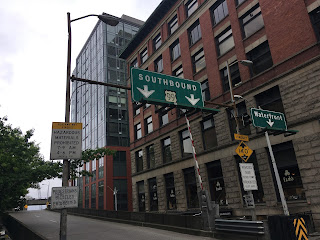
These photos are from southbound British Columbia Highway 99 on the one-way couplet along Howe Street approaching the Granville Street Bridge. The highway carries three lanes of traffic departing downtown Vancouver.




Comments