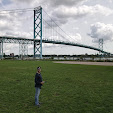

One of the most isolated and curiously placed bridges on the
lower Mississippi River, the John James Audubon Bridge spans the great river
north of Baton Rouge, LA as the northernmost bridge on the river located
entirely within Louisiana. Information is hard to come by in this case, but its
possible that the Audubon Bridge is the lightest-trafficked bridge on the lower
Mississippi River, despite it being in a supposedly advantageous location
between US Highway 61 to the east, and Highway 1 to the west.
This bridge was built to replace a long-running ferry
service between the river towns of St. Francisville in West Feliciana Parish and
New Roads in Pointe Coupee Parish. It is a large-scale impressive-looking
cable-stayed bridge, with a center span of 1,583 ft and reinforced concrete pylons
that stand 520 ft tall. At the time of its completion in May 2011, it was the
largest cable-stayed bridge in North America and remains one of the largest
such bridges in the United States today. The bridge’s four-lane roadway stands
about 75 ft above mean river level and strangely lacks full-width shoulders, a
typical design trait of modern-designed long-span bridges. Due to the need for
the bridge and its connecting roadways to span the flood plain on either side
of the river, the bridge’s elevated approach viaducts span from levee to levee,
resulting in a structure that’s over 2 ½ miles long from abutment to abutment.
Construction on the bridge and its approaches cost $410 million. Included in
this cost were the 12 total miles of approach highways on both sides of the
river (part of LA Highway 10) that connect US 61 near St. Francisville with LA
Highway 1 in New Roads. These approaches are built for a single lane of traffic
in each direction, however right-of-way does exist for a parallel roadway to be
constructed so that these approaches can be widened to a total of four lanes
should traffic demands ever warrant their expansion.

The John James Audubon Bridge is a visually appealing bridge trapped in one of the most isolated corners of rural Louisiana
The bridge is named for John James Audubon, a
French-American artist, naturalist, and ornithologist, who is known for his extensive
documentation and illustration of North American bird species in their natural
habitats. His greatest published work, The Birds of America, was
published in 1839 and is seen in modern times as one of the most definitive and
comprehensive ornithological pieces ever assembled. Much of his work on this
project was completed while living in nearby St. Francisville in the 1820s. His
name is not the only one attached to this project. Each of the bridge’s
approaches are named for prominent members of the armed forces who were from
this corner of Louisiana. The bridge’s western approach honors Gen. John A.
Lejeune, who served as Commandant of the United States Marine Corps (1920-1929)
and was a native of Pointe Coupee Parish. The bridge’s eastern approach honors
Gen. Robert H. Barrow, who served in the same position (1979-1983) and was a
native of West Feliciana Parish.


Above: John James Audubon (1785-1851)
Bottom Left: Gen. Robert H. Barrow (1922-2008)
Bottom Right: Gen. John A. Lejeune (1867-1942)
Cable-stayed bridges have become a dime a dozen across the
United States over the last 30 years. Many of them are ordinary and conventional
in their design and appearance. In my opinion, this bridge is an exception to
that trend. It’s appearance brings to mind both the bright colors of the Sunshine
Skyway Bridge in Florida while also sporting a pylon design that is striking in
how it mimics the appearance of those from the mighty suspension bridges of
North America. I’ve had the chance to visit this bridge on two occasions, first
in early 2017 and more recently in 2023. On both occasions, I walked away from
the experience thoroughly impressed by the physical proportions of the bridge
and its memorable appearance, while also being disappointed in its overall lack
of utility in spite of it crossing such an important waterway.
While the construction of this bridge might be seen as a positive for the local economy in the long-term, the $410 million investment made for this project was seen as problematic at the time, due to the isolation of the area and the forecasted light traffic volumes. It is this author’s opinion that the funds allocated for this project could have and should have been utilized differently and in locations that would have immediately benefited more from their use. The need for additional bridges and lane miles spanning the lower Mississippi River has been well-known for many years, however the way that the state of Louisiana has gone about addressing this problem has been inefficient at best and has done little to solve the problem of mobility across the river in the most populated corners of the state. While the state has invested hundreds of millions of dollars toward new bridges in isolated parts of the region such as Gramercy and New Roads, no such realistic ideas and solutions have been offered for the cities of Baton Rouge and New Orleans, the state’s two largest metropolitan areas, who are both dealing with chronic congestion and the aging conditions of their bridges on the Mississippi. It’s time for the state of Louisiana to get serious and stop investing in these dead-end eye-candy infrastructure projects to nowhere, and instead use the funds available to them to construct and maintain a smarter transportation system that better serves the needs of the state’s population centers while also enhancing the redundancy of the regional transportation network. Louisianans should not be resigned to double down on the trends of the past, but instead should be willing to learn from these mistakes and use the lessons of the past and present to construct a Louisiana that will be sustainable and viable well into the future.


Further Reading:
John James Audubon Bridge by John Weeks
Bridges, Crossings, and Structures of the Lower Mississippi River
Next Crossing upriver: Natchez-Vidalia Bridge (Natchez, MS)
Next Crossing downriver: Huey P. Long Bridge (Baton Rouge, LA)
Nearby Flood Control Structure: Morganza Control Structure (Morganza, LA)
Return to the Bridges of the Lower Mississippi River Home Page
__________________________________________________
Comments