
During April 2023 a portion of the sign gantry on the eastbound Ventura Freeway (California State Route 134) approaching the Golden State Freeway (Interstate 5) fell. The fallen portion of the sign gantry revealed a once covered US Route 99 shield. The uncovered US Route 99 sign (blog cover courtesy Ian Ligget) is a 1956-63 era freeway specification US Route shield. This blog will explore in brief how the Golden State Freeway was developed as US Route 99 and US Route 6 before becoming solely Interstate 5.
This blog is part of the larger Gribblenation US Route 99 Page. For more information pertaining to the other various segments of US Route 99 and it's three-digit child routes check out the link the below.
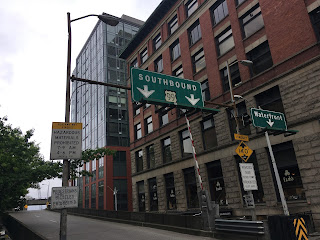
Part 1; visiting the US Route 99 shield at the Ventura Freeway/Golden State Freeway Interchange
As noted in the introduction the US Route 99 shield can be seen on the eastbound Ventura Freeway (California State Route 134) approaching the Golden State Freeway (Interstate 5) interchange.


Part 2; a brief history of US Route 99 and the development of the Golden State Freeway
Much of the information below is abridged from the two longer blogs regarding history of US Route 99 between the city of Los Angeles and city of Redlands:
The US Route System was finalized on November 11, 1926, by the Executive Committee of the American Association of State Highway Officials ("AASHO"). US Route 99 was one of the original US Routes created by the AASHO Executive Committee. As originally plotted US Route 99 began at US Route 80 in El Centro, California and terminated at the Canadian Border in Blaine, Washington. The original southern terminus of US Route 99 in El Centro can be seen in the AASHO US Route descriptions for California dated November 11, 1926. North of downtown Los Angeles the initial routing of US Route 99 followed San Fernadno Road through the communities of Glendale, Burbank and San Fernadno towards Newhall Pass.


The Los Angeles City Council meeting notes from February 5, 1930, explicitly state that the US Routes were not yet signed within Los Angeles. The Los Angeles City Council did elect have the ACSC sign US Route 99 and US Route 101 during the February 5, 1930, meeting but not US Route 66. US Route 99 is stated to have been approved to be signed via San Fernando Road south from the Glendale city limit to Avenue 20. The Los Angeles City Council did not elect to select a signed routing to Pasadena beyond Avenue 20. Note: traffic from San Fernando Road near Avenue 20 could have easily accessed previous routing of the National Old Trails Road via Broadway towards Pasadena.


The AASHO Executive Committee on June 22, 1932, notified the California Division of Highways that US Route 99 was approved to be extended to the Mexican Border.

State Maintenance of Legislative Route Number 26 and US Route 60 was extended to downtown Los Angeles to Aliso Street during 1933. A series of September 1934, letters by the California State Highway Engineer to the AASHO Executive Secretary noted a recommendation to move US Route 99 from Los Angeles to Redlands via Legislative Route Number 26 through Pomona and Colton. The California State Highway Engineer noted traffic on US Route 99 would be better served traversing downtown Los Angeles and utilizing Legislative Route Number 26 directly to reach Redlands. Notably the alignment the sketch map provided by the California State Highway Engineer shows existing US Route 99 following San Fernando Road to US Route 66 at Arroyo Seco Avenue and a multiplex on US Route 66/Legislative Route Number 165 via Figueroa Street to Colorado Boulevard.
The same exchange of letters also notes US Route 70 had been extended into California with an endpoint following US Route 60/Legislative Route Number 26 into downtown Los Angeles. The routing definition of US Route 70 indicated it would multiplex US Route 99/US Route 60 east from downtown Los Angeles to Pomona and onward to US Route 60 east to Beaumont.


A letter dated February 8, 1937, by the AASHO Executive Secretary to the State Highway Engineers of; Colorado, Nevada and California announced the approved extension of US Route 6 from Greeley, Colorado to Long Beach, California. The extension of US Route 6 to Long Beach was carried via multiplex of US Route 99/Legislative Route Number 4 from San Fernando Pass south onto San Fernando Road and US Route 99/US Route 66/California State Route 11/Legislative Route Number 165 via the Figueroa Street Tunnels to downtown Los Angeles.


The January/February 1954 California Highways & Public Works illustrates the planned realignment of US Route 99/US Route 6 north of Los Angeles onto the Golden State Freeway. Below the Golden State Freeway (part of Legislative Route Number 4) can be seen in the vicinity of San Fernando Pass and Weldon Canyon at what is now near the Los Angeles city limit. Existing US Route 99/Legislative Route Number 4 on San Fernando Road can be seen right of the construction zone.

The planned scale of the Golden State Freeway between Weldon Canyon to existing US Route 99/US Route 6/Legislative Route Number 4 at San Fernando Road can be seen in the January/February 1954 California Highways & Public Works. The portion of the Golden State Freeway in the process of construction included a new junction between US Route 99/Legislative Route Number 4 and US Route 6/Legislative Route Number 23 at Sierra Highway.


On June 29, 1956, the Federal Highway Aid Act of 1956 was signed into law on the Federal Level. The Federal Highway Aid Act of 1956 was the genesis point of the Interstate Highway System which would in the coming decade sew the demise via of US Route 99 in California. US Route 99 on the Golden State Freeway was destined become part of Interstate 5 whereas US Route 99 on the San Bernardino Freeway was destined to become part of Interstate 10.
The September/October 1957 California Highways & Public Works features the opening of the Golden State Freeway between the Los Angeles River near Griffith Park north to Ash Avenue. The Los Angeles River-Ash Avenue corridor of the Golden State Freeway opened as realignment of US Route 99/US Route 6/Legislative Route Number 4 on September 6, 1957. US Route 99 and US Route 6 can be seen in 1956-63 era US Route shield specifications on a one of the photos of a guide sign. This segment of the Golden State Freeway at Griffith Park would later serve as the location of the interchange with the Ventura Freeway extension (California State Route 134).


The September/October 1962 California Highways & Public Works announced the Golden State Freeway was fully complete from Lankershim Boulevard south to the Santa Ana Freeway. The Golden State Freeway from Glendale Boulevard south to Arnold Street is stated to have opened during January 1962 whereas the segment south to Pasadena Avenue opened during March 1962. The completion of the Golden State Freeway from Lankershim Boulevard to the Santa Freeway would see US 99 realigned. US Route 99 now followed Interstate 5/Legislative Route Number 4 on the Golden State Freeway directly to the San Bernardino Freeway bypassing the Pasadena Freeway and Santa Ana Freeway through downtown Los Angeles.


US Route 99 can be seen following the Golden State Freeway and Interstate 5/Legislative Route Number 4 on a bypass of downtown Los Angeles on the 1963 Division of Highways Map.

The truncation of US Route 6 from Long Beach to Bishop was approved by the AASHO Executive Committee on June 19, 1963, in the run up to the 1964 State Highway Renumbering. The truncation of US Route 6 to Bishop removed it from the Golden State Freeway, Pasadena Freeway and left California State Route 11 as the only designation on the Harbor Freeway.


The truncation of US Route 99 from Calexico to the junction of the Golden State Freeway and San Bernardino Freeway in Los Angeles was approved by the AASHO Executive Committee on June 19, 1963. The justification by the California Division of Highways to truncate US Route 99 was to avoid what the agency viewed as confusing multiplexes on the new Interstate corridors of Southern California.


The AASHO Renumbering database shows that US 99 was approved to be truncated out of California to Ashland, Oregon by the AASHO Executive Committee on June 29, 1965. This measure would have become effective on New Years Day 1966. The largest portion of US Route 99 in California remaining today is California State Route 99 from near Wheeler Ridge north through the Central Valleys to near Red Bluff.


On June 24, 1969, the AASHO Executive Commitee approved a request by the Washington State Highway Commission to eliminate US Route 99 in Washington. The Washington State Highway Commission approved a motion to eliminate US Route 99 on April 22, 1969. The justification to eliminate US Route 99 in Washington State was to avoid confusion and cost associated with signing the highway concurrent on much of Interstate 5.


On July 27, 1971, the Oregon State Highway Division informed the AASHO Executive Director that the State Highway Commission had approved the elimination of US Route 99 from the State in favor of like numbered State Routes.

The elimination of US Route 99 from Oregon was approved by the AASHO Executive Committee on December 4th, 1971. The deletion of US Route 99 in Oregon left only US Route 199 as the remaining part of the US Route 99 family left in the US Route System .

Vers
Comments