
When we think of the greatest engineering achievements and
the greatest bridges of North America, we tend to focus on those located in
places familiar to us or those structures that serve the greatest roles in
connecting the many peoples and cultures of our continent. Greatness can also
be found in the places we least expect to find it and that 'greatness' can
unfortunately be overlooked, due in large part to projects that are mostly inconsequential,
if not wasteful, to the development and fortunes of the surrounding area.
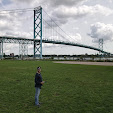
In the aftermath of the George Prince ferry disaster that claimed the lives of 78 people in October 1976 in nearby Luling, LA, the state of Louisiana began the process of gradually phasing out most of its prominent cross-river ferry services, a process that remains a work in progress today. While the Luling-Destrehan Ferry service was eliminated in 1983 upon completion of the nearby Hale Boggs Memorial Bridge, the ferry service at Gramercy, LA in rural St. James Parish was seen as a safety issue and planning for a bridge in the area commenced shortly thereafter. By the mid-1980s, the Mississippi River was crossed by only one bridge between greater New Orleans and Baton Rouge and that bridge, the Sunshine Bridge near Donaldsonville, was seen by this time as beneficial project for the downriver parishes. The Gramercy Bridge (as it is known by locals) was completed in 1995 at a cost of $110 million and is the most recent example of long-span steel cantilever/through truss bridge design at its finest. With a center main span of 1,460 ft, it is one of the longest bridges of its type in the world, even rivaling the size of the dual spans of the Crescent City Connection in New Orleans. Due to its location downriver from Baton Rouge in the sea-level section of the Mississippi River that is frequented by large ocean-going ships, the bridge’s clearance above mean river level is 165 ft, making it among the tallest bridges on the lower Mississippi.
The bridge’s four lane roadway carries LA Highway 3213 as it connects Interstate 10 and US Highway 61 (Airline Highway) to the north with LA Highway 3127 to the south. Until 2008, this bridge was quite literally a “Bridge to Nowhere”, as the bridge’s southern (west bank) approach dead-ended and all traffic was forced to use the low-speed and inconvenient River Road (LA Highway 18). The completion of the west bank approach highway in that year aided in making this bridge more useable for locals, however as of 2024 it has not turned into the busy river crossing and economic lifeline for the region it was predicted to become.

Although visually impressive and a landmark in the history of modern American engineering, the Gramercy Bridge is largely seen today as an overreach and an underutilized structure that fails to justify its existence due to low traffic counts and negligible related economic benefits.
While it may be argued that a bridge across the river was
ultimately necessary and that there was enough demand to warrant some kind of
fixed crossing of the river in this area, it’s clear, in this author’s opinion,
that the amount of bridge that was built here comes nowhere near the amount
that was appropriate given the traffic demands of the area, whether in terms of
traffic in 1990 or that of 2024. The desire to eliminate the ferry crossing in
Gramercy was an unnecessary overcorrection. Passenger ferries themselves are
not dangerous modes of transportation when they are placed in the hands of
competent, sober crews. The regulatory changes brought about by the George
Prince tragedy ensured that this would remain the case all the way to the
present day. The ferries that continue to operate on the lower Mississippi,
whether in Plaquemine or in greater New Orleans, do so safely to the highest of
standards with a terrific safety record. The Gramercy Ferry was not unsafe, but
the disaster downriver in Luling caused an overreaction that led to one of
Louisiana’s largest boondoggle projects of the last 50 years.
Great projects like the Gramercy Bridge unfortunately take on a bad reputation and are oftentimes seen as “white elephants” due to the exorbitant costs involved and the comparatively minor benefits. While it’s true that the redundancy of another bridge on the Mississippi River is a positive trait on the face of it, the location of this project, in a rural part of the state that’s located away from the common travel patterns and thoroughfares of the region, is not beneficial for solving the problems of cross-river mobility in the state’s largest population centers. The funds that were allocated for the construction of this bridge could have been, and should have been, used more appropriately to address these concerns elsewhere in the state where well-established facilities and infrastructure were (and still are) in need of modernization and supplementation. The Gramercy Bridge is a great bridge and a great example of modern American engineering. Unfortunately, it’s also an example of how 'greatness' can be unnecessary and inconsequential despite good intentions.


Further Reading:
Veterans Memorial Bridge by John Weeks
Bridges, Crossings, and Structures of the Lower Mississippi River
Next Crossing upriver: Sunshine Bridge (Donaldsonville, LA)
Next Crossing downriver: Hale Boggs Memorial Bridge (Luling, LA)
Nearby Flood Control Structure: Bonnet Carre Control Structure (Norco, LA)
Return to the Bridges of the Lower Mississippi River Home Page
__________________________________________________
Comments