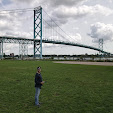

The Greenville Bridge spans the lower Mississippi River near
the city of Greenville, MS in the heart of the Mississippi Delta region. The
bridge has been part of the US Highway 82 and 278 corridors since its completion
in 2010. At the time of its construction, it was the longest cable-stayed
bridge on the Mississippi River and remains one of the longest such bridges in
the Mississippi River basin today.
Construction of this bridge was undertaken in the early 2000s in order to replace the aging and insufficient predecessor bridge nearby, an impressive steel truss bridge known as the Benjamin Humphreys Bridge. Due to this bridge’s presence at a prominent bend in the Mississippi River, the bridge’s piers proved to be dangerous obstacles for passing marine traffic. The old bridge’s narrow two lane roadway, which may have been state-of-the-art for the region when it was built in 1940, was no longer sufficient to carry the significant amount of heavy truck traffic utilizing the US 82 corridor between Mississippi and Arkansas. In addition, there had been plans dating back to the 1970s to relocate cross-river traffic onto a long-distance bypass that would remove truck traffic from the local streets of downtown Greenville.

This aerial artist's impression shows the location of the new Greenville Bridge in relation to that of its predecessor, the Humphreys Bridge. The old bridge was demolished following the opening of the present bridge.
With these factors in mind, construction began on a replacement bridge, located about ½ mile downriver from the site of the old bridge, which was demolished in 2012 following completion of the new bridge. Construction of the new bridge progressed in distinct phases, beginning in 2001 with the building of the central main span, which was completed in 2006. Work on both approaches began in 2006 and was completed in 2010. The bridge’s longest center span is 1,378 ft long and its modern four-lane roadway stands about 120 ft above mean river level. The bridge's H-shaped pylons stand 425 ft tall and can be seen from miles around due to the flat, treeless landscape in the part of the Delta. Due to the need for the bridge to span both the river and its surrounding flood plain, the approaches of this bridge span the entire distance from levee to levee, meaning that overall length of the bridge from abutment to abutment is over 2 ½ miles. After nearly ten years of construction at a cost of $260 million, the Greenville Bridge opened in August 2010, ushering in a new era of cross-river travel for the Mississippi Delta.


Left: The H-shaped pylons of the Greenville Bridge stand tall and are visible from miles away, as is the case in this view from the Mississippi side of the river.
Right: This unused overpass was built as part of the larger Greenville Bypass project, but has not gone into use as of February 2023.
The new bridge at Greenville was envisioned as part of a larger transportation puzzle intended to relieve traffic along US 82 through the center of town. The eastern approach was always meant to continue straight ahead onto a new four lane highway, known as the Greenville-Leland Bypass, which would run generally eastward for about 15 miles around the south side of Greenville to a terminus at existing US 82 east of Leland. When I visited the Greenville Bridge in February 2023, it was interesting to note how the bridge’s east end is configured: traffic veers to the north upon touching down, rather than continuing straight ahead onto what’s clearly been graded/prepared for a highway continuation. Significant work for the bypass had been performed around the time of the construction of the bridge; there’s an unused overpass east of the bridge that was built for the eventual relocation of MS Highway 454 and a new interchange intended for that location. This infrastructure had not been put into use as of the day of my visit. After years of delay and uncertainty, construction began in earnest on completing the bypass in 2022. The $137 million contract is planned to reach completion at the end of 2025, at which time there will finally be a seamless connection between the east end of the Greenville Bridge and its long-planned connecting highway to the east.


Further Reading:
Greenville Bridge by John Weeks
Old Benjamin Humphreys Bridge by John Weeks
Bridges, Crossings, and Structures of the Lower Mississippi River
Next Crossing upriver: Helena Bridge (Helena-West Helena, AR)
Next Crossing downriver: Old Vicksburg Bridge (Vicksburg, MS)
Return to the Bridges of the Lower Mississippi River Home Page
__________________________________________________
Comments