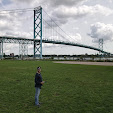

Located near the town of Caruthersville, MO, the
Caruthersville Bridge spans the Mississippi River as part of Interstate 155 and
US Highway 412 between the Missouri Bootheel and northwest Tennessee near
Dyersburg. Officially, it’s the northernmost bridge on the lower Mississippi
River, which is defined to begin at the confluence of the Mississippi and Ohio
Rivers at Fort Defiance near Cairo, IL. It's also the lone crossing of the river connecting the states of Missouri and Tennessee.
In the years following World War II, the states of the
Mississippi Valley region sought to improve connectivity between them across
the Mississippi River. Numerous outdated ferry crossings existed in those days,
however these connections were tenuous and oftentimes dependent of river and
weather conditions for their reliability. The states of Missouri and Tennessee
approved a study for a new bridge in the vicinity of Caruthersville in 1949,
with a site being chosen and approved by the U.S. Army Corps of Engineers by
1953. Funding for the project was ensured by the creation of the Federal Aid
Highway Act of 1956, as this corridor was selected to be part of the broader
42,500 mile national “Interstate” highway system that would be funded primarily
by the federal government.
Construction of the bridge began in 1969 and was completed
in 1976, at a cost of $26 million. One look at this bridge reveals that it
contains a very unusual and asymmetrical superstructure, which is unique on the
lower Mississippi River. The longer of the two main spans is 920 ft long,
resting 100 ft above the river. The structure supports a four-lane
interstate-standard roadway with full shoulders on the right. Temporary
falsework piers had to be built in the river in order for the out-of-balance
weight of the structure to remain in place as it was being assembled. It’s a
practice that although innovative for its time, has largely been phased out due
to worker/maritime safety considerations. The means and methods that
contractors use to build bridges nowadays have been greatly simplified due to the
introduction of modern, streamlined processes and bridge designs that reduce
the risk of on-site incidents. With that being the case, it’s unlikely that a
bridge like this one will be built again anytime soon. (We may therefore see
this bridge as a rarity that should be mentioned rather than forgotten about.)
A final design consideration at this location is its
proximity to the New Madrid Seismic Zone, with the bridge being located about
30 miles downriver from the titular Missouri village. At the time of its design
and construction, the underlying complexity and potential power of this fault
system was not well understood and this bridge was not built with seismic
resilience in mind. In the years since, other structures along the Mississippi
River between St. Louis and Memphis have been retrofitted as the history and
potential of the New Madrid Fault have come into clearer focus. That said, no
such work has taken place at Caruthersville as of the writing of this post in January
2024. Proposals to improve the stability of the bridge’s foundations and
superstructure connections have gone unbuilt to this point due to prohibitively
high costs.
The bridge was incorporated into the larger Interstate 155 corridor
upon completion, which connects Interstate 55 near Hayti, MO with US Highway 51
in Dyersburg, TN. Since the 1980s, the bridge has also been part of the US 412
corridor, which stretches westward from Tennessee as far as eastern New Mexico.
The US 51 corridor through western Tennessee is also part of the future
Interstate 69 corridor, intended to seamlessly connect south Texas and the
Mexico border with the Great Lakes region and southern Canada. This means that
the potential exists for the I-155 corridor and the Caruthersville Bridge to
serve an important role in the future by connecting two long-distance
north/south interstates in the nation’s Mid-South region. In addition, this
bridge is the lone Mississippi River bridge for over 200 river miles between
Cairo, IL and Memphis, TN. Given these realities, its value to the local and
regional transportation system cannot be understated and it is indeed far from
a useless crossing.
As far as my documentation of this bridge is concerned, this is one of those locations I’d like to have the opportunity to revisit at some point in the future. My lone visit to the bridge took place in May 2019, prior to me getting involved with aerial/drone photography. The only photos I’ve collected of this bridge were taken from along the highway, though it’s my understanding that there’s at least one decent vantage point along the Tennessee side of the river that would be worth checking out.


Bridges, Crossings, and Structures of the Lower Mississippi River
Next Crossing upriver: Dorena-Hickman Ferry (Hickman, KY)
Next Crossing downriver: Hernando de Soto Bridge (Memphis, TN)
Return to the Bridges of the Lower Mississippi River Home Page
__________________________________________________
Comments