
.JPG)
Opened to the public on June 15, 1917, the iconic Fremont Bridge in Seattle, Washington was built as part of the construction of the Fremont Cut of the Lake Washington Ship Canal project. Named for the nearby Fremont neighborhood on the north side of the bridge, the Fremont Bridge is a 317-foot-long double-leaf pony truss bascule bridge that connects downtown Seattle and the Queen Anne neighborhood with Fremont and other neighborhoods north of the Lake Washington Ship Canal. The Fremont Bridge replaced temporary bridges that were built over the Ship Canal at Stone Avenue (now Stone Way) and in Fremont before the modern-day bridge was constructed. With a clearance of only 30 feet, the Fremont Bridge opens an average of 35 times a day, which earns it the claim as the busiest drawbridge on the planet.
The Fremont Bridge was designed by engineers Arthur H. Dimock and Frank A. Rapp, who arrived in Seattle in 1912 after designing railroad bridges for the railroad. This happened during a crucial point in Seattle's transportation timeline, as the Lake Washington Ship Canal was being widened and permanent solutions for fixed crossings across the canal were needed for both marine and ground traffic. While workers were dredging and widening the channel, planners were considering alternatives that would best suit the needs of marine and surface traffic. Various options were outlined in meetings with the Seattle City Council in April 1914. Per Arthur Dimock, tunnels wide enough to accommodate streetcars and motor vehicles would be difficult to construct because of the canal's soft bottom. Fixed bridges that required a 150-foot clearance would also require extremely long approaches, new streets, and land acquisitions. Vertical lift bridges would require 200-foot towers and wing bridges would occupy too much land. Dimock told the council he had spent two years studying various bridge types and concluded bascule bridges were the best choice in the circumstance, given considerations to both cost and available space.
The bridge was financed with the sale of bonds, which had been stalled because of Frank Rapp. Nonetheless, the Fremont Bridge opened at a cost of $410,000. When Rapp died in 1923, his obituary stated that he had designed nearly all of Seattle's important bridges, which checks out as the Ballard, University, and Montlake Bridges all opened during the 1910s and 1920s. The Fremont Bridge was the first of the bridges to be built across the Lake Washington Ship Canal and was modeled after bridges built in Chicago by the public works department in that city. When contracts for the project were awarded in August 1915, initial estimates indicated that the bridge would cost $342,000 and require at least 100 tons of structural steel. The span was built with two short towers on each end, with the control tower located on the southeast. While the bridge is a drawbridge, it is also opened by way of a weighted system that uses huge concrete weights and minimal motor power, similar to how a seesaw works.
A few improvements to the Fremont Bridge were made over the decades. In 1928, backup motors were added to the bridge, and in 1960, an addition with an exterior deck raised the height of the control towers, which improved visibility for the bridge tender. Given how often the Fremont Bridge is raised for boats daily, that must have been a welcome improvement. A major overhaul of the Fremont Bridge commenced in September 2005 and work was completed until June 2007, at the cost of $42 million. The project included replacing the bridge's crumbling approaches, rebuilding its decks and railings, and updating mechanical and electrical systems
As Seattle grew, it was found that the Fremont Bridge alone was inadequate to serve the transportation needs of Fremont and surrounding neighborhoods. As early as 1920, it was reported that motor vehicle traffic in Seattle had increased by 85 percent in the few years since the Fremont Bridge opened. The bridge had quickly become a bottleneck between downtown Seattle and the neighborhoods to the north, especially during the evening rush hour. By 1927, it was estimated that 26,000 cars crossed the Fremont Bridge daily. The traffic problems were not all caused by ships needing to have the bascule bridge opened, or streetcars that were backed up because of cars. Planning was soon underway for a high-level bridge across the northwest corner of Lake Union at Stone Way. That particulate site was foretold by Dimock when he met with city officials 14 years prior. However, it was determined that a bridge crossing at Aurora Avenue would be shorter and have a firmer foundation to be built upon, and that is where the high-level bridge was inevitably constructed. The Aurora Bridge was built as a federal and state project as part of US 99. After it opened in 1932, surface traffic eased somewhat on the other bridges that cross the ship canal, including the Fremont Bridge.
Much has been debated about the Fremont Bridge's color scheme over the years. For decades, the bridge was painted green. In 1972, when it was time to repaint the bridge, the Fremont Improvement Committee picked a new color, Fremont Orange, and residents approved the change, as it distinguished the bridge from the spans along the ship canal. Proponents expected the Fremont Orange to be reminiscent of the paint color of the Golden Gate Bridge in San Francisco, but it was much brighter. While the Fremont Orange paint color was designed for Seattle's weather conditions, it was said to fade to a color described as somewhere between pink, dull coral, or "between dead salmon and stale fruit". When it came time to repaint the bridge in 1984, Seattle engineers offered five color choices to the Fremont community, holding a vote at the Fremont Street Fair that year. Pickle Green, Canal Blue, Nutmeg Brown, Pirate Gold, and Sky Gray were the colors to choose between. Armen Stepanian, a mover and shaker who was the self-described mayor of Fremont at the time, believed the bridge should still be painted as Fremont Orange and campaigned for that color as a write-in candidate. Canal Blue was the winning choice, and Fremont Orange was in second place. The blue color scheme with orange accents was ultimately chosen for the Fremont Bridge paint color, which has remained to this day even after the bridge was repainted a few times.
Paint colors aren't the only quirky thing about the Fremont Bridge. Fitting in with the quirkiness of the Fremont neighborhood, there are some Easter eggs to be found on the towers of the bridge. After all, you can find the Fremont Troll, a Vladimir Lenin statue, dinosaur shrubberies, and a sculpture of people Waiting for the Interurban around Fremont. But these are not actual eggs, they are neon sculptures that were added to the bridge towers in 1994. One neon sculpture, installed on the northwest tower, shows Rapunzel with her wavy neon-yellow locks extending out of the window. On the northeast tower, there is a neon sculpture that depicts Rudyard Kipling's fable, "How the Elephant Got Its Trunk." The neon sculptures were created by Rodman Miller. The Fremont Bridge also sees its fair share of cyclists. In 2012, the Fremont Bridge Bike Counter debuted and is maintained by the Seattle Department of Transportation. Just in 2023 alone, more than 903,000 bicyclists crossed the Fremont Bridge. That is on top of the over 33,000 motor vehicles that cross the Fremont Bridge every day.
I wonder how many pedestrians cross the Fremont Bridge, as that's how I crossed the bridge on a lovely Sunday summer afternoon. While I didn't pay attention to the neon sculptures on the bridge towers, I was able to discover the other nooks and crannies of the Fremont Bridge, both on the bridge and alongside the canal, where there is a park and recreational trail that follows the canal. I was glad I included this in a walking tour of some of the different neighborhoods of Seattle.
.JPG) |
| The Fremont Bridge opened in 1917, but MCMXVI is 1916 in Roman numerals. |
.JPG) |
| Looking at the seamy underbelly of the Fremont Bridge. |
.JPG) |
| This boat is just low enough that the bascule bridge did not have to be lifted. |
.JPG) |
| The blue paint color and orange accents works well, I think. |
.JPG) |
| Looking west at the Fremont Cut of the Lake Washington Ship Canal, which connects Lake Washington and Lake Union with the Puget Sound. |
.JPG) |
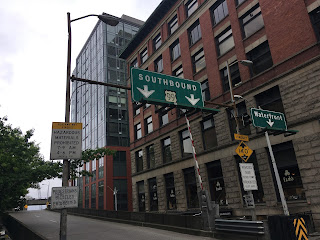
| Walking along the Fremont Bridge, which was pretty quiet when I took this photo. |
How to Get There:
Sources and Links:
Seattle Department of Transportation - Bridges
Living New Deal - Fremont Bridge Improvements - Seattle WA
Fremont Universe - Some Fun Fremont Bridge Facts!
Post Alley | Seattle - Ups and Downs: How the Fremont Bridge Came to Be
HistoryLink.org - Fremont Bridge (Seattle)
Seattle Post-Intelligencer - Happy 100th Fremont Bridge! A look at its fascinating history (June 15, 2017)
Seattle Department of Transportation - Building bridges: The history behind the Fremont, University, and Ballard bridges
Comments