Diamond Head State Monument

Diamond Head Crater is a volcanic tuff cone on the Hawaiian Island of O'hau located in the City of Honolulu.  The Diamond Head Crater is surrounded by several neighborhoods of Honolulu and offers a vista of the City from the top of the Summit Trail.  Diamond Head Crater in the Hawaiian language is known as Lēʻahi.


This page is part of the Gribblenation Hawaii Roads series.  A compellation of all Hawaii-related media from both Gribblenation and RoadwayWiz can be found by clicking here


Part 1; the history of Diamond Head State Monument 

The formation of O'ahu began between 2.5-4 million years ago with volcanic eruptions from two shield volcanos emerging into a land mass from the Pacific Ocean.  Over time the erosion of the two shield volcanos formed the basis of the modern Ko'olau and Wai'anae Mountain Ranges.  Approximately 1.3 million years ago volcanic activity began in the Pacific Ocean at the southeastern end of the Ko'olau Range forming numerous cones.  Lēʻahi is thought to have formed approximately 300,000 years ago from a single and brief eruption.  Since erupting Lēʻahi began to erode into the state it is seen today.

In 1825 Lēʻahi was named "Diamond Hill" by British Sailors.  The British mistook the volcanic calcite crystals on Lēʻahi for diamonds.  Despite the lack of actual diamonds present on Lēʻahi the English name stuck and eventually became "Diamond Head" due to it being part of a headland.  Diamond Head/Lēʻahi can be seen on 1856 J.H. Colton Map of the Hawaiian Islands on O'ahu. 


Diamond Head can be seen in much greater detail on the 1881 Hawaiian Government Survey Map of O'ahu


In 1904 Diamond Head was purchased by the Federal Government of the United States and designated for military use.  Fortification of Diamond Head began in 1908 with construction of gun emplacements and the Kapahulu Tunnel on the northern rim.  Originally known as "Diamond Head Reservation" the military encampment was renamed to "Fort Ruger" during 1909.  The Fire Control Station which is now the top of the Summit Trail to the top of Diamond Head was constructed circa 1908-1910.  Coastal Batteries were added to Diamond between 1910-1916 with one additional (Battery 407) being constructed during 1943.  The construction of Battery 407 included excavation of the Kahala Tunnel through the eastern rim of Diamond Head which now is part of the State Monument entrance road.  Diamond Head and Fort Ruger as they were immediately after World War II can be seen on the 1946 Army Map of O'ahu.


The importance of Fort Ruger diminished following World War II with much of the U.S. Army infrastructure inside Diamond Head becoming obsolete.  Diamond Head Crater was declared a Hawaii State Monument in 1962 and became a National Natural Landmark in 1968.  In modern times a few military facilities such remain active at Diamond Head Crater such as; the northern Kapahulu Tunnel, Battery 407, the Hawaii State Civil Defense Headquarters and a National Guard emergency operations center.


Part 2; hiking the Summit Trail to the top of Diamond Head Crater

From flying overhead Honolulu Diamond Head Crater is an obvious geographic feature.  From the view below Diamond Head Crater can be seen towering east of Waikiki. 


Diamond Head State Monument is accessible via Diamond Head Road along the eastern rim of the Crater.  Traffic entering Diamond Head Crater must utilize the one lane Kahala Tunnel.  


Traffic emerges from the Kahala Tunnel into the center of Diamond Crater where the trailhead for the Summit Trail can be found at the Diamond Head State Monument Visitor Center.  


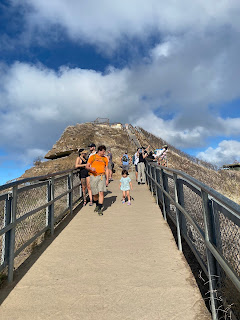
The Summit Trail is approximately 0.8 miles long but gains 560 feet in elevation.  The starting portion of the Summit Trail is paved but comes a rock surface approaching the Diamond Head Crater rim.  


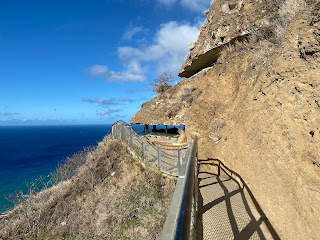
The Summit Trail ascends through a series of rock switchbacks to an observation deck overlooking the center of Diamond Head Crater. 


The Summit Trail ascends 74 stairs to a 225 foot long tunnel.  


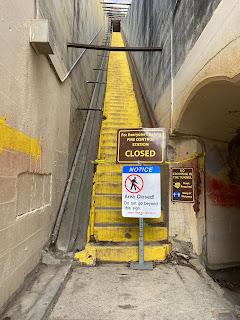
The Summit Trail emerges onto a second set of stairs which has 99 steps.  The second set of stairs is advertised as a spur which can be used to access a second tunnel to the interior of the Fire Control Station.  Unfortunately the spur trail to the Fire Control Station was closed when I was hiking the Summit Trail. 


The Summit Trail approaches a metal staircase with a spur which overlooks Koko Crater east of Diamond Head Crater. 


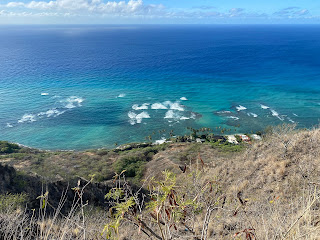
The metal staircase is 82 steps high approaching the Fire Control Station observation point.  From the top of the 82 step metal staircase the 1917 Diamond Head Lighthouse can be below.  


A final 54 step metal staircase ascends to the Fire Control Station observation point located at 761 feet above sea level.  Looking westward a full view of Waikiki and downtown Honolulu can be observed. 


The entirety of Diamond Head Crater can be seen from the Fire Control Station observation point facing east.  Much of the Ko'olau Range and Koko Crater can also be observed facing eastward. 


Comments

Popular posts from this blog

Did Caltrans just kill the G26 cutout US Route shields?

The US Route System was formally created by the American Association of State Highway Officials during November 1926.  Through the history of the system the only state to which has elected to maintain cutout US Route shields has been California.  The G26 series cutout US Route shields have become a favorite in the road enthusiast hobby and are generally considered to be much more visually pleasing than the standard Federal Highway Administration variant.  However, the G26 shield series appears to have been killed off on January 18, 2026, when Caltrans updated their Manual of Uniform Traffic Control Devices.  This blog will examine the history of the US Route shield specifications in California and what is happening with the 2026 changes.  The blog cover photo is facing towards the terminus of California State Route 136 and at a G26-2 specification US Route 395 shield.  In the background Mount Whitney can be seen in the Sierra Nevada range.   ...

May 2023 Ontario Trip (Part 3 of 3)

  Over the years, I have made plenty of trips to Ontario, crisscrossing the southern, central and eastern parts of the province. Living in Upstate New York, it's pretty easy to visit our neighbor to the north, or is that our neighbor to the west? Ottawa is one of my favorite cities to visit anywhere in the world, plus I've discovered the charm of Kingston, the waterfalls of Hamilton (which is on the same Niagara Escarpment that brings us Niagara Falls), the sheer beauty of the Bruce Peninsula, and more. But I hadn't explored much of Cottage Country. So I decided to change that, and what better time to go than over Memorial Day weekend, when the daylight is long and I have an extra day to explore. On the third and final day of my trip, I started in Huntsville and made my way through Muskoka District and Haliburton County, passing by many lakes along the way. I stopped in towns such as Dorset, Haliburton and Bancroft before making a beeline down to Belleville and then over th...

Ghost Town Tuesday; Nichols, FL

A couple years ago I spent a lot of spare time exploring phosphate mining ghost towns in the Bone Valley of Polk County, Florida.  One ghost town in particular called Nichols on Polk County Route 676 west of Mulberry caught my eye due to a relative lack of documentation on ghosttowns.com. Nichols was created in 1905 during the early phosphate mining boom in the Bone Valley region.  For the time Nichols was unusual since it had company housing in the Nichols Mine site and private residences outside the gate.  Nichols is only about two miles west of Mulberry which probably made it a somewhat reasonable commute even by the wonky standards of the early 20th Century.  Most of the Bone Valley region was relatively remote which made commuting or homesteading impractical which is why there are so many ghost towns in the area.  The company housing section of Nichols was phased out and abandoned by 1950. The Nichols town site is largely abandoned and could "possibl...