Interstate H-201 is a 4.10 mile auxiliary spur of Interstate H-1 located on the Island of O'ahu in the State of Hawaii. Interstate H-201 westbound begins near downtown Honolulu at Interstate H-1 and jogs back to it at Aiea. Interstate H-201 is known as the Moanalua Freeway and was originally constructed as Hawaii Route 78.
This page is part of the Gribblenation Hawaii Roads series. A compellation of all Hawaii-related media from both Gribblenation and RoadwayWiz can be found by clicking here.
Part 1; the history of Interstate H-201 and the Moanalua Freeway
The corridor of Interstate H-201 is tied historically to Moanalua Road which skirted the namesake Moanlau Valley. Moanalua Road was constructed during the 19th Century and originally connected from King Street in Honolulu westward to Aiea. Moanalua Road was paved in macadam circa 1899 which greatly enhanced overland travel. The Moanalua Road can be seen on the 1899 J.T. Taylor map of O'ahu listed as the "Government Road" through the Moanlau Military Reservation.
Construction of U.S. Army Fort Shafter began in 1905 and would be completed during 1907. The establishment of Fort Shafter led to an influx of traffic on the Moanalua Road which began to degrade. Moanalua Road was repaired during the 1910s and plans were announced in 1921 to straighten it.
During World War II the territory of Hawaii saw an influx of military activity following the attack on Pearl Harbor on December 7th, 1941. Numerous Military Routes and early Hawaii Routes were signed through the Hawaiian Territory to aid military personnel in navigating the islands. Military Highways were assigned US Route style shields whereas lesser highways were assigned an early variation of what is now the Hawaii Route Spade. A 1946 Army Map of the Island of O'ahu shows the existing Moanalua Road signed as Hawaii Route 103 ("HI 103"). A full version of the 1946 Army Map of O'ahu can be seen on hawaiihighways.com here.
The Hawaiian Territorial government began construction of a four lane expansion of HI 103/Moanalua Road following the opening of the Triple Army Medical Center in 1948. The full scope of the expansion project would reduce the number of curves on Moanalua Road by 75% and was planned to connect with the Mauka Arterial (now Interstate H-1) in Honolulu. The westernmost 2.7 miles of the expanded Moanalua Road opened to traffic on April 28th, 1954.
Circa 1955 following the conclusion of World War II the United States Bureau of Public Roads renumbered the Hawaii Route System. The 1955 Hawaii Route renumbering saw most of the conventions utilized by the current Hawaii State Route System established. Primary Hawaii Routes were given two digit numbers whereas Secondary Hawaii Routes were given three digit numbers. The Hawaii Routes were assigned in sequence for what Island/County they were located on coupled with what Federal Aid Program number they were tied to. In the case of O'ahu the Island was assigned numbers in the range of 60-99. HI 103/Moanalua Road was subsequently renumbered as part of HI 72 during due it being designated a primary highway. A far more detailed explanation of the 1955 Hawaii Route Renumbering can be found at hawaiihighways.com here.
The 1959 Gousha Map of Hawaii provides a detailed insert for the City of Honolulu. From Aiea HI 72/Moanalua Road eastbound is shown as a four lane highway from Hale Street to the boundary of Fort Shafter. The 1959 Gousha Map of Hawaii shows a planned realignment of HI 72/Moanalua Road through Fort Shafter. The realignment of HI 72/Moanalua Road is stated to have a anticipated completion during 1959 and would connect to King Street and the planned western extent of the Lunalilo Freeway.
On August 21st, 1959 Hawaii became the 50th State which saw it's profile rise significantly. The Hawaii Department of Transportation's History of Interstate H-3 guide details much of the early history of the Interstate System in Hawaii. The Interstate System in Hawaii was authorized as part of the 1960 Statehood Act. The 1960 Statehood Act authorized Interstates H-1, H-2 and H-3 on the Island of O'ahu. Notably HI 72/Moanalua Road was not included in the initial run of Interstates on O'ahu.
During late 1971 work began to convert the corridor of Moanalua Road to a freeway. The Moanalua Road corridor was reassigned as HI 78 which reflected it's freeway conversion largely being funded under Federal Aid Primary 78. The conversion of Moanalua Road into the Moanalua Freeway is listed as being fully available to traffic by January 23rd, 1975 in the AASHTO Database.
On April 6th, 1988 the Honolulu Division Administrator of the Hawaii Department of Transportation submitted a request to the Federal Highway Administration to add entirety of HI 78 and the Moanalua Freeway to the Interstate System as Interstate H-1A. On November 1st, 1989 The Federal Highway Administration informed the Hawaii Department of Transportation that HI 78/Moanalua Freeway was approved to be added to the Interstate System as Interstate H-1A. The Federal Highway Administration did note that the Middle Street Interchange did not conform to Interstate standards. The Federal Highway Administration further noted the Hawaii Department of Transportation would need to petition the American Association of State Highway and Transportation ("AASHTO") Route Numbering Committee to approve the designation of Interstate H-1A.
On May 18th, 1990 the Hawaii Department of Transportation submitted an application to the AASHTO for Interstate H-1A to be designated over HI 78/Moanalua Freeway.
On June 14th, 1990 the AASTHO informed the Hawaii Department of Transportation that the consideration of the approval of the designation of Interstate H-1A was withheld pending further review.
The Federal Highway Administration in a letter to the AASHTO dated June 18th, 1990 noted that it was aware the latter was no longer approving suffixed US Routes and Interstates. The Federal Highway Administration went onto add it would ask the Hawaii Department of Transportation to seek a three digit auxiliary designation for the Moanalua Freeway given it looped to/from Interstate H-1.
On October 24th, 1990 the Hawaii Department of Transportation petitioned to the AASHTO assigned the Moanalua Freeway as Intestate H-101. On December 8th, 1990 the AASHTO Executive Committee approved the designation of Interstate H-201 on the Moanalua Freeway. In the AASHTO's response to the Hawaii Department of Transportation noted it selected H-201 given the Moanalua Freeway was a loop of Interstate H-1 and thusly an even digit auxiliary designation was appropriate. Note; odd three digit Interstate numbers are intended to denote auxiliary spur Intestates.
The designation of Interstate H-201 was not signed on the Moanalua Freeway for numerous years and the existing HI 78 signage remained in place. The Hawaii Department of Transportation over years noted several concerns over signing Interstate H-201:
- The department wanted to encourage travelers to use Interstate H-1 on the Queen Liluokalini Freeway over the older Moanalua Freeway.
- The department was concerned motorists would confuse Interstate H-201 for Interstate H-2.
- The department struggled to fit four digits into a 36 inch wide Interstate shield.
Beginning during July of 2004 the Hawaii Department of Transportation began converting HI 78 signage to Interstate H-201. Very few instances of HI 78 can still be found such as the example below at the parking lot at Pearl Harbor National Memorial.
Part 2; a drive on Interstate H-201 and the Moanalua Freeway
From Interstate H-1/Lunalilo Freeway westbound in Honolulu traffic staying in lane merges onto Intestate H-201/Moanalua Freeway at the Middle Street Interchange via Exit 19B. Oddly Interstate H-1 crosses over itself to transition from the Lunalilo Freeway to the Queen Liliuokalani Freeway.
Interstate H-201/Moanalua Freeway westbound Exit 4 accesses Fort Shafter via Ahua Street.
Interstate H-201/Moanalua Freeway westbound Exit 3 accesses HI 7310/Puuloa Road.
Interstate H-201/Moanalua Freeway westbound Exit 2 accesses Moanalua Valley, Salt Lake and Red Hill.
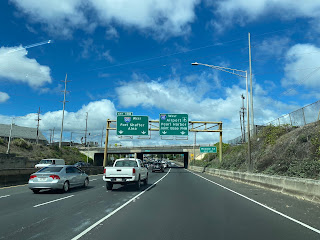
Interstate H-201/Moanalua Freeway westbound Exit 1E accesses Aloha Stadium whereas Exit 1D accesses Interstate H-3. Interstate H-201 Exit 1C accesses Interstate H-1 before the Moanalua Freeway terminates at HI 99/Kamehameha Highway.
Part 3; Roadwaywiz on Interstate H-201
During May of 2019 Dan Murphy of the Roadwaywiz YouTube Channel (and Gribblenation) featured real time drives on Interstate H-201. Below Interstate H-201 and the Moanalua Freeway can be seen eastbound.
Below Interstate H-201 and the Moanalua Freeway can be seen westbound.
Grand Loop Road is a 140 mile loop highway which traverses the interior of Yellowstone National Park. Grand Loop Road connects all of the major attractions and geological features of Yellowstone National Park along with the entrance roads. Grand Loop Road is a seasonal highway and despite some conjecture never has been part of the US Route System. Part 1; the history of Grand Loop Road The majority of history pertaining to Grand Loop Road was taken from the below National Park Service article: Historic Roads - Yellowstone National Park (U.S. National Park Service) (nps.gov) Yellowstone was declared the first National Park of the United States on March 1st, 1872. The first real highway to access Yellowstone National Park came in 1873 when a tolled facility was constructed from Bozeman, Montana via Yankee Jim Canyon to Mammoth Hot Springs. Numerous attempts were made to fund construction of roadway infrastructure during the early years of Yellows...
Along southbound California State Route 170 (the Hollywood Freeway Extension) approaching the Hollywood Freeway/Ventura Freeway interchange a white California State Route 134 Sign State Route Spade can be observed on guide sign. These white spades were specifically used during the 1956-63 era and have become increasingly rare. This blog is intended to serve as a brief history of the Sign State Route Spade. We also ask you as the reader, is this last 1956-63 era Sign State Route Spade or do you know of others? Part 1; the history of the California Sign State Route Spade Prior to the Sign State Route System, the US Route System and the Auto Trails were the only highways in California signed with reassurance markers. The creation of the US Route System by the American Association of State Highway Officials during November 1926 brought a system of standardized reassurance shields to major highways in California. Early efforts to create a Sign State Route ...
From 2017 through to early 2019 I drove the majority of the California State Route 70; the Feather River Highway from CA 89 southwest to CA 99. CA 70 is an approximately 178.5 mile state highway which starts at US 395 near the Nevada State Line and travels west through the Feather River Canyon to CA 99. CA 70 is often referred to as the Feather River Highway" given it's close association with the river. Historically CA 70 was previously signed as US 40A and CA 24. The Legislative Routes prior to the 1964 California Highway Renumbering that made up the current route of CA 70 are as follows: - Legislative Route Number 21 from US 395 westward to Oroville. - LRN 87 from Oroville south to Marysville. - LRN 232 from Marysville to the current junction with CA 99. CA 70 was even dual signed with CA 99 into Sacramento on what was LRN 232 for a time. The change from US 40A/LRN 21/LRN 87/LRN 232 can be seen by comparing the 1963 State Highway Ma...




Comments