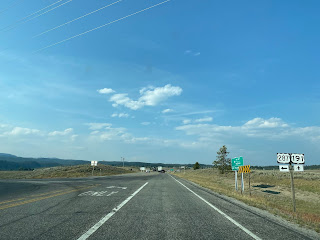
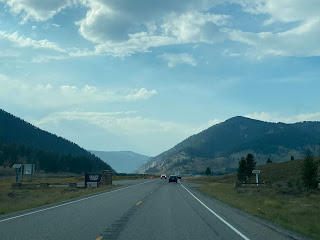
US Route 191 in the Gallatin Range of Yellowstone National Park

Since 1934 US Route 191 has traversed the Gallatin Range north of West Yellowstone, Montana to Bozeman Montana.  Since being extended to Bozeman during 1934 US Route 191 has remained the only US Route to ever be signed within the boundaries of Yellowstone National Park.  The course of US Route 191 north of West Yellowstone through the Gallatin Range takes it north through the Yellowstone National Park where it briefly dips into the State of Wyoming.  


Part 1; the history of US Route 191 in the Gallatin Range

The Gallatin Range is a sub-range of the Rocky Mountains and is located largely on the Montana/Wyoming State Line.  The Gallatin Range extends 75 miles north/south and largely is bisected by the Gallatin River.  The Gallatin Range takes it's name from Albert Gallatin who was the longest tenured US Secretary of the Treasury.  

Road access through the Gallatin Range between West Yellowstone and Bozeman is largely tied to the development of West Yellowstone as the terminus of the Oregon Short Line Railroad.  West Yellowstone was plotted by the Oregon Short Line Railroad as it's eastern terminus during November of 1907.  The Oregon Short Line Railroad subsequently completed it's line to West Yellowstone by June of 1908.  The rail terminus of the Oregon Short Line Railroad in West Yellowstone was the head of a stage road via the Madison River into Yellowstone National Park.  The Oregon Short Line Railroad bypassed more well known Targhee Pass for the more favorable grades of nearby Reas Pass located southeast of modern US Route 20 ("US 20").  The Oregon Short Line Railroad can be seen terminating in West Yellowstone on the 1912 Rand McNally Map of Montana.  Notably the Gallatin Range is displayed in great detail north of West Yellowstone.  

During the emergence of the automobile the Oregon Short Line Railroad was supplemented by a highway through the Gallatin Range.  The 1924 Rand McNally Map of Montana, Wyoming, Colorado, Idaho, Utah and Nevada shows Gallatin Way and the Great White Highway aligned as Auto Trails through the Gallatin Range from West Yellowstone to Bozeman.  Notably both Gallatin Way and Great White Highway are shown skirting through Wyoming via the boundaries of Yellowstone National Park.  The full extent of the Gallatin Way is shown be routed between West Yellowstone and Bozeman.  Even in modern times US 191 between West Yellowstone and Bozeman is known as Gallatin Road which ties back to it's Auto Trail origin.


The US Route System was created on November 11th, 1926 as a replacement for the preexisting Auto Trails.  US 191 was selected to be aligned from the western entrance of Yellowstone National Park towards Idaho Falls via Targhee Pass.  Notably no US Route was plotted through the Gallatin Mountains in the initial system grid nor did it have a State Route designation.  The 1927 National Company Map displays US 191 utilizing Targhee Pass and terminating at West Yellowstone.. 
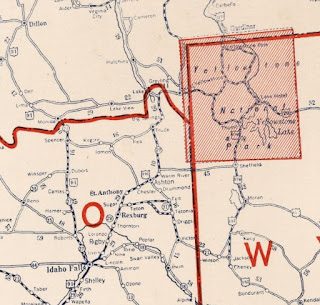
The 1931 Clason's Road Map of Montana shows Montana Highway 60 ("MT 60") designated on Gallatin Way from West Yellowstone to Bozeman via the Gallatin Range.  It is unclear if the MT 60 designation was applied to the existing highway in the Gallatin Range within Yellowstone National Park.  
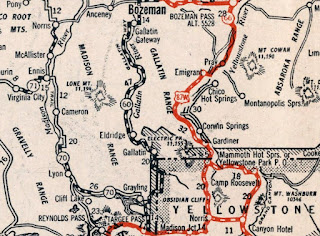
US 191was extended north from West Yellowstone to Bozeman circa 1934 via MT 60.  The extension of US 191 towards Bozeman left no US Route reaching the western entrance of Yellowstone National Park.  The Bozeman extension of US 191 was the first and only US Route to ever be approved for designation within the boundaries of Yellowstone National Park.  The exact date of the extension of US 191 to Bozeman isn't fully clear but it is referenced in a September 4th, 1934 letter from the Montana State Highway Commissioner to the Executive Secretary of the American Association of State Highway Officials ("AASHO").  The letter states the AASHO requested an updated route log from the State of Montana on August 20th, 1934 detailing the extension of US 191 to Bozeman.  


US 191 can be seen on the 1937 Gousha Map of Idaho extending north of West Yellowstone through the Gallatin Range to Bozeman. 

On October 30th, 1940 Idaho Department of Public Works acknowledged in a letter to the AASHO that US 20 had been extended through West Yellowstone via multiplex of US 191 to Sugar City.  The AASHO description of US 20 had it jog west via Idaho State Route 28 to Sage Junction to reach US 91.  The Idaho Department of Public Works requested US 20 be clarified to multiplex US 191 to Blackfoot (through Idaho Falls) to reach US 91 due to Idaho State Route 28 not being constructed to Sage Junction.  


1944 State Farm Map of Idaho shows US 20/US 191 multiplexing from West Yellowstone to US 91 in Idaho Falls.  


The truncation of US 191 from Idaho Falls to US 287 north of West Yellowstone at the edge of the Gallatin Range was approved by the AASHTO Executive Committee on during October 1978.  This left US 20 as the only highway aligned from West Yellowstone west over Targhee Pass to Idaho Falls.  


The extension of US 191 from US 287 near West Yellowstone to Interstate 40 in Chambers, AZ was approved by the AASHTO Executive Committee during June of 1981.  This extension of US 191 saw it multiplex US 20/US 287 through West Yellowstone to the west entrance of Yellowstone National Park.  


Part 2; a drive on US Route 191 from West Yellowstone to Big Sky via the Gallatin Range

From the western entrance of Yellowstone National Park US 191 begins it's northern segment co-signed with US 287 and US 20 on Yellowstone Avenue.  US 191, US 20 and US 287 are discontinuous through the heart of Yellowstone National Park and don't have a implied connection via Grand Loop Road.  US 191, US 20 and US 287 make a right hand turn from Yellowstone Avenue northward onto Canyon Street.  


The Oregon Short Line Railroad stopped operating passenger trains to West Yellowstone circa 1960 due to declining ridership.  The Union Pacific Railroad subsequently deeded the Oregon Short Line buildings to the City of West Yellowstone after it incorporated on June 6th, 1966.  The West Yellowstone Oregon Short Line Terminus Historic District was added to the National Register of Historic Places during 1983.  The Oregon Short Line Railroad Depot located on Yellowstone Avenue was constructed during 1909.


US 191, US 20 and US 287 multiplex briefly on Canyon Street to Firehole Avenue.  US 20 splits west towards Targhee Pass via Firehole Avenue whereas US 191 and US 287 continue north via a multiplex on Canyon Street.  


US 191/US 287 northbound depart West Yellowstone via a multiplex on Gallatin Road and cross the Madison River.  Approaching Duck Creek US 287 splits from US 191 via Hebgen Lake Road towards Virginia City.  US 191 stays aligned northbound towards Bozeman via Gallatin Road.  


From the US 287 junction the alignment of US 191 northbound is signed as 39 miles from Big Sky and 80 miles from Bozeman.  


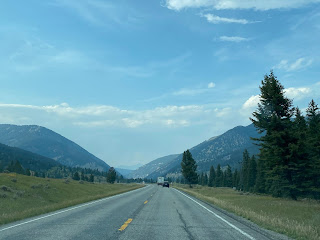
US 191 northbound on Gallatin Road ascends into the Gallatin Range where it briefly passes through Gallatin National Forest before entering the boundary of Yellowstone National Park.  


Within Yellowstone National Park US 191 dips into Wyoming following Grayling Creek to a pass where it picks up the course of the Gallatin River.  US 191 northbound begins to follow the Gallatin River northbound and reenters the State of Montana.  Upon returning to Montana US 191 enters Gallatin National Forest.  US 191 has one reassurance shield in both directions while in Yellowstone National Park and is signed with a 55 MPH speed limit.


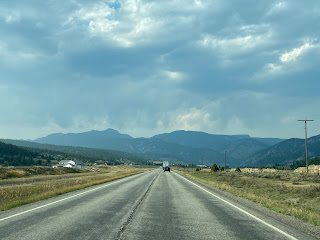
US 191 northbound on Gallatin Road follows the Gallatin River to a junction with MT 64/Lone Mountain Trail in Big Sky.  Traffic headed to Big Sky is directed to take westward MT 64 whereas Bozeman traffic is directed to continue another 40 miles northward through the Gallatin Range to Bozeman.






Part 3; exploring Montana Highway 64 and Big Sky

MT 64 is a 9.039 mile State Highway which begins at US 191 and follows Long Mountain Trail westward to the Mountain Village of the Big Sky Resort.  MT 64 was constructed during the 1970s when the resort community of Big Sky was being developed.  Downtown Big Sky can be found by following MT 64 west from US 191 to Ousel Falls Road.  


The community of Big Sky developed around the Big Sky Resort and has year-round population ranging from 2,000-3,000 residents.  Big Sky lies within Big Sky Valley of the Gallatin Range which was largely used as ranching prior to the 1970s.  The Big Sky Resort was founded during December 1973 by NBC Newscaster Chet Huntley at the base of nearby Lone Mountain.  The Big Sky Resort was later purchased by Boyce USA Resorts during 1976 which would go onto construct the community of Big Sky.


Comments

Popular posts from this blog

Did Caltrans just kill the G26 cutout US Route shields?

The US Route System was formally created by the American Association of State Highway Officials during November 1926.  Through the history of the system the only state to which has elected to maintain cutout US Route shields has been California.  The G26 series cutout US Route shields have become a favorite in the road enthusiast hobby and are generally considered to be much more visually pleasing than the standard Federal Highway Administration variant.  However, the G26 shield series appears to have been killed off on January 18, 2026, when Caltrans updated their Manual of Uniform Traffic Control Devices.  This blog will examine the history of the US Route shield specifications in California and what is happening with the 2026 changes.  The blog cover photo is facing towards the terminus of California State Route 136 and at a G26-2 specification US Route 395 shield.  In the background Mount Whitney can be seen in the Sierra Nevada range.   ...

May 2023 Ontario Trip (Part 3 of 3)

  Over the years, I have made plenty of trips to Ontario, crisscrossing the southern, central and eastern parts of the province. Living in Upstate New York, it's pretty easy to visit our neighbor to the north, or is that our neighbor to the west? Ottawa is one of my favorite cities to visit anywhere in the world, plus I've discovered the charm of Kingston, the waterfalls of Hamilton (which is on the same Niagara Escarpment that brings us Niagara Falls), the sheer beauty of the Bruce Peninsula, and more. But I hadn't explored much of Cottage Country. So I decided to change that, and what better time to go than over Memorial Day weekend, when the daylight is long and I have an extra day to explore. On the third and final day of my trip, I started in Huntsville and made my way through Muskoka District and Haliburton County, passing by many lakes along the way. I stopped in towns such as Dorset, Haliburton and Bancroft before making a beeline down to Belleville and then over th...

Ghost Town Tuesday; Nichols, FL

A couple years ago I spent a lot of spare time exploring phosphate mining ghost towns in the Bone Valley of Polk County, Florida.  One ghost town in particular called Nichols on Polk County Route 676 west of Mulberry caught my eye due to a relative lack of documentation on ghosttowns.com. Nichols was created in 1905 during the early phosphate mining boom in the Bone Valley region.  For the time Nichols was unusual since it had company housing in the Nichols Mine site and private residences outside the gate.  Nichols is only about two miles west of Mulberry which probably made it a somewhat reasonable commute even by the wonky standards of the early 20th Century.  Most of the Bone Valley region was relatively remote which made commuting or homesteading impractical which is why there are so many ghost towns in the area.  The company housing section of Nichols was phased out and abandoned by 1950. The Nichols town site is largely abandoned and could "possibl...