Hawaii Route 95

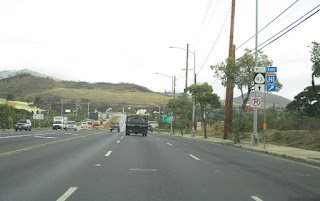
Hawaii Route 95 is an unsigned State Highway on the Island of O'ahu.  Hawaii Route 95 begins at Interstate H-1/Queen Liliuokalani Freeway Exit 1 near Makalio.  From Interstate H-1 the alignment Hawaii Route 95 follows Kalaeloa Boulevard 1.5 miles south and Makakole Street westward towards Barbers Point Harbor.  

This page is part of the Gribblenation Hawaii Roads series.  A compellation of all Hawaii-related media from both Gribblenation and RoadwayWiz can be found by clicking here


Part 1; the history Hawaii Route 95

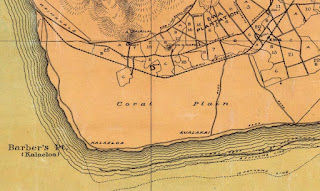
During October 1795 British Sea Captain Henry Barber was leading a trading voyage to China on the ship known as the Arthur.  After resupplying in Waikiki, the Arthur set sail westward for Kaua'i.  While rounding O'ahu the Arthur wrecked on a reef which led to the death of six of the crewmembers.  The remaining fifteen crew of the Arthur made it ashore at what came to be known as Barbers Point.  Barbers Point is known as Kalaeloa in Hawaiian and can be seen on the 1899 J.T. Taylor Map of O'ahu.
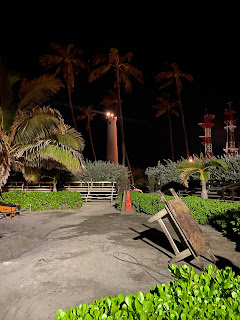
In 1888 a lighthouse was built at Barbers Point as a navigational aid.  The original Barbers Point Lighthouse was replaced by the current structure in 1933.  The second Barbers Point Lighthouse was automated in 1964 and is accessible from Barbers Point Beach Park. 
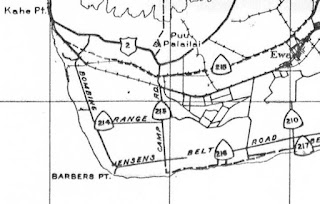
During World War II the territory of Hawaii saw an influx of military activity following the attack on Pearl Harbor on December 7th, 1941.  Numerous Military Routes and early Hawaii Routes were signed through the Hawaiian Territory to aid military personnel in navigating the islands.  Military Highways were assigned US Route style shields whereas lesser highways were assigned an early variation of what is now the Hawaii Route Spade.  A 1946 Army Map of the Island of O'ahu shows Hawaii Route 215 (following Camp Road) and Hawaii Route 214 over the general corridor of modern Hawaii Route 95 within the ranges of Naval Air Station Barbers Point.  Naval Air Station Barbers Point had been opened by the United States Navy during 1943.  A full version of the 1946 Army Map of O'ahu can be seen on hawaiihighways.com here.  

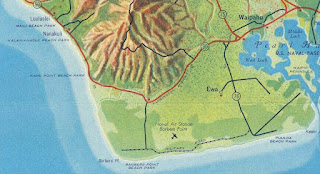
Circa 1955 following the conclusion of World War II the United States Bureau of Public Roads renumbered the Hawaii Route System.  The 1955 Hawaii Route renumbering saw most of the conventions utilized by the current Hawaii State Route System established.  Primary Hawaii Routes were given two digit numbers whereas Secondary Hawaii Routes were given three digit numbers.  The Hawaii Routes were assigned in sequence for what Island/County they were located on coupled with what Federal Aid Program number they were tied to.  In the case of O'ahu the Island was assigned numbers in the range of 60-99.  World War II era Hawaii Route 215 and Hawaii Route 214 were not given new 1955 era designations.  Barbers Point can be seen on the 1959 Gousha Map of Hawaii being accessible only via a military road from Naval Air Station Barbers Point.  

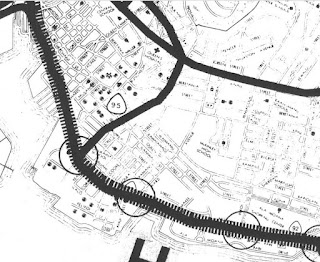
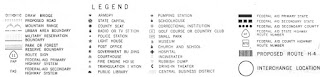
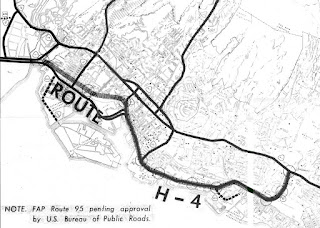
Conceptually Hawaii Route 95 was first proposed as a Federal Aid Primary Program in downtown Honolulu which can be seen in the Interstate H-4 proposal document titledProposed Route H-4.  The original Hawaii Route 95 proposal would have followed the general corridor of South Street north from proposed Interstate H-4 to Interstate H-1/Luanlilo Freeway.  

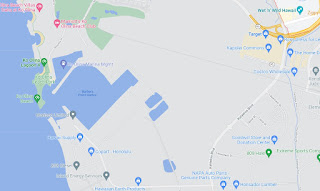
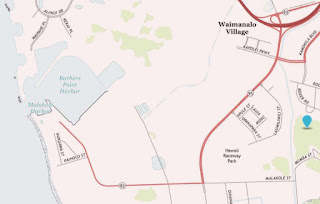
The Barbers Point Deep Draft Habor was completed by the United State Army Corps of Engineers during 1985 at a cost of $59,000,000 dollars.  Naval Air Station Barbers Point was closed during 1999 as part of the Base Realignment and Closure Acts of the 1990s.  Barbers Point Harbor was subsequently turned over to the State of Hawaii.  The transfer of Barbers Point Harbor saw it converted to commercial usage via which led to the emergence of the current Hawaii Route 95.  Hawaii Route 95 (Hawaii Route 93 is shown in error on Malakole Street) can be seen on the 2013 USGS Map of Barbers Point.
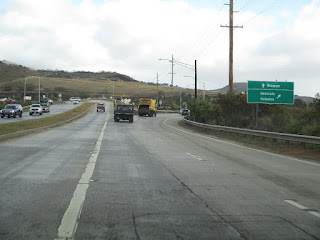
Part 2; a drive on Hawaii Route 95

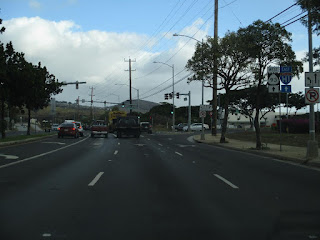
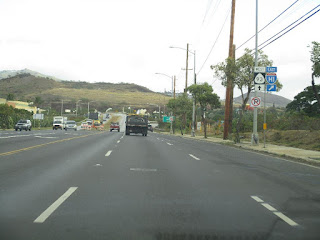
Below Hawaii Route 95 can be seen headed eastbound via Kalaeloa Boulevard from Malakole Street to Interstate H-1/Queen Liliuokalani Freeway.


During May of 2019 Dan Murphy of the Roadwaywiz Channel and Gribblenation featured real-time drives on Hawaii Route 95.  Below Hawaii Route 95 can be viewed westbound. 


Below Hawaii Route 95 can be viewed eastbound.


Comments

Popular posts from this blog

Crescent City Connection (New Orleans, LA)

The Crescent City Connection is a massive dual-span steel truss bridge that spans the lower Mississippi River at downtown New Orleans, about 95 river miles upstream from the mouth of the great river at the Head of Passes Light. If counted as a single bi-directional highway bridge, the parallel spans combine to form the single busiest bridge on the Mississippi River and its importance as a linchpin in the region’s transportation network cannot be overstated. While there have been various schemes over the years to construct bridges downriver from Algiers Point, this bridge has been the southernmost bridge on the Mississippi River since its initial construction in the 1950s. The years immediately following the end of World War II were a transformational period in the history of New Orleans. Already one of the great economic and cultural centers of the American Deep South, it was recognized at this time that major changes and improvements to the city’s transportation infrastructure would b...

Old US Route 99 through Tipton, Tulare, and Tagus Ranch

This summer I had a look into the alignment history of US Route 99 through the Tulare County communities of Tipton, Tulare, and Tagus Ranch.  While this slab below might seem like much it is one of the few remaining reminders of how US Route 99 was during the 1920s in Tulare County. This blog is part of the larger Gribblenation US Route 99 Page.  For more information pertaining to the other various segments of US Route 99 and it's three-digit child routes check out the link the below. Gribblenation US Route 99 Page Part 1; the history of US Route 99 in Tipton, Tulare, and Tagus Ranch Tipton and Tulare were both founded in 1872 as sidings of the Southern Pacific Railroad.  The Southern Pacific Railroad laid the groundwork for development of southern San Joaquin Valley.  Previous to the Southern Pacific Railroad travel via wagon or foot in Central California tended to avoid San Joaquin Valley in favor of the Stockton-Los Angeles Road.  The Stockton Los Ange...

Former US Route 101 and California State Route 41 through Paso Robles

Paso Robles is a city located on the Salinas River of San Luis Obispo County, California.  As originally configured the surface alignments of US Route 101 and California State Route 41 converged in downtown Paso Robles.  US Route 101 originally was aligned through Paso Robles via Spring Street.  California State Route 41 entered the City of Paso Robles via Union Road and 13th Street where it intersected US Route 101 at Spring Street.  US Route 101 and California State Route 41 departed Paso Robles southbound via a multiplex which split near Templeton.   Pictured above is the cover of the September/October 1957 California Highways & Public Works which features construction of the Paso Robles Bypass.  Pictured below is the 1935 Division of Highways Map of San Luis Obispo County which depicts US Route 101 and California State Route 41 intersecting in downtown Paso Robles.   Part 1; the history of US Route 101 and California State Route 41 i...