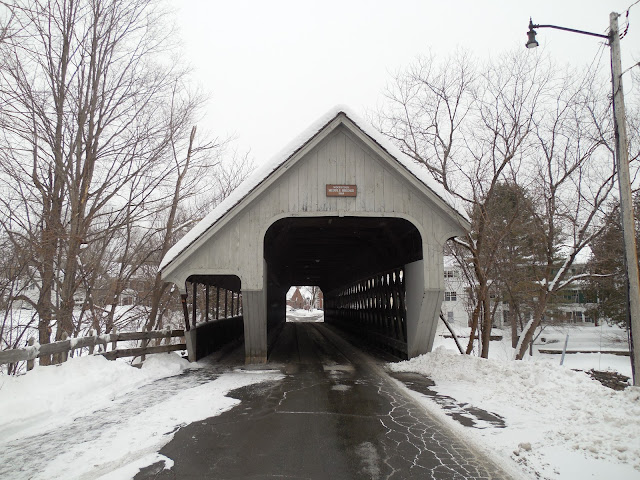
Middle Covered Bridge - Woodstock, Vermont


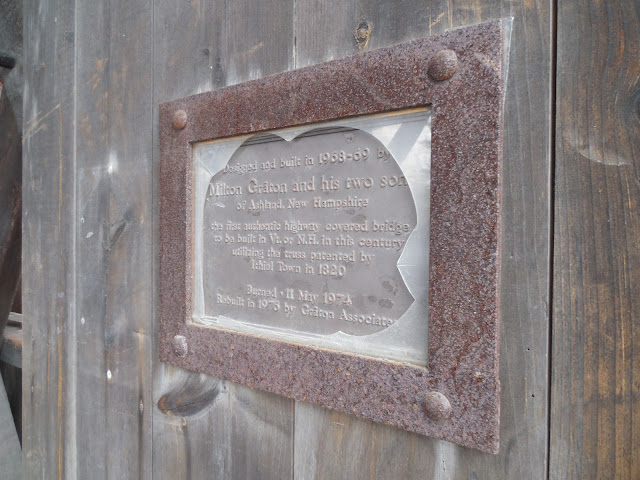
The Middle Covered Bridge spans over the Ottaquechee River as the centerpiece bridge of Woodstock, Vermont, just a stone's throw away from the downtown business district. Built in 1969 by Milton S. Graton and his sons (now Arnold M. Graton Associates), the 181 foot long covered bridge was designed in a Town lattice through truss design and replaced an iron truss bridge called the Middle Bridge that had been rendered obsolete.

The Middle Covered Bridge is the first public covered bridge built in the State of Vermont since 1889. Builder Milton Graton constructed this masterpiece near the crossing, then in July 1969, it was pulled across the river by a team of oxen named Ben and Jo. The covered bridge was built using traditional methods and materials down to the wooden pegs in lieu of nails. Details of the construction of the Middle Covered Bridge can also be found in a book written entitled The Last of the Covered Bridge Builders by covered bridge builder Milton Graton.

The covered bridge was burned by arsonists on May 11, 1974. Fortunately, Milton Graton came to the rescue and was able to restore the covered bridge. Today, the bridge can be enjoyed by drivers and pedestrians alike, especially with its separate portals for pedestrian traffic. Visitors to the bridge will notice that while most of the bridge has a stained wood look, the north entrance to the bridge has been painted a white or light gray color. The covered bridge has a nice view in the background of Mount Tom, which was once a ski area. When I visited the Middle Covered Bridge during a snowy New England day, I definitely got the classic vibes of the Vermont of yore. I think it blends perfectly with its surroundings.
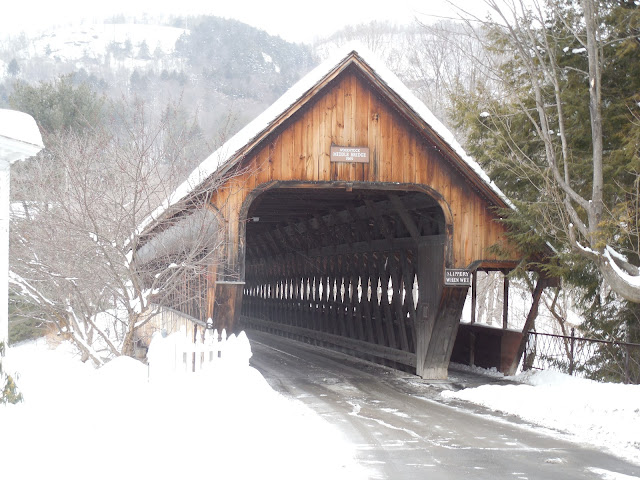
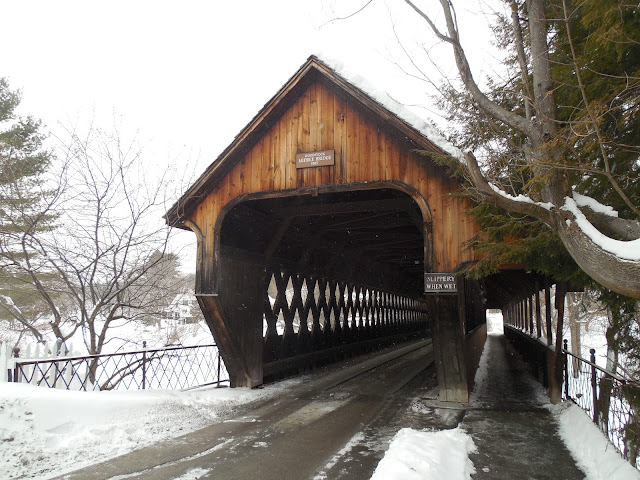
South entrance of the Middle Covered Bridge.

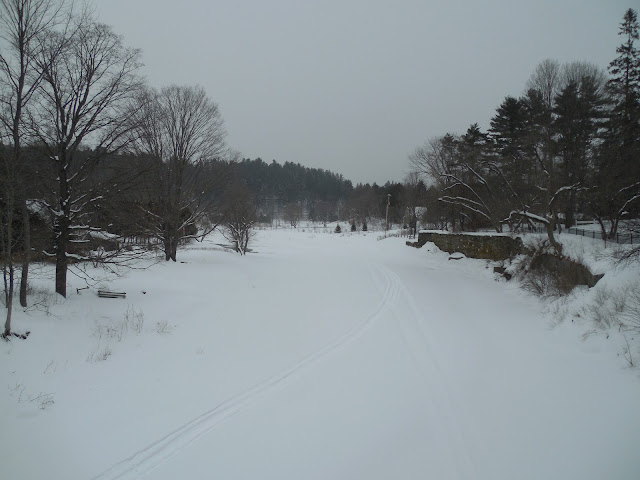
An icy, snowy Ottaquechee River, apparently with ice thick enough to run tracks along the river.

Bridge plaque.

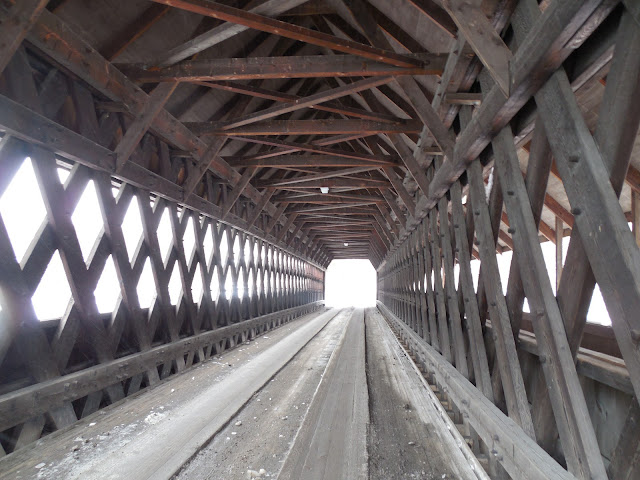
Inside the covered bridge. The open Town lattice design allows the light to come into the bridge.

A parting shot of the Middle Covered Bridge.


How to Get There:


Sources and Links:
The Travels of Tug 44 - Middle Covered Bridge
Bridgehunter.com - Middle Covered Bridge 45-14-15
Vermont Covered Bridge Society - Middle Covered Bridge
Woodstock, Vermont - 4 covered bridges that epitomize Vermont charm: A visual tour

Comments

Popular posts from this blog

Crescent City Connection (New Orleans, LA)

The Crescent City Connection is a massive dual-span steel truss bridge that spans the lower Mississippi River at downtown New Orleans, about 95 river miles upstream from the mouth of the great river at the Head of Passes Light. If counted as a single bi-directional highway bridge, the parallel spans combine to form the single busiest bridge on the Mississippi River and its importance as a linchpin in the region’s transportation network cannot be overstated. While there have been various schemes over the years to construct bridges downriver from Algiers Point, this bridge has been the southernmost bridge on the Mississippi River since its initial construction in the 1950s. The years immediately following the end of World War II were a transformational period in the history of New Orleans. Already one of the great economic and cultural centers of the American Deep South, it was recognized at this time that major changes and improvements to the city’s transportation infrastructure would b...

Old US Route 99 through Tipton, Tulare, and Tagus Ranch

This summer I had a look into the alignment history of US Route 99 through the Tulare County communities of Tipton, Tulare, and Tagus Ranch.  While this slab below might seem like much it is one of the few remaining reminders of how US Route 99 was during the 1920s in Tulare County. This blog is part of the larger Gribblenation US Route 99 Page.  For more information pertaining to the other various segments of US Route 99 and it's three-digit child routes check out the link the below. Gribblenation US Route 99 Page Part 1; the history of US Route 99 in Tipton, Tulare, and Tagus Ranch Tipton and Tulare were both founded in 1872 as sidings of the Southern Pacific Railroad.  The Southern Pacific Railroad laid the groundwork for development of southern San Joaquin Valley.  Previous to the Southern Pacific Railroad travel via wagon or foot in Central California tended to avoid San Joaquin Valley in favor of the Stockton-Los Angeles Road.  The Stockton Los Ange...

Former US Route 101 and California State Route 41 through Paso Robles

Paso Robles is a city located on the Salinas River of San Luis Obispo County, California.  As originally configured the surface alignments of US Route 101 and California State Route 41 converged in downtown Paso Robles.  US Route 101 originally was aligned through Paso Robles via Spring Street.  California State Route 41 entered the City of Paso Robles via Union Road and 13th Street where it intersected US Route 101 at Spring Street.  US Route 101 and California State Route 41 departed Paso Robles southbound via a multiplex which split near Templeton.   Pictured above is the cover of the September/October 1957 California Highways & Public Works which features construction of the Paso Robles Bypass.  Pictured below is the 1935 Division of Highways Map of San Luis Obispo County which depicts US Route 101 and California State Route 41 intersecting in downtown Paso Robles.   Part 1; the history of US Route 101 and California State Route 41 i...