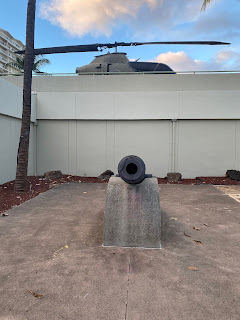
Kalākaua Avenue, Honolulu

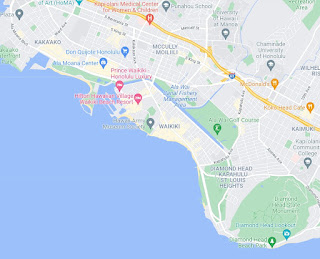
Kalākaua Avenue ("Kalakaua Avenue") is a major city street in the City of Honolulu on the Hawaiian island of O'ahu.  Kalakaua Avenue originates in the neighborhood of Makiki near Interstate H-1.  Kalakaua Avenue follows a generally eastward course through McCully-Moiliili over the Ala Wai Canel into Waikiki.  Kalakaua Avenue through Waikiki is generally a one-way through road which terminates near Diamond Head Crater.

This page is part of the Gribblenation Hawaii Roads series.  A compellation of all Hawaii-related media from both Gribblenation and RoadwayWiz can be found by clicking here


Part 1; a brief history of Kalākaua Avenue 

What is now Kalakaua Avenue has been the main point of entry into Waikiki since the 19th Century when it was known as Waikiki Road.  Stage service opened for service on Waikiki Road during 1868 which was replaced by a horse driven tramcar system in 1888.  Below Waikiki Road can be seen on the 1881 C.J. Lyons Map of O'ahu.

Waikiki Road can be seen as the main highway through Waikiki on the 1899 J.T. Taylor Map of O'ahu.
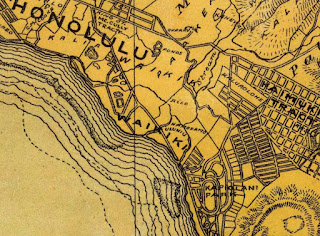

During 1901 electric trolley service opened on Waikii Road.  Waikiki Road was renamed during 1908 to Kalakaua Avenue in honor of the last King of Hawaii Kalākaua.  Kalakaua Avenue modernized significantly upon the completion of the Ala Wai Canal in 1928.  The Ala Wai Canal shunted stream run off into Waikiki which allowed it to transform from a wet land into the tourism district of Honolulu.  

During World War II the territory of Hawaii saw an influx of military activity following the attack on Pearl Harbor on December 7th, 1941.  Numerous Military Routes and early Hawaii Routes were signed through the Hawaiian Territory to aid military personnel in navigating the islands.  Military Highways were assigned US Route style shields whereas lesser highways were assigned an early variation of what is now the Hawaii Route Spade.  A 1946 Army Map of the Island of O'ahu Kalakaua Avenue in Waikiki was assigned as part of Hawaii Route 101.  Kalakaua Avenue was an important military connector due to the presence of Fort DeRussy in Waikiki and Fort Ruger at Diamond Head Crater.  


Circa 1955 following the conclusion of World War II the United States Bureau of Public Roads renumbered the Hawaii Route System.  The 1955 Hawaii Route renumbering saw most of the conventions utilized by the current Hawaii State Route System established.  Primary Hawaii Routes were given two digit numbers whereas Secondary Hawaii Routes were given three digit numbers.  The Hawaii Routes were assigned in sequence for what Island/County they were located on coupled with what Federal Aid Program number they were tied to.  In the case of O'ahu the Island was assigned numbers in the range of 60-99.  Kalakaua Avenue was not retained as a Hawaii Route and did not receive a new designation.  Kalakaua Avenue can be seen on the 1959 Shell Highway Map of Hawaii without a Hawaii Route designation.  


Part 2; exploring Kalākaua Avenue 

From Interstate H-1 traffic is directed to use Exit 23 onto Punahoa Street to reach Waikiki.


From Punahoa Street southbound traffic can access Kalakaua Avenue by turning west onto Beretania Street.  From westbound Beretania Street traffic can access Kalakaua Avenue southbound.  


Kalakaua Avenue southbound passes through Makiki and McCully-Moiliili to the Ala Wai Canal into Waikiki.  


Within Waikiki southbound Kalakaua Avenue becomes a one-way street and intersects Hawaii Route 92 at Ala Moana Boulevard at Fort DeRussy.  


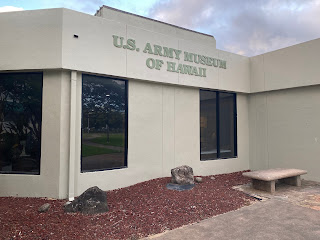
The Fort DeRussy Military Reservation in Waikiki is under the jurisdiction of the U.S. Army but functions more as a park during modern times.  Fort DeRussy was originally constructed during 1911 along with Battery Randolph.  Battery Randolph now houses the U.S. Army Museum of Hawaii.


From Fort DeRussy Beach one can see how much Diamond Head Crater towers of Waikiki.  


Kalakaua Avenue has several all-way pedestrian crossings such as the one below at Lewers Street.


Featured below is a Blue Stop Sign seen at Lauula Street and Lewers Street just east of Kalakaua Avenue. Blue Stop Signs are typically seen in Hawaii on private drives given the State prohibits official looking signage.


Kalakaua Avenue southbound at Royal Hawaiian Center Avenue.


Part 3; Roadwaywiz
Kalākaua Avenue

During June of 2019 Dan Murphy of the Roadwaywiz Youtube Channel (and Gribblenation) featured real-time drives on Kalakaua Avenue. Below Kalakaua Avenue can be viewed headed eastbound during the daytime.


Below Kalakaua Avenue can be viewed headed eastbound during the nighttime.


Comments

Popular posts from this blog

Did Caltrans just kill the G26 cutout US Route shields?

The US Route System was formally created by the American Association of State Highway Officials during November 1926.  Through the history of the system the only state to which has elected to maintain cutout US Route shields has been California.  The G26 series cutout US Route shields have become a favorite in the road enthusiast hobby and are generally considered to be much more visually pleasing than the standard Federal Highway Administration variant.  However, the G26 shield series appears to have been killed off on January 18, 2026, when Caltrans updated their Manual of Uniform Traffic Control Devices.  This blog will examine the history of the US Route shield specifications in California and what is happening with the 2026 changes.  The blog cover photo is facing towards the terminus of California State Route 136 and at a G26-2 specification US Route 395 shield.  In the background Mount Whitney can be seen in the Sierra Nevada range.   ...

May 2023 Ontario Trip (Part 3 of 3)

  Over the years, I have made plenty of trips to Ontario, crisscrossing the southern, central and eastern parts of the province. Living in Upstate New York, it's pretty easy to visit our neighbor to the north, or is that our neighbor to the west? Ottawa is one of my favorite cities to visit anywhere in the world, plus I've discovered the charm of Kingston, the waterfalls of Hamilton (which is on the same Niagara Escarpment that brings us Niagara Falls), the sheer beauty of the Bruce Peninsula, and more. But I hadn't explored much of Cottage Country. So I decided to change that, and what better time to go than over Memorial Day weekend, when the daylight is long and I have an extra day to explore. On the third and final day of my trip, I started in Huntsville and made my way through Muskoka District and Haliburton County, passing by many lakes along the way. I stopped in towns such as Dorset, Haliburton and Bancroft before making a beeline down to Belleville and then over th...

Ghost Town Tuesday; Nichols, FL

A couple years ago I spent a lot of spare time exploring phosphate mining ghost towns in the Bone Valley of Polk County, Florida.  One ghost town in particular called Nichols on Polk County Route 676 west of Mulberry caught my eye due to a relative lack of documentation on ghosttowns.com. Nichols was created in 1905 during the early phosphate mining boom in the Bone Valley region.  For the time Nichols was unusual since it had company housing in the Nichols Mine site and private residences outside the gate.  Nichols is only about two miles west of Mulberry which probably made it a somewhat reasonable commute even by the wonky standards of the early 20th Century.  Most of the Bone Valley region was relatively remote which made commuting or homesteading impractical which is why there are so many ghost towns in the area.  The company housing section of Nichols was phased out and abandoned by 1950. The Nichols town site is largely abandoned and could "possibl...