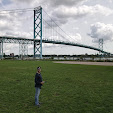

Like the expansion of the railroads the
previous century, the modernization of the country’s highway infrastructure in the early and mid 20th Century required the construction of new landmark bridges along the lower Mississippi
River (and nation-wide for that matter) that would facilitate the expected
growth in overall traffic demand in ensuing decades. While this new movement had been
anticipated to some extent in the Memphis area with the design of the Harahan
Bridge, neither it nor its neighbor the older Frisco Bridge were capable of accommodating
the sharp rise in the popularity and demand of the automobile as a mode of
cross-river transportation during the Great Depression. As was the case 30 years prior, the solution in the
1940s was to construct a new bridge in the same general location as its
predecessors, only this time the bridge would be the first built exclusively
for vehicle traffic. This bridge, the Memphis & Arkansas Bridge, was
completed in 1949 and was the third in the series of bridges completed across
the lower Mississippi River at Memphis.
Planning for this new bridge began in earnest in 1939 with
the creation of a bi-state bridge commission chaired by Memphis political boss
E.H. Crump. Crump, who had served as the Mayor of Memphis in the 1910s, envisioned the new bridge being a central piece in a larger postwar highway and
boulevard system for the city. The construction of the connecting boulevard
that carries his name and runs eastward from the Memphis approach was among the
first of these new highway projects to be built in the city that would
transform the transportation system of southwestern Tennessee.
Construction on the bridge began in 1945, a matter of weeks after the official end of World War II. As was the case when the Harahan Bridge was built 30 years prior, the proportions and span lengths of this third bridge were required to be kept in line with the bridges immediately upriver so that the piers of all three bridges would line up in the river navigation channels and reduce the hazard to on-water traffic. This limitation led the design engineering firm Modjeski & Masters (the firm founded by famed American civil engineer Ralph Modjeski, who was the chief designer of the nearby Harahan Bridge) to utilize the familiar steel truss superstructure design already demonstrated successfully with the previous two structures at this location.

Edward Hull (E.H.) Crump Jr. (1874-1954) was the political "boss" of Memphis for much of the first half of the 20th Century and his influence extended to the planning of the city's highway & bridge projects on the Mississippi River, such as the Harahan and Memphis & Arkansas Bridges.
The new Memphis & Arkansas Bridge carried its first
traffic on December 17, 1949. The bridge’s deck carries four lanes for vehicle traffic,
and it also includes raised sidewalks on the north and south sides of the
structure, although these are considered hazardous and are officially not in
use as of 2024. The bridge has carried portions of a few US Highways over the
course of its lifespan. Currently, the bridge is part of US Highways 61, 64,
70, and 79. It also marks the western terminus of the Memphis-to-Bristol
Highway, Tennessee’s first state highway (and signed east of Memphis as TN
Highway 1), which is the state’s single longest highway designation at nearly
550 miles in length. The bridge became part of the Interstate 55 corridor in
1967, a critical long-distance freeway for traffic between the cities of
Chicago, St. Louis, Memphis, and New Orleans. In order to accommodate the
growth in vehicle traffic across the Mississippi River and the Memphis area in
general throughout the 1950s & 60s, construction of a fourth bridge across
the river at Memphis commenced at about this time and was completed in 1973 as
the Hernando de Soto Bridge, which carries Interstate 40 across the Mississippi
a couple miles upriver from this location, closer to downtown Memphis.
There are a couple recent developments that will impact the
short and long-term future of this bridge. The Tennessee Department of
Transportation is in the process of reconstructing the antiquated interchange
between Interstate 55, E.H. Crump Boulevard, and Riverside Drive at the Memphis
approach to the bridge. This $140 million project, which includes high-speed
flyovers for interstate highway traffic and a reconstructed roundabout for
traffic utilizing the local streets, began construction in 2022 and is planned
for completion in 2025. In December 2023, TDOT and their counterparts in Arkansas
announced plans to replace this bridge with a new structure, with construction commencing
as early as 2026. The existing bridge falls well short of modern standards in
terms of its roadway dimensions and has long been a substandard weak link in
the I-55 corridor across the region. With the recent realization of the potential
of the New Madrid Seismic Zone, this bridge is considered vastly ill-equipped
to withstand earthquakes that this fault system could unleash in the future.
With these considerations in mind, replacement of this bridge has become a
priority project, as it should. The existing bridge helped transform the
Memphis area into a hub of automobile travel just like how its neighboring
bridges had the same impact on the city from a railroad transportation point of
view. While the Memphis & Arkansas Bridge was invaluable in serving the
region’s cross-river traffic demands in recent decades, the future lies with
the construction of a new bridge that can better accommodate the demands of the
busy Interstate 55 corridor and southwestern Tennessee for decades to come.
The following photos from my visits to the Memphis & Arkansas Bridge showcase various vantage points from ground level on the Mississippi Riverfront in Memphis, TN. Notice the proximity of the Frisco Bridge and Harahan Bridge immediately upriver. Click on each photo to see a larger version.


Further Reading:
Memphis & Arkansas Bridge by John Weeks
Memphis & Arkansas Bridge at historicbridges.org
Bridges, Crossings, and Structures of the Lower Mississippi River
Next Crossing upriver: Frisco Bridge (Memphis, TN)
Next Crossing downriver: Helena Bridge (Helena-West Helena, AR)
Visit the Mississippi River Bridges of Memphis Overview Page
Return to the Bridges of the Lower Mississippi River Home Page
__________________________________________________
Comments