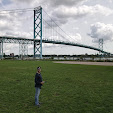

The lower Mississippi River is lined with important
landmarks that help trace the history and development of civil engineering across
the Mississippi Delta. One such example is the Frisco Bridge, which spans the
lower Mississippi River at Memphis, TN. Built in 1892, this was the first
bridge attempted and completed across the lower Mississippi (and the first completed on the river south of St. Louis) and its completion
ushered in a new era of expansion and prosperity for the railroads of the
southern United States.
Construction of the bridge commenced in 1888, with the
Kansas City, Fort Scott, and Memphis Railway serving as the principal client
railroad. The entire structure stretches about one mile in length and features a steel truss superstructure about
½ mile long with its longest span over the river being 790 ft. It was one of
America’s longest steel bridges at the time and it demonstrated that
large-scale projects on imposing waterways like the lower Mississippi River
were in fact possible.
The new Memphis Bridge cost about $3 million to build and it
carried its first train on May 12, 1892. The KCFS&M Railroad operated on
the bridge until it was acquired by the St. Louis – San Francisco Railway in
1901. This railroad, known nationally as the “Frisco” railroad, gave their name
to the Memphis Bridge shortly thereafter and the name has applied ever since. (This
became important to distinguish this bridge from its neighboring structures as
more bridges were built across the river in the ensuing decades.) The SLSF
Railroad was absorbed into what is now the Burlington Northern – Santa Fe
Railroad in 1980 and that railroad is the primary carrier that uses the bridge
today.
The huge success of what became known as the “Great Bridge
at Memphis” led to the planning and construction of other railroad bridges on
the lower Mississippi River in the ensuing decades. It also led railroad
planners to begin considering the construction of a second bridge at Memphis,
as the amount of traffic using the bridge overwhelmed its single track within only
a few years. This parallel bridge was completed just upriver in 1916 as the
Harahan Bridge, which itself continues to carry rail traffic over the river
more than 100 years after its construction. Upon the completion of the Harahan
Bridge, all non-railroad traffic was banned from the Frisco Bridge and this has
remained the case ever since.
The chief engineer of the “Memphis Bridge” project was George
S. Morison, a civil engineer who was well known in the late 19th
Century mainly for the many railroad bridges he oversaw the construction of,
particularly along the Missouri, Ohio, and upper Mississippi Rivers. The
completion of the Memphis Bridge represented his single greatest achievement
and the fame and notoriety that went along with it led to him serving as the
President of the American Society of Civil Engineers (ASCE) and being appointed
by President William McKinley to the Isthmian Canal Commission in 1898. This
group led the initial feasibility studies for the construction of a canal
connecting the Pacific Ocean with the Caribbean Sea. Morison was instrumental
in influencing the Commission’s finding that the canal be built across Panama
as opposed to neighboring Nicaragua. The rest, as they say, is history.

George S. Morison (1842-1903)
The Frisco Bridge remains a very active railroad bridge
today as it serves in tandem with the adjacent Harahan Bridge to handle all cross-river
rail traffic in the Memphis area. The bridge was designated as a National Civil
Engineering Landmark in 1987. In recent years, the character of this bridge has
changed somewhat, not necessarily for the better. The western approach trestle,
which had consisted of 52 individual spans that totaled about ½ mile long, was completely
replaced in a project that concluded in 2017. This utilitarian structure is a
far cry from the intricate appearance of its predecessor; however, this massive
project was undertaken with the aim of extending the useful life of the bridge
and ensuring that it will be a viable river crossing for at least the next few
decades. In that respect, I cannot argue with the goal of the project and am
glad to see that this bridge will continue to be a key piece of the
transportation puzzle in the region for years to come.
The following photos from my May 2019 visit to the Frisco Bridge showcase various vantage points from ground level on the Mississippi Riverfront in Memphis, TN. Notice the proximity of the Harahan Bridge immediately upriver and the Memphis & Arkansas Bridge immediately downriver. Click on each photo to see a larger version.


How To Get There:
Further Reading:
Frisco Bridge at historicbridges.org
Frisco Bridge by John Weeks
Bridges, Crossings, and Structures of the Lower Mississippi River
Next Crossing upriver: Harahan Bridge/"Big River Crossing" (Memphis, TN)
Next Crossing downriver: Memphis & Arkansas Bridge (Memphis, TN)
Visit the Mississippi River Bridges of Memphis Overview Page
Return to the Bridges of the Lower Mississippi River Home Page
__________________________________________________
Comments