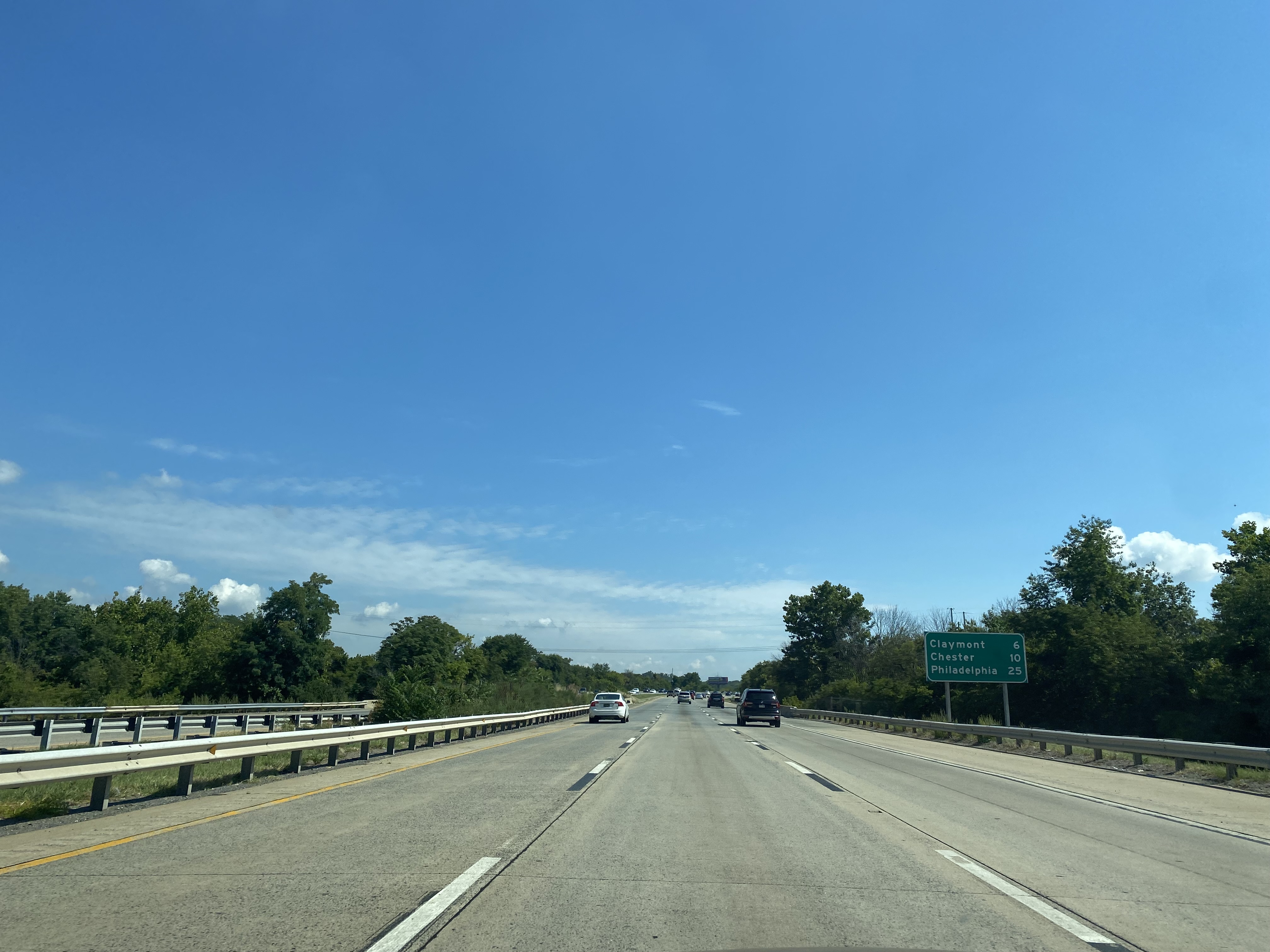
Interstate 495 in Delaware


Interstate 495 within Delaware is a 11.47-mile auxiliary of Interstate 95 and bypass of downtown Wilmington.  Interstate 495 opened during 1977 and between 1978-1980 briefly served as mainline Interstate 95 while the South Wilmington Viaduct was being reconstructed.  Interstate 495 in addition to bypassing downtown Wilmington serves as access to the Port of Wilmington.  


Part 1; the history of Interstate 495

During 1948 the Wilmington Transportation Study proposed two limited access corridors to connect from Wilmington to the Pennsylvania State Line.  The first corridor would have followed what is now Interstate 95 (Plan A) whereas the second followed what is now modern Interstate 495 (Plan B) as a bypass of Wilmington.  By 1950 Plan A was selected as a limited access corridor from downtown Wilmington to the Pennsylvania State Line.  

On June 29th, 1956, the Federal Highway Aid Act of 1956 was signed into law on the Federal Level.  The Federal Highway Aid Act of 1956 was the genesis point of the Interstate Highway System and established the corridor of Federal Aid-Interstate #3.  Federal Aid-Interstate #3 would go through the process of design during 1960 and be assigned the designation of Interstate 495 during 1962.  

Construction of Interstate 495 would commence during 1968.  The Christina River Bridge would be completed by 1975 and first completed segment of Interstate 495 between US Route 13 to Interstate 95 in Claymont would open during 1976.  During June 1977 the remainder of Interstate 495 would open to traffic. 

On June 28, 1978, the AASHTO approved realigning Interstate 95 onto Interstate 495.  Existing Interstate 95 through Wilmington was requested to be designated as Interstate 595.  The justification for moving Interstate 95 to Interstate 495 was the higher capacity of the then new freeway bypass which had been completed during 1977.  A secondary justification is noted to be the reconstruction of Interstate 95 through Wilmington.  The designation of existing Interstate 95 through Wilmington as Interstate 595 was deferred by the AASHTO in favor of designating a suggested even numbered three-digit Interstate. 


What had been Interstate 95 through Wilmington was approved to be signed as Interstate 195 and Interstate 395 by the AASHTO on October 27, 1978.  Interstate 395 was to be designated from US Route 202 in Wilmington to what had been the Interstate 495 interchange near the Pennsylvania State Line.  Interstate 195 was to be designated from what was the southern Interstate 495 interchange to Delaware Route 141 in Wilmington.  


Interstate 195 and Interstate 395 through Wilmington were approved by the AASHTO to be renumbered to Interstate 895 on June 26, 1979.  


Interstate 95 was redesignated along the corridor of Interstate 895 by the AASHTO on November 15, 1980.  Likewise, the corridor Interstate 495 was restored to what had been briefly designated as Interstate 95.  The justification for restoring the corridor of Interstate 95 was that the project through Wilmington had been completed. 


During June 2014 the Christina River Bridge on Interstate 495 was closed for emergency repairs after tilting support columns were discovered.  The southbound lanes of Interstate 495 would reopen on July 31st whereas the northbound lanes would reopen on August 23th.  


Part 2; a drive on Interstate 495

South of Wilmington, Interstate 495 splits from northbound Interstate 95 via a right-hand transition.  Traffic headed to Philadelphia and the Port of Wilmington are directed onto Interstate 495. 


Traffic on Interstate 495 northbound is advised the Port of Wilmington is 2 miles away whereas Philadelphia is 30 miles.  Interstate 495 is named the Vietnam Veterans Memorial Highway. 


Interstate 495 northbound Exit 1 accesses US Route 13 Business in Wilmington. 


Interstate 495 northbound Exit 2 accesses Delaware Route 9A and the Port of Wilmington.  


Interstate 495 northbound crosses the Christina River Bridge and accesses 12th Street at Exit 3.  


Northbound Interstate 495 Exit 4 accesses Delaware Route 3 and US Route 13 in Edgemoor.


Interstate 495 northbound follows the shore of the Delaware River to Exit 5/US Route 13 in Claymont.  Interstate 495 terminates at Interstate 95 in Claymont approaching the Pennsylvania State Line.  


Comments

Popular posts from this blog

Grand Loop Road of Yellowstone National Park

  Grand Loop Road is a 140 mile loop highway which traverses the interior of Yellowstone National Park.  Grand Loop Road connects all of the major attractions and geological features of Yellowstone National Park along with the entrance roads.  Grand Loop Road is a seasonal highway and despite some conjecture never has been part of the US Route System.   Part 1; the history of Grand Loop Road The majority of history pertaining to Grand Loop Road was taken from the below National Park Service article: Historic Roads - Yellowstone National Park (U.S. National Park Service) (nps.gov) Yellowstone was declared the first National Park of the United States on March 1st, 1872.  The first real highway to access Yellowstone National Park came in 1873 when a tolled facility was constructed from Bozeman, Montana via Yankee Jim Canyon to Mammoth Hot Springs.  Numerous attempts were made to fund construction of roadway infrastructure during the early years of Yellows...

The last 1956-63 era California Sign State Route Spade?

Along southbound California State Route 170 (the Hollywood Freeway Extension) approaching the Hollywood Freeway/Ventura Freeway interchange a white California State Route 134 Sign State Route Spade can be observed on guide sign.  These white spades were specifically used during the 1956-63 era and have become increasingly rare.  This blog is intended to serve as a brief history of the Sign State Route Spade.  We also ask you as the reader, is this last 1956-63 era Sign State Route Spade or do you know of others?  Part 1; the history of the California Sign State Route Spade Prior to the Sign State Route System, the US Route System and the Auto Trails were the only highways in California signed with reassurance markers.  The creation of the US Route System by the American Association of State Highway Officials during November 1926 brought a system of standardized reassurance shields to major highways in California.  Early efforts to create a Sign State Route ...

California State Route 70; the Feather River Highway

From 2017 through to early 2019 I drove the majority of the California State Route 70; the Feather River Highway from CA 89 southwest to CA 99. CA 70 is an approximately 178.5 mile state highway which starts at US 395 near the Nevada State Line and travels west through the Feather River Canyon to CA 99.  CA 70 is often referred to as the Feather River Highway" given it's close association with the river.  Historically CA 70 was previously signed as US 40A and CA 24.  The Legislative Routes prior to the 1964 California Highway Renumbering that made up the current route of CA 70 are as follows: -  Legislative Route Number 21 from US 395 westward to Oroville. -  LRN 87 from Oroville south to Marysville. -  LRN 232 from Marysville to the current junction with CA 99.  CA 70 was even dual signed with CA 99 into Sacramento on what was LRN 232 for a time. The change from US 40A/LRN 21/LRN 87/LRN 232 can be seen by comparing the 1963 State Highway Ma...