Most visitors to Maui will visit the Hāna and Kīpahulu regions via Hāna Highway along the northern shores of the island. Another roadway known as Pi'ilani Highway follows the southern shoreline of Maui to the Kīpahulu area. Pi'ilani Highway is a 32.4-mile discontinuous highway which is comprised of Hawaii Route 31 and Maui County Route 31.
The state-maintained portion of Pi'ilani Highway is 7.2-miles long. The State Route segment begins at the junction of Hawaii Routes 310 and 311 in Kihei. From Kihei the State Highway tracks southward and terminates at Wailea Ike Drive.
The Maui County Route 31 portion of Pi'ilani Highway begins at the southern terminus of Hawaii Route 37 (Kula Highway) and follows the southeastern shore of Maui 25.2 miles to the beginning of Hāna Highway at Kalepa Gulch. The Maui County Route 31 portion of Pi'ilani Highway traverses the barren volcanic southern shores of Maui through the Kaupō area.
The modern origins of Pi'ilani Highway are tied to the completion of the Kalepa Gulch Bridge in 1937. The completion of this bridge permitted continuous automobile access to Kaupō via Kīpahulu and Hāna. Pi'ilani Highway was later linked with the Kula and Kihei areas when the road west of Kaupō to Ulupalakua was completed in 1951.
When the modern Hawaii Route System was created in 1955 the entirety of Pi'ilani Highway was designated as Hawaii Route 31. Pi'ilani Highway was originally continuous from Ulupalakua via a now inaccessible road to Makena. During the 1960s this connecting road would be dropped from the Hawaii State Highway System. It was during this era that the eastern segment of Pi'ilani Highway became Maui County Route 31.
Within Kihei the early alignment of Pi'ilani Highway was carried by South Kihei Road. The modern alignment of Hawaii Route 31 bypassing the business area of Kihei was constructed during the 1981-1990 era. Long term Hawaii Department of Transportation plans include linking the discontinuous segments of Pi'ilani Highway with an approximately 6-mile link between Kihei and Ulupalakua.
This page is part of the Gribblenation Hawaii Roads series. A compellation of all Hawaii-related media from both Gribblenation and RoadwayWiz can be found by clicking
here.
Part 1; the history of Pi'ilani HighwayPi'ilani Highway (Piilani Highway) is named in of honor the first Ali'nui (roughly "King" in English) of Maui. Pi'ilani was the first ruler to unite the entire Island of Maui under one king. Pi'ilani's son Kiha-a-Pi'ilani would go on to form much of the conceptual basis of Piilani Highway and Hāna Highway (Hana Highway).
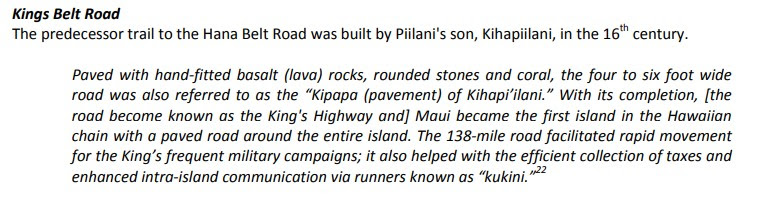
During the 16th Century a 138-mile belt road known as the King's Highway was constructed around the island perimeter under the direction Maui King Kiha-a-Pi'ilani. King's Highway was the paved with hand fitted lava rocks and was the first perimeter road on any Hawaiian Island. King's Highway was four to six feet wide and was intended to facilitate rapid foot travel around Maui.
The King's Highway and Pi'ilani Highway from Makena east to Kalepa Gulch largely occupy the same general corridor. Between Makena and Ulupalakua much of the King's Highway still exists and is located generally down slope from Piilani Highway. A primitive road connecting Makena to Hana via Kalepa Gulch appears on the
1906 F.S. Dodge Map of Maui.
Between 1908-1926 Hana was connected to Wailuku and Kahului during the construction of Hana Highway. Hana Highway was opened to Hana on December 18, 1926, following a procession of 200 cars. Hana Highway would continue to be modernized into the 1930s and formed a belt road around eastern Maui coupled with Piilani Highway.
Originally Piilani Highway did not have bridges as the route it inherited from the King's Highway was built as a foot path. The completion of the Alalele and Kalepa Bridges during
April 1937 connected Hana Highway to Piilani Highway at Kalepa Gulch. The new modern highway facilitated automotive access between
Kaupō (Kaupo) and the rest of Maui. In 1951 the corridor of Piilani Highway was constructed westward from Kaupo to Ulupalakua which made it possible to fully loop eastern Maui by automobile.
The Island of Maui was not part of the original World War II era Hawaii Route System. Circa 1955 the United States Bureau of Public Roads renumbered the Hawaii Route System. The 1955 Hawaii Route Renumbering saw most of the conventions utilized by the current Hawaii State Route System established. Primary Hawaii Routes were given two-digit numbers whereas Secondary Hawaii Routes were given three-digit numbers. The Hawaii Routes were assigned in sequence for what Island/County they were located on coupled with what Federal Aid Program number they were tied to. In the case of the Island of Maui it was assigned numbers in the range of 30-40.
Hawaii Route 31 be seen on the 1959 Gousha Highway Map of Hawaii. Hawaii Route 31 originated at Hawaii Route 30 (Honoapi'ilani Highway) near Maalaea. From Maalaea the path of Hawaii Route 31 tracked eastward via Kihei, Makena, Ulupalakua and
Kīpahulu (Kipahulu) to Hawaii Route 36 in Hana.
Hawaii Route 31 can be seen following the below alignment on the 1959 Gousha Highway Map:
- North Kihei Road to South Kihei Road.
- South Kihei Road to Makena Road.
- Makena Road through a once public road to the southern terminus of Hawaii Route 37 and Kula Highway.
- Piilani Highway to Hana Highway at Kalepa Gulch.
- Hana Highway to Keawa Place and Hawaii Route 36 in Hana.
The 1955 Hawaii Route System was applied with little regard to whether or not the territory or counties maintained the actual roadways. After Hawaii became a state the Hawaii Route System would be simplified through the much of the 1960s. Mileage not maintained by the State of Hawaii was subsequently spun off into Maui County Routes. The County Route shields of Hawaii functionally are the same as the Hawaii Route shield.
Much of Makena Road from Makena east to the junction of Hawaii Route 37 (Kula Highway) was recommended for inclusion into the State Highway System during
1967. The corridor of Makena Road was never adopted by the State of Hawaii which led to a gap between Hawaii Route 31 and Maui County Route 31 when the segment was closed during 1984 due to liability concerns.
In 1961 North Kihei Road was proposed to be reassigned as Hawaii Route 310. The proposed Hawaii Route 310 corridor included a proposed State Highway connection with the Maui County Route 31 portion of Piilani Highway. The proposed extension of Piilani Highway was shown to turn inland eastward from Keawakapu Beach.
The state-maintained portion of Piilani Highway on Hawaii Route 31 opened in stages. The first segment of the state-maintained portion of Piilani Highway opened between Hawaii Route 310 and North Kihei Road during April 1981. The state-maintained portion was extended south to Wailea Ike Drive was completed by June 1990. The current state-maintained portions of Piilani Highway shifted the corridor of Hawaii Route 31 east from South Kihei Road.
During March 2022 a Hawaii Department of Transportation roundabout project on Piilani Highway at Kulanihakoi Street broke ground. The roundabout provided access from Hawaii Route 31 to a new high school and was completed during 2023. The Kulanihakoi Street roundabout is located near the planned junction of Hawaii Route 374 and Hawaii Route 31 at Kaonoulu Street. If constructed Hawaii Route 374 would provide direct access to from Kihei to Pukalani and the Haleakalā Highway (Haleakala Highway) segment of Hawaii Route 37.
Part 2; a drive on the Hawaii Route 31 portion of Pi'ilani Highway
From the eastern terminus of Hawaii Route 310 (North Kihei Road) the Hawaii Route 31 portion of Piilani Highway begins with a right-hand turn southward.
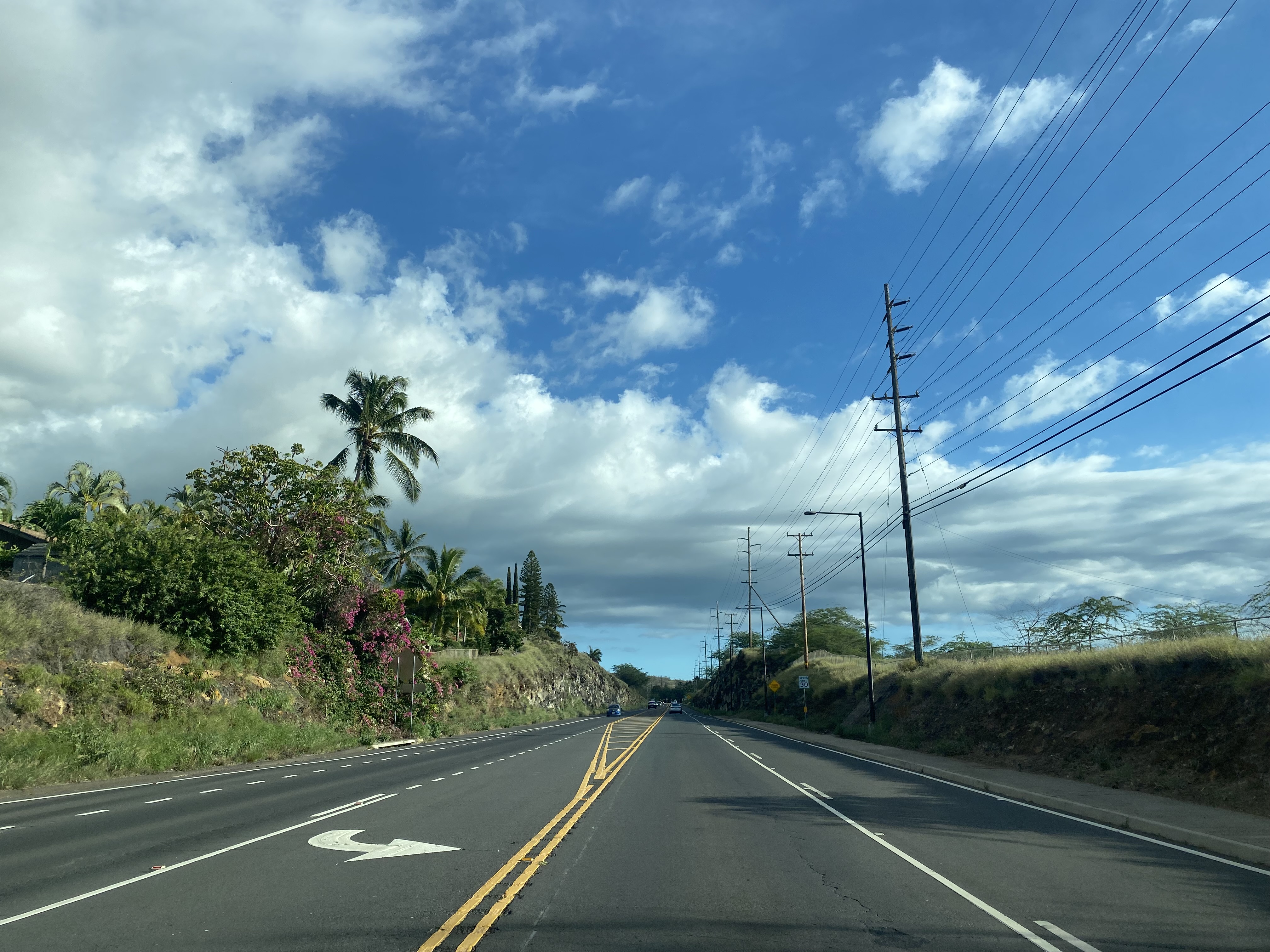
Hawaii Route 31 passes through Kihei and the Kulanihakoi Street project zone (photos from 2022).
Hawaii Route 31 continues southward into Wailea-Makena.
The Hawaii Route 31 portion of Piilani Highway terminates at Wailea Ike Drive.
Part 3; exploring former Hawaii Route 31 and Pi'ilani Highway on South Kihei Road
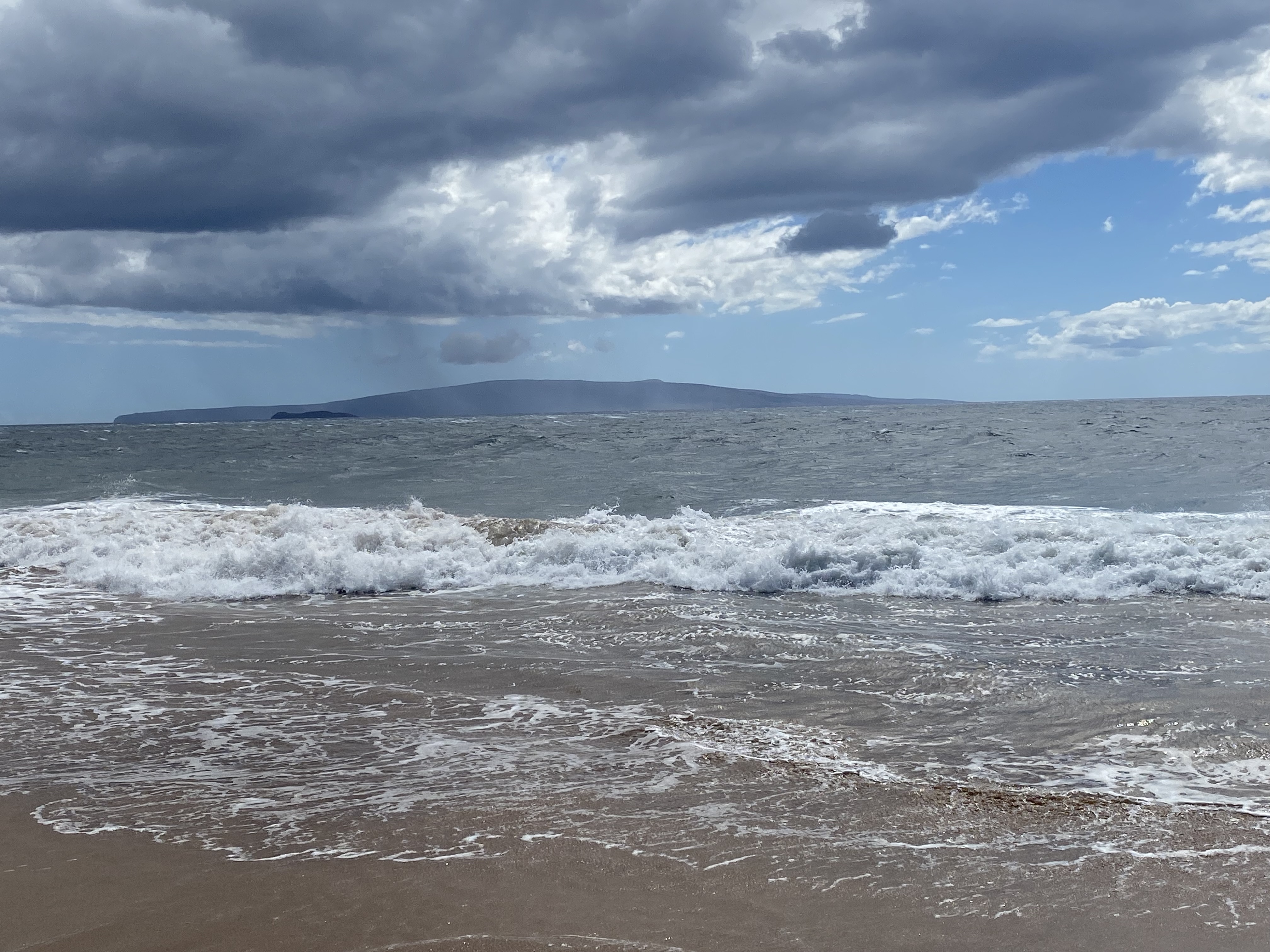
The former portions of Hawaii Route 31 on South Kihei Road are now lined by businesses and resorts. The Molokini Crater and Island of Kahoolawe are easily observed from the beaches on South Kihei Road. The below views are from Kamaole Beach Park facing southwest from South Kihei Road. Molokini Crater is thought to have erupted approximately 230,000 years ago. Kahoolawe is the smallest of the eight main Hawaiian Islands. Kahoolawe historically has been historically very dry and hosted a small population of Hawaiians until the 1940s. Kahoolawe and Molokini Crater were both once used as Naval munition and training grounds.
Numerous Maui County sourced Hawaii Route 31 shields can be found on the evacuation signs along South Kihei Road. These signs direct traffic to the state-maintained portion of Piilani Highway.
Several Hawaii Department of Transportation spec Hawaii Route 31 shields can also be found on South Kihei Road directing traffic to the state-maintained portion of Piilani Highway.
Kihei and South Kihei Road are among the most popular tourist districts on Maui. Numerous food truck events and car shows are a commonplace.
Part 4; the County Route 31 portion of Pi'ilani Highway
To my knowledge no rental car agency currently prohibits travel on the Maui County Route 31 portion of Piilani Highway. Conjecture via social media sources claim that rental car agencies don't permit access due to dirt covering broken asphalt east of Kaupo. This haggard segment of Piilani Highway is located roughly at Mile Markers 36-38.5 from Kaupo to the start of Hana Highway at Kalepa Gulch.
When I first arrived visited Maui in 2022 unfortunately Mile Markers 31-38 of Piilani Highway were inaccessible due to landslides. However, when I returned in 2026 the entire corridor was accessible to Kalepa Gulch. Moreso, the entire southern shore of Maui was a vibrant green due to plant growth spurred by heavy precipitation driven by Hurricane Lowell.
The Maui County Route 31 portion of Piilani Highway begins as Hawaii Route 37 (Kula Highway) terminates near Ulupalakua.
Traffic on Maui County Route 31 during November 2026 was advised of weekday construction closures ahead at Kalepa Gulch at Mile Marker 38.5. For my purposes this closure meant little as the entirety of Piilani Highway was accessible to the beginning of Hana Highway.
Mile Markers on the Maui County Route 31 don't make an appearance until Kanaio-Kalama Park Road. This junction serves as Mile Marker 16 and likely is a reference to the long term planned connection with Hawaii Route 31 out of Kihei.
The volcanic terrain of the southern shoreline becomes obvious as Maui County Route 31 tracks east of Mile Marker 16.
Maui County Route 31 begins to descend rapidly and narrows to a single lane at Kamole Gulch.
Maui County Route 31 crosses the Manawainui Gulch Bridge. The current span was constructed in 1993 and sees about 300 vehicles cross daily. The footing for the original bridge was never removed and can be easily observed.
The Manawainui Gulch Bridge from the eastern approach.
Maui County Route 31 crosses the Poopoo Gulch Bridge (insert joke here). This bridge was constructed in 1997 and apparently rapidly deteriorating.
Maui County Route 31 crosses the Waiopai Stream Bridge.
The Waiopai Stream Bridge was constructed in 1982. Looking westward from the bridge reveals the Pākōwai Sea Arch.
Maui County Route 31 crosses over Hawelewele Gulch via a gravel road grade. Signage warns travelers not to cross Hawelewele Gulch when water is topping the road. The former community of
Nu'u reportedly was once located here.
Maui County Route 31 passes through an of Haleakala National Park. Departing the park boundary the roadway briefly widens to two lanes.
Maui County Route 31 enters the community of Kaupo at Mile Marker 33.
When Polynesian settlement at Kaupo isn't fully clear. It was likely first settled around the same time as Kipahulu (1164-1384 A.D.). Historically Kaupo was part of the
1775 Battle of Kalaeokailio. Said battle was a continuation of a lengthy series of conflicts between Hawaii and Maui. The first census of Kaupo came in 1831-1832 when western missionaries counted approximately 3,220. This population figure is thought to have been significantly above 10,000 residents during the pre-contact period.
In 1862 Saint Joseph Church was plotted in Kaupo. The church is one of the scent pieces of evidence which suggest a much larger population. The 1910 census counted a population of approximately 350 residents. 19th century disease and economic opportunities in Wailuku are thought to have caused much of the population decrease. Currently the Kaupo area is thought to have approximately 100 full-time residents.
Maui County Route 31 passes through the central part of Kaupo. Traffic can access the road to the Kaupo Gap Trail just past the last residential building.
As Maui County Route 31 departs Kaupo it crosses the Manawainui Stream Bridge. This bridge was constructed in 1947.
Maui County Route 31 passes by Huailoah Church. This church was constructed in 1859 and is accessible via a high-clearance dirt road.
Maui County Route 31 degrades significantly beginning at Mile Marker 36. The highway hugs the coastal bluffs via mix of broken asphalt and top laying dirt. Piilani Highway terminates at Mile Marker 38.5 at Kalepa Gulch and Maui County Route 31 transitions onto Hana Highway.
Signage used to be present at Kalepa Gulch which marked the boundary between Piilani Highway and Hana Highway. This signage can be seen below as it was during October 1999 (
Oscar Voss of Hawaii Highways photos).
Version History
- Originally published on November 21, 2022.
- First updated on November 15, 2026.








Comments