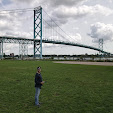

Located in the western fringes of the New Orleans
metropolitan area, the Hale Boggs Memorial Bridge spans the lower Mississippi
River in St. Charles Parish between the communities of Luling and Destrehan.
Completed in 1983, it’s an example of an early-age, primitive cable-stayed
bridge designed during a time when this type of bridge was only just beginning
to be well-understood and built with any frequency in the United States.
The New Orleans area grew rapidly in the years after World War II, as suburban sprawl encroached on the historically rural river parishes around the city. In response to the development of the region’s Westbank and the emergence of communities in St. Charles and St. John the Baptist Parishes as viable suburban communities during this period, regional planners began to consider the addition of multiple new bridges on the Mississippi River to serve this growing population. One of these bridges planned was intended to connect the east & west banks of the river in the growing western suburbs and was intended to serve as part of the regional freeway system. This new bridge was incorporated into a much larger New Orleans Bypass, sometimes referred to as the “Dixie Freeway”, which was intended to encircle the southern fringes of the metro area and serve as a relief route for the major suburbs of the Westbank. This project was added to the Interstate Highway System in 1968 and the length of the project was designated as Interstate 410. While the construction of this freeway was held up due to environmental and development concerns further east (and was ultimately cancelled in 1977), planning and design work continued for the bridge in St. Charles Parish, with construction beginning in 1976.

This c. 1972 map provided by "roadfan.com" shows the proposed alignment of the southern New Orleans Bypass, known as the "Dixie Freeway" and intended to be signed as Interstate 410. The Hale Boggs Memorial Bridge was planned as the western of the two new Mississippi River bridges intended as part of the plan.
The design of this bridge, which had the working title of “Luling-Destrehan
Bridge” during planning, is remarkable and represents a significant step forward
in the design of long-spanning bridges. The cable-stayed bridge had been
invented in Europe in the 1950s, but it was late to catch on as a viable option
in North America. The first bridges of this design type on this side of the
Atlantic were built in 1970s and by this time, the design was proving itself to
be a less-expensive option for intermediate to long-span bridges than its rival
steel truss or conventional cable suspension designs. The cable-stayed design
of this bridge sets it apart from all the other bridges on the Mississippi
River and it’s become this author’s favorite bridge on the length of the river
due to its futuristic appearance and utility. Including its lengthy approach
viaducts on each riverbank, the bridge is nearly two miles long. Its central
cable-supported main span totals 2,200 ft long, with its longest span being 1,230
ft. The main span is supported by 72 stay cables that fan outward from its pair
of 400 ft tall towers and are clustered in groups of two or four cables. This
method of support creates a minimalist visual that at first glance seems
dangerously insufficient yet is perfectly safe and intentional. The bridge’s
roadway consists of four freeway lanes with full interstate-width shoulders and
reaches a crown at a height 160 ft above mean river level.
The bridge opened to traffic on October 6, 1983, after more than seven years of construction at a cost of $135 million. Its opening represented the completion of the first segment of the new freeway corridor planned to connect Interstate 10 and Airline Highway (US 61) near New Orleans International Airport with the US Highway 90 corridor near Boutte. In the aftermath of the cancellation of the I-410 New Orleans Bypass in 1977, the western leg of the project was revived and rebranded as I-310 to serve this purpose later that year and the bridge’s approaches and connecting interstate were built in stages, reaching final completion in 1993. While the bridge has served its purpose well over the last 40 years, the structure has been problematic from a maintenance standpoint. The bridge’s steel towers were found to be rusting faster than anticipated, due in part to the high humidity of the Louisiana climate and inadequate dehumidification systems inside the towers. More recently, the bridge’s stay cables needed to be replaced in a project undertaken in 2009 due to advanced deterioration caused by the failure of their protective coating intended to protect against corrosion.

The cable-stayed design of the Hale Boggs Memorial Bridge was among the first such bridges in the United States and its success led to the construction of similar bridges across North America in the following 40 years.
Construction of the bridge had only recently begun
when in the early morning of October 20, 1976, the ferry boat George Prince
carrying 96 passengers between Luling and Destrehan was rammed and sunk by a
passing freighter the Frosta. 78 people perished in the sinking, and it
remains the deadliest ferry disaster in U.S. history. This tragedy led to sweeping
changes in U.S. maritime law. In the investigation following the disaster, it
was determined that the ferry’s pilot had been drinking and likely experienced
significant impairment at the time of the collision. As a result, stricter laws
were implemented for all maritime pilots & captains, including the
introduction of regular drug & alcohol testing. Furthermore, right-of-way
regulations on the Mississippi River were changed. Prior to the disaster, there
were no clear rules governing which vessels had the right-of-way in the event
of up & downriver traffic encountering cross-river traffic of any kind. The
new rules govern that cross-river traffic must yield to traffic passing along
the river, thereby eliminating the chance of conflict.
The George Prince disaster continues to reverberate across southern Louisiana today. In 2009, a public memorial dedicated to the memory of the victims was unveiled in Destrehan under the east bank approach to the bridge. The memorial wall lists the names of the 78 lives who were lost. The Luling-Destrehan Ferry service ended in 1983 upon the opening of the nearby bridge and other ferry services along the lower Mississippi were ended in the subsequent years as this mode of transport was supplanted by additional bridges and a shift in public sentiment.

A public memorial commemorating the lives lost in the George Prince ferry disaster is located near the bridge on the east bank (Destrehan) side of the river.
This bridge is named after U.S. Congressman Hale Boggs, who
served the state of Louisiana in this role for 28 years beginning
in 1941 and from 1947 until his death in a plane crash over Alaska in October 1972.
At the time of his death, he was House Majority Leader and had previously
served on the Warren Commission following the assassination of President John
F. Kennedy in 1963. Among his greatest contributions were his support of the
Voting Rights Act of 1965 (which was atypical of most southern representatives
at the time) and he was a strong supporter of the legislation that was
ultimately passed as the Federal Aid Highway Act of 1956, which opened the door
for modern road & freeway transportation in Louisiana and nationwide.
.jpg)
Thomas Hale Boggs, Sr. (1914-1972)


Further Reading & Sources:
Hale Boggs Memorial Bridge by John Weeks
Bridges, Crossings, and Structures of the Lower Mississippi River
Next Crossing upriver: Veterans Memorial Bridge (Gramercy, LA)
Next Crossing downriver: Huey P. Long Bridge (New Orleans, LA)
Nearby Flood Control Structure: Bonnet Carre Control Structure (Norco, LA)
Return to the Bridges of the Lower Mississippi River Home Page
__________________________________________________
Comments