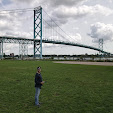

The Old River Control Structure (ORCS) and its connecting
satellite facilities combine to form one of the most impressive flood control
complexes in North America. Located along the west bank of the Mississippi
River near the confluence with the Red River and Atchafalaya River nearby, this
structure system was fundamentally made possible by the Flood Control Act of
1928 that was passed by the United States Congress in the aftermath of the
Great Mississippi River Flood of 1927 however a second, less obvious motivation
influenced the construction here.
The Mississippi River’s channel has gradually elongated and
meandered in the area over the centuries, creating new oxbows and sandbars that
made navigation of the river challenging and time-consuming through the steamboat
era of the 1800s. This treacherous area of the river known as “Turnbull’s Bend”
was where the mouth of the Red River was located that the upriver end of the
bend and the Atchafalaya River, then effectively an outflow channel for the
Mississippi River, began at the downriver end. An artificial channel was dug in
1831 to enable the river to bypass this bend in the river, which resulted in
the southern arm of the former Turnbull’s Bend becoming the new outflow
connection to the Atchafalaya River, a setup that gradually led to an
ever-increasing amount of water flowing down the former channel, known as the “Old
River”, rather than continuing within its natural channel. It is this waterway,
a former segment of the Mississippi River, that the Old River Control Structure
is named for.
Through the mix of human intervention and natural evolution,
the Mississippi River’s flow gradually diverted more and more into the Atchafalaya
River basin over the ensuing decades, ranging from about 10% diversion in 1900
to about 30% by 1950. The U.S. Army Corps of Engineers recognized that in
addition to the ever-present flood threat along the river, they concluded that the
river was beginning to change course down the Atchafalaya basin, a process that
once completed could not be reversed. The response to this dual threat was the
construction of the Old River Control Structure system, work on which began in
the 1950s. The Low Sill Control Structure and the Overbank Structure were the
first two components to enter operation in 1964. The Low Sill Structure is the
primary means by which water distribution is regulated, while the Overbank
Structure is only used in times of high water levels. The Low Sill Structure helps
maintain the 30% diversion rate for Mississippi River flow into the Atchafalaya
basin. Situated a few miles south of the main control structures, the Old River
Lock was built in 1963 to allow navigation between the lower Mississippi River,
and the Red River & Atchafalaya River by way of the Old River channel.

The Old River Lock is spanned by this bridge along LA Highway 15, a few miles south of the main Old River Control Structure complex
In the aftermath of the near-failure of the original structure, the U.S. Army Corps built the Old River Auxiliary Structure a short distance downriver in the ensuing decade. Made operational in 1986, this structure enables the complex to handle a higher volume of discharge while providing needed redundancy across the system to avoid the overtaxing of any one entity. At the same time, the need for a low-cost energy source for rural northeastern Louisiana led to the construction of the Sidney Murray Hydroelectric Station, made operational in 1990. This power station is unique among hydroelectric power plants in that it relies solely on the Mississippi River’s natural flow and elevation drop through the ORCS, thereby eliminating the seed for a dam & reservoir system.

The Low Sill Control Structure was built as the main water diversion structure in the ORCS complex and is crossed by LA Highway 15.
The collective capacity and engineering of the ORCS has helped ensure that the Mississippi River would remain within its artificial banks for the last 60 years. It has become an indispensable location for ensuring the stability of the lower Mississippi River’s flowrate across Louisiana in the event of flooding and has also served as a man-made barrier that has kept the river in its banks by limiting the amount of water diverted out of the river into the Atchafalaya basin. While it is seen as a great example of water management and flood control, there are those who warn that the Mississippi River will not be able to be tamed forever and that one day the river will ultimately win in its gradual diversion into a new main channel along the current Atchafalaya River. If this were ever to happen, the Atchafalaya Basin and the communities along it would become permanently inundated while the Mississippi River across Louisiana would largely dry up, leaving the economic centers of Baton Rouge and New Orleans permanently cut off from the river. Without the river flowing through, the economy of Louisiana would collapse, without any short-term hope of revival. The economic importance of keeping the Mississippi River in its banks is perhaps the single greatest motivation behind the decades of investment made by the federal government since the Great Flood of 1927. Approaching 100 years since that event that changed the way we view the river and its relationship with the cities along it, there are those who argue that time is running out to prepare for the inevitable permanent changing of the mouth of the Mississippi River. It is said that Mother Nature always prevails in the end. Time will tell whether they are right.
The following photos from my visit to the Old River Lock in February 2023 showcase various vantage points of the lock from ground level nearby. Click on each photo to see a larger version.


The following photos from my February 2023 visit to the Old River Lock showcase the northbound crossing of the lock & bridge on LA Highway 15. Click on each photo to see a larger version.


The following photos from my February 2023 visit to the Old River Lock showcase the southbound crossing of the lock & bridge on LA Highway 15. Click on each photo to see a larger version.


The following photos from my February 2023 visit to the Old River Control Structure showcase the northbound crossing of the structures on LA Highway 15. Click on each photo to see a larger version.


The following photos from my February 2023 visit to the Old River Lock showcase the southbound crossing of the structures on LA Highway 15. Click on each photo to see a larger version.


Bridges, Crossings, and Structures of the Lower Mississippi River
Next Crossing upriver: Natchez-Vidalia Bridge (Natchez, MS)
Next Crossing downriver: John James Audubon Bridge (New Roads, LA)
Nearby Flood Control Structure: Morganza Control Structure (Morganza, LA)
Return to the Bridges of the Lower Mississippi River Home Page
__________________________________________________
Comments