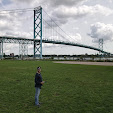
Belle Chasse-Scarsdale Ferry (Belle Chasse, LA)

The southernmost reaches of the Mississippi River downriver from greater New Orleans can only be crossed by way of remote & lightly-trafficked ferries and this service, which connects the communities of Belle Chasse and Scarsdale in northern Plaquemines Parish, is the northernmost of the two cross-river ferries in Louisiana’s southernmost parish. Like its neighboring ferries, this crossing requires the payment of a toll and ferries depart from each landing every 30 minutes on most days.

A commercial ferry service was established at this location in 1959. Since 2013, the ferry has been the southernmost crossing of the Mississippi River open to most commercial vehicles. These vehicles were barred indefinitely from the downriver Pointe à la Hache Ferry at the time and this ferry crossing took on somewhat greater importance as a result. The eastern ferry landing leads to LA Highway 39, which follows the east bank of the river southward toward Pointe à la Hache and northward toward St. Bernard Parish and greater New Orleans. LA Highway 3137, known as English Turn Road – a former alignment of the east bank highway, also begins at the eastern landing and follows the river for a short distance northward. The western ferry landing leads to LA Highway 23 (sometimes known as Belle Chasse Highway), which follows the west bank of the river northward into greater New Orleans and southward toward Venice and the mouth of the Mississippi River.

This ferry route is located near a popular anchorage point for ocean-going vessels seeking to travel upriver on the Mississippi River through and beyond New Orleans. On any given day, travelers on the ferry will be able to view the line of anchored ships in the river awaiting passage to their destinations inland. This ferry is also located near the so-called “English Turn”, a prominent 120-degree bend in the Mississippi River, named for a chance encounter in 1699 between the initial French explorers to the area and a competing British exploration party. The French party, led by Jean-Baptiste Le Moyne de Bienville, who would go on to establish the permanent settlement of New Orleans in 1718, were successful in convincing the British party to abandon their exploration of the area out of concern that their French rivals had already laid claim to the area.

The following pictures were taken during my eastbound crossing of the Belle Chasse Ferry in January 2018. Included in this set are pictures of English Turn Road (LA Highway 3137). Click on each photo to see a larger version.

Dashcam video of the eastbound trip over the Belle Chasse Ferry was filmed in January 2018 for the 'roadwaywiz' YouTube channel and is available for viewing at the link below:


How To Get There:

Bridges, Crossings, and Structures of the Lower Mississippi River
Next Crossing upriver: Chalmette-Lower Algiers Ferry (Chalmette, LA)
Next Crossing downriver: Pointe a la Hache Ferry (Pointe a la Hache, LA)
Return to the Bridges of the Lower Mississippi River Home Page
__________________________________________________

Comments

Popular posts from this blog

Did Caltrans just kill the G26 cutout US Route shields?

The US Route System was formally created by the American Association of State Highway Officials during November 1926.  Through the history of the system the only state to which has elected to maintain cutout US Route shields has been California.  The G26 series cutout US Route shields have become a favorite in the road enthusiast hobby and are generally considered to be much more visually pleasing than the standard Federal Highway Administration variant.  However, the G26 shield series appears to have been killed off on January 18, 2026, when Caltrans updated their Manual of Uniform Traffic Control Devices.  This blog will examine the history of the US Route shield specifications in California and what is happening with the 2026 changes.  The blog cover photo is facing towards the terminus of California State Route 136 and at a G26-2 specification US Route 395 shield.  In the background Mount Whitney can be seen in the Sierra Nevada range.   ...

May 2023 Ontario Trip (Part 3 of 3)

  Over the years, I have made plenty of trips to Ontario, crisscrossing the southern, central and eastern parts of the province. Living in Upstate New York, it's pretty easy to visit our neighbor to the north, or is that our neighbor to the west? Ottawa is one of my favorite cities to visit anywhere in the world, plus I've discovered the charm of Kingston, the waterfalls of Hamilton (which is on the same Niagara Escarpment that brings us Niagara Falls), the sheer beauty of the Bruce Peninsula, and more. But I hadn't explored much of Cottage Country. So I decided to change that, and what better time to go than over Memorial Day weekend, when the daylight is long and I have an extra day to explore. On the third and final day of my trip, I started in Huntsville and made my way through Muskoka District and Haliburton County, passing by many lakes along the way. I stopped in towns such as Dorset, Haliburton and Bancroft before making a beeline down to Belleville and then over th...

Ghost Town Tuesday; Nichols, FL

A couple years ago I spent a lot of spare time exploring phosphate mining ghost towns in the Bone Valley of Polk County, Florida.  One ghost town in particular called Nichols on Polk County Route 676 west of Mulberry caught my eye due to a relative lack of documentation on ghosttowns.com. Nichols was created in 1905 during the early phosphate mining boom in the Bone Valley region.  For the time Nichols was unusual since it had company housing in the Nichols Mine site and private residences outside the gate.  Nichols is only about two miles west of Mulberry which probably made it a somewhat reasonable commute even by the wonky standards of the early 20th Century.  Most of the Bone Valley region was relatively remote which made commuting or homesteading impractical which is why there are so many ghost towns in the area.  The company housing section of Nichols was phased out and abandoned by 1950. The Nichols town site is largely abandoned and could "possibl...