
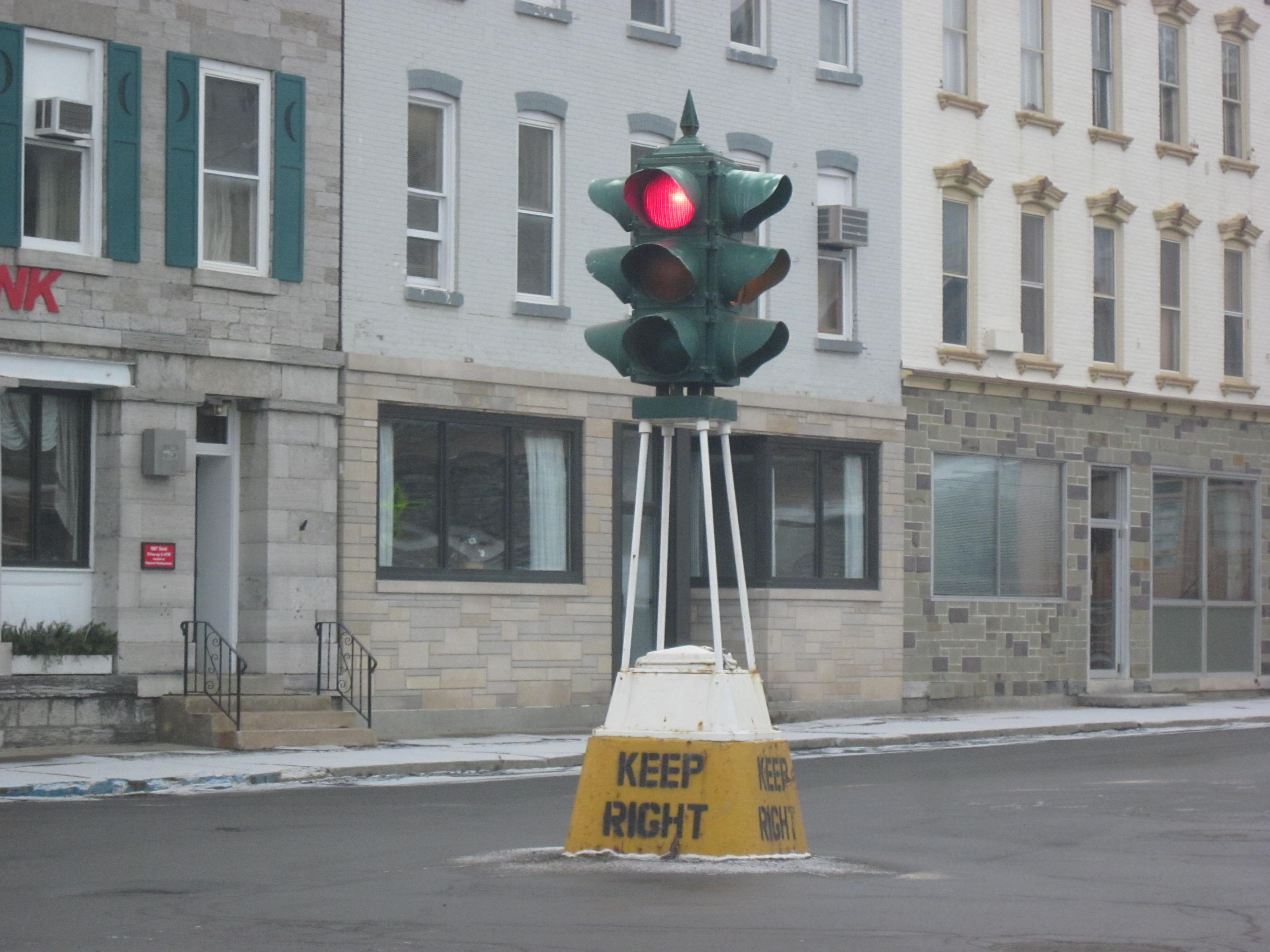
A relic of the early days of motoring, dummy lights were traffic lights that were placed in the middle of a street intersection. In those early days, traffic shuffled through busy intersections with the help of a police officer who stood on top of a pedestal. As technology improved and electric traffic signals became commonplace, they were also originally positioned on a platform at the center of the intersection. Those traffic signals became known as "dummy lights" and were common until traffic lights were moved onto wires and poles that crossed above the intersection.
In New York State, only a handful of these dummy lights exist. The dummy lights are found in the Hudson Valley towns of Beacon and Croton-on-Hudson, plus there is an ongoing tug of war in Canajoharie in the Mohawk Valley, where their dummy light has been knocked down and replaced a few times. The dummy light in Canajoharie is currently out of commission, but popular demand has caused the dummy light to make a few reappearances in recent years. The common theme with these dummy lights throughout New York State is that they first became operational in 1926, allowing people passing through to have a glimpse into a bygone era. Another common theme, especially in the case of Beacon and Croton-on-Hudson, is that these dummy lights are able to claim that they are the oldest continuously operating traffic lights in the United States of America.
In the City of Beacon, the dummy light is located at the corner of Main Street and East Main Street, just around the corner from downtown Beacon and a short stone's throw away from Fishkill Overlook Falls. While the light functions differently today, Beacon’s first dummy light came from the Essco Manufacturing Company of Peoria, Illinois. The light changed every forty seconds, and a yellow light meant ready to go, green was go and red was stop. The lights changed every forty seconds. To save electricity, power for the signal was turned on manually by police at 8 am and off at 10 pm.
Over time, the dummy light became a part of the community. A workshop was held in Beacon in 2007 regarding the possibility of moving the dummy light elsewhere. One plan was to move the light from the middle of the intersection to a nearby sidewalk. However, many of the citizens in attendance strongly urged officials to keep the light where it had been, due to its historic nature, but also because the dummy light became a thing that people became used to, and that something as unique as the dummy light is part of the community's character and should be preserved for future generations. Ultimately, Beacon's City Council voted to keep the light in the middle of Main Street, making repairs after motor vehicle crashes as necessary.
Going further down the Hudson Valley from Dutchess County to Westchester County is the dummy light in the Village of Croton-on-Hudson. The dummy light at the corner of Grand Street and Old Post Road in Croton-on-Hudson's downtown has become a community landmark of its own. Some find the dummy light to have charm, while others see it as out-of-date. The dummy light was produced by the Marbelite Company of Brooklyn, New York, which supplied a large number of traffic signals and parts around the Greater New York City Metropolitan Area during the 1920s.
Over the years, village officials in Croton-on-Hudson discussed replacing the historic dummy light with a modern traffic light, but the public was strongly against the idea. The principal argument centered around the matter that dummy lights are extremely rare and historic. Plus, the dummy light in Croton-on-Hudson has a neat quirk to its history that makes it even more unique. Part of the dummy light's brick base covers a cistern that supplied water to Grand Street and connected to another cistern at the bottom of Mount Airy Road until 1929, making the dummy light even more utilitarian.
Of course, we cannot talk about dummy lights in New York State without talking about the dummy light in Canajoharie. Long a landmark for this quiet village alongside the New York State Thruway and Erie Canal, Canajoharie is known for more than just the song of the same name from They Might Be Giants. The dummy traffic light in Canajoharie was installed in 1926. When the dummy light was first installed, instructions were published in the local newspaper, advising motorists to blow their horns when making a left turn or a right on red. It further suggested that residents cut out the instructions and paste them into their hats. I think we would consider that distracted driving today, but fedora hats were in vogue during the Roaring 20s. Even one of my early memories of being on the road involved passing by the Canajoharie dummy light on the way to Niagara Falls during a family vacation during the 1980s.
The dummy light in Canajoharie stood at the corner of Church Street (NY Route 10), Montgomery, and Mohawk Streets until it was struck by a truck in November 2021. Given that NY 10 sees some commercial traffic (for instance, there is a Walmart distribution center located to the south in Sharon Springs), there was a higher possibility that the dummy light in Canajoharie could meet its demise that way as compared to the dummy lights in the Hudson Valley. At the time when the dummy light was struck and removed, the traffic signal was been replaced with stop signs at the intersection and a manhole cover where the traffic light once rested. However, as chance happened, there is a future for the Canajoharie dummy light. In May 2025, the dummy light in Canajoharie was reinstalled, with a higher concrete base. I believe this is to help minimize the possibility that the traffic signal being knocked down in the future, plus it helps with seeing the dummy light as many motor vehicles are built higher off the ground now. The classic traffic signal was held in storage before the light could be reinstalled in place. While the New York State Department of Transportation hasn't supported the idea of restoring the dummy light as it maintains a state touring route through the intersection, calling the dummy light unwarranted, and that a future roundabout or the current flashing stop sign set-up are better alternatives from an operational and safety standpoint. However, it was found that the motor vehicle collision rate increased since the dummy light was taken down.
A feasibility study was launched by the Village of Canajoharie, finding that the village has full jurisdiction over the intersection, which eliminates the previously presumed need for state approval. Even though the village can approve the restoration of the dummy light on its own, it cannot seek public grants in its restoration efforts, given the dummy light's non-compliance with federal highway standards. Reinstallation of the dummy light had been expected to cost $38,000 to $40,000.
My thoughts on dummy lights are that they are a part of both local history and transportation history that should be preserved. Local sentiment tends to dictate that the dummy lights should continue to operate at their present locations, and I agree with that position, especially when they are confined to local traffic use. If the dummy lights are taken out of commission for one reason or another, displaying them locally in a public space such as a park should be the option that is explored. A good example of that is in Meriden, Connecticut, where its beloved traffic control tower is on display near the spot where it was once in use. While I do not think we should install new dummy lights, we can appreciate the few that remain.
.JPG) |
| Croton-on Hudson's dummy light features a brick base. The control box is found next to the signal. |
 |
| "A beacon shines in Beacon". When I visited the Beacon dummy light, it was recently refurbished. |
 |
| Canajoharie's "dummy light" looks quite stately as the centerpiece of the village. |
 |
| The Canajoharie dummy light was reinstalled in May 2025 with a higher concrete base, in hopes to minimize the possibility of being knocked down by a wayward motor vehicle in the future. |
How to Get There:
Sources and Links:
Croton Friends of History - A Dummy Forever!
Governing.com - Behind the Lens: This Vintage Stoplight Still Keeps Traffic Moving
The Highlands Current - Don't Hit The Dummy
Historic Towns of America - Oldest Traffic Light in America
The Recorder - 'Dummy light' to be reinstalled at Canajoharie intersection
News 10 Albany - Dummy Light Back Up and Running in Canajoharie
Comments