
Vicksburg Mississippi River Bridges


Built nearly 45 years apart, the Mississippi River bridges in Vicksburg, MS are a great demonstration of how transportation and traffic changed dramatically in the United States during the 20th Century.


Opened in 1930, what is now known as the Old Vicksburg Bridge, was a missing link in the early American transportation network. Prior to the bridge's completion, all vehicle and rail traffic had to cross the Mississippi via ferry. The newly completed bridge solved that issue by having one rail line and an 18-foot roadway cross the mighty river.

The bridge, at the time the only Mississippi River bridge south of Memphis, would be a key connection for east-west travel in the South.
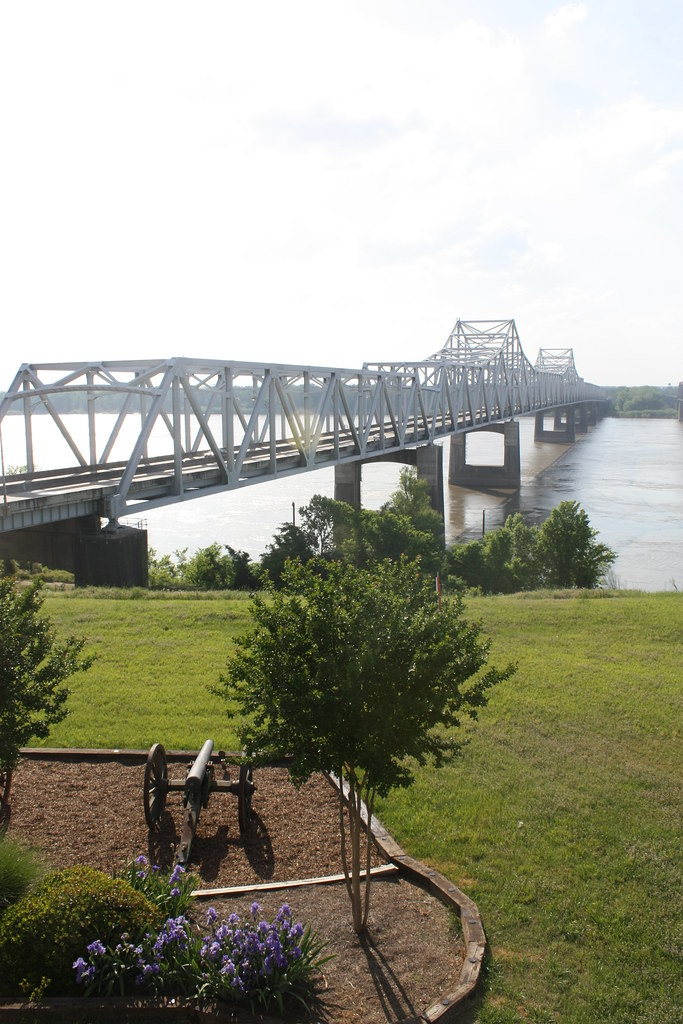

However, the bridge would quickly become outdated. At only 18 feet wide, the roadway was extremely difficult for trucks to navigate - and in later years the bridge would halt traffic to allow trucks to cross along with daytime-only crossings.

With the creation of the Interstate Highway System, the bridge would not be able to handle any of the modern freeway traffic. The new Vicksburg Bridge - located immediately downriver - opened in 1973. The new bridge carries four lanes of Interstate 20 and US 80 traffic on a 60-foot-wide highway.


The old Vicksburg Bridge didn't go away quietly. It continued to carry vehicular traffic until 1998. Freight trains still use the old Vicksburg Bridge to this day. The bridge will also 'open' occasionally for bike and pedestrian traffic for various festivals or race events.

All photos taken by post author - April 2010.

Further Reading:
How To Get There:

Comments

Popular posts from this blog

Crescent City Connection (New Orleans, LA)

The Crescent City Connection is a massive dual-span steel truss bridge that spans the lower Mississippi River at downtown New Orleans, about 95 river miles upstream from the mouth of the great river at the Head of Passes Light. If counted as a single bi-directional highway bridge, the parallel spans combine to form the single busiest bridge on the Mississippi River and its importance as a linchpin in the region’s transportation network cannot be overstated. While there have been various schemes over the years to construct bridges downriver from Algiers Point, this bridge has been the southernmost bridge on the Mississippi River since its initial construction in the 1950s. The years immediately following the end of World War II were a transformational period in the history of New Orleans. Already one of the great economic and cultural centers of the American Deep South, it was recognized at this time that major changes and improvements to the city’s transportation infrastructure would b...

Old US Route 99 through Tipton, Tulare, and Tagus Ranch

This summer I had a look into the alignment history of US Route 99 through the Tulare County communities of Tipton, Tulare, and Tagus Ranch.  While this slab below might seem like much it is one of the few remaining reminders of how US Route 99 was during the 1920s in Tulare County. This blog is part of the larger Gribblenation US Route 99 Page.  For more information pertaining to the other various segments of US Route 99 and it's three-digit child routes check out the link the below. Gribblenation US Route 99 Page Part 1; the history of US Route 99 in Tipton, Tulare, and Tagus Ranch Tipton and Tulare were both founded in 1872 as sidings of the Southern Pacific Railroad.  The Southern Pacific Railroad laid the groundwork for development of southern San Joaquin Valley.  Previous to the Southern Pacific Railroad travel via wagon or foot in Central California tended to avoid San Joaquin Valley in favor of the Stockton-Los Angeles Road.  The Stockton Los Ange...

Former US Route 101 and California State Route 41 through Paso Robles

Paso Robles is a city located on the Salinas River of San Luis Obispo County, California.  As originally configured the surface alignments of US Route 101 and California State Route 41 converged in downtown Paso Robles.  US Route 101 originally was aligned through Paso Robles via Spring Street.  California State Route 41 entered the City of Paso Robles via Union Road and 13th Street where it intersected US Route 101 at Spring Street.  US Route 101 and California State Route 41 departed Paso Robles southbound via a multiplex which split near Templeton.   Pictured above is the cover of the September/October 1957 California Highways & Public Works which features construction of the Paso Robles Bypass.  Pictured below is the 1935 Division of Highways Map of San Luis Obispo County which depicts US Route 101 and California State Route 41 intersecting in downtown Paso Robles.   Part 1; the history of US Route 101 and California State Route 41 i...