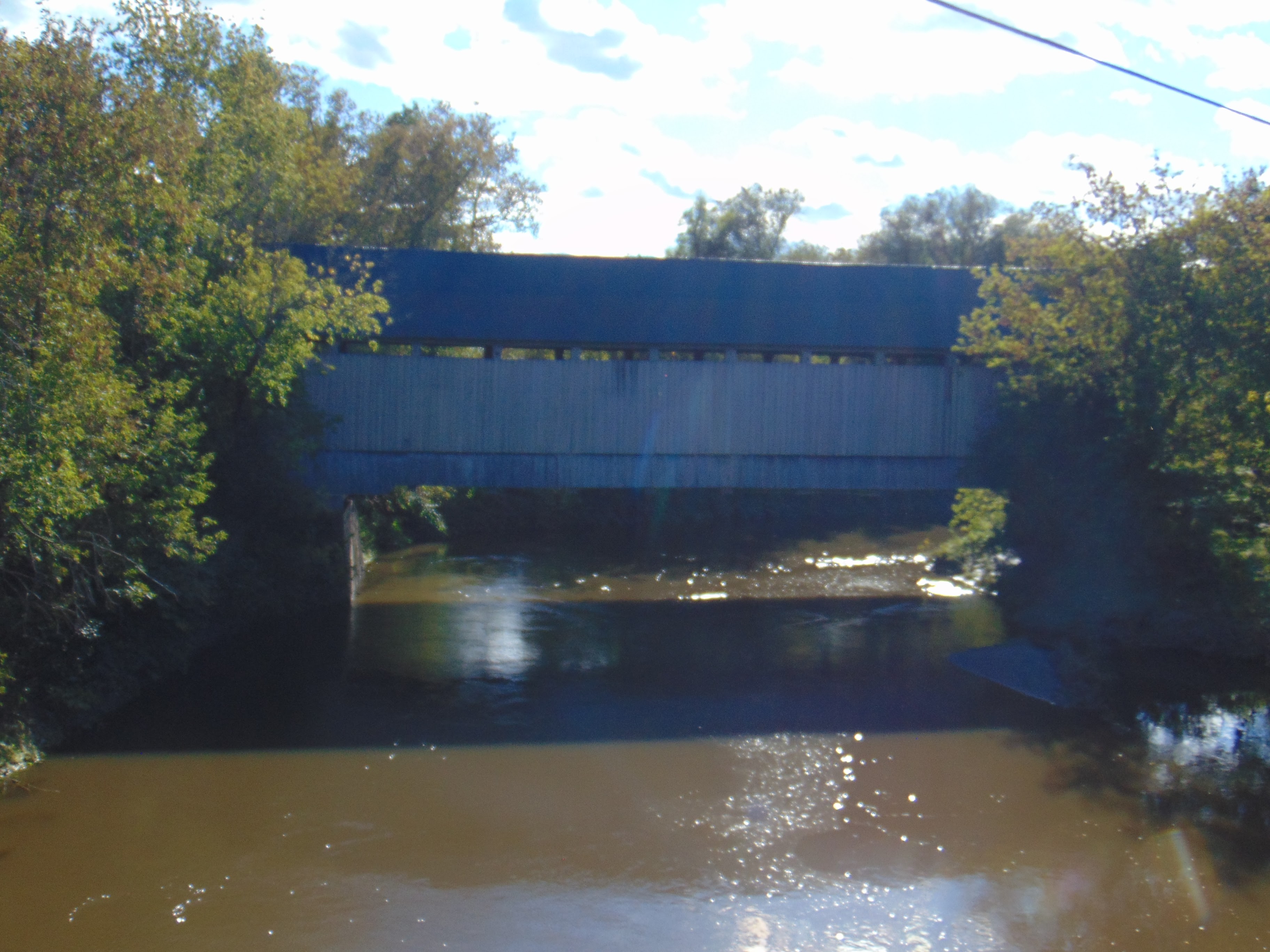
Drouin Covered Bridge - Quebec


Originally known as the Spafford Covered Bridge after a family that once owned land nearby, the Drouin Covered Bridge was constructed between 1886 and 1889 and is the second bridge to be located at this site across the Coaticook River. Located in the Eastern Townships of Compton, Quebec, the Drouin Covered Bridge is built in a multiple Kingpost design at a length of 98 feet. Wooden plank drop siding and a portal without jamb are featured in its construction. No longer open to vehicular traffic, the bridge is located off of Chemin Drouin between Waterville and Compton, near a landing where you can take small boats that allow you take in the views of the covered bridge.

In 1886, the first Spafford Bridge collapsed under the weight of Patrick Ryan along with his horse and wagon. Due to the unfortunate event, Ryan sued Compton Township for $275, eventually settling with the township for $100. At the same time, arrangements to construct a new covered bridge were underway. A contract was awarded to Daniel Saultry for $908.50 and construction for the new bridge was completed in 1889. During the 1960s, the bridge's span was reduced with the addition of a steel pier at the bridge's west abutment and strengthened with the addition of steel beams underneath each end of the timber trusses. Around 1980, the covered bridge could no longer support heavy traffic and a new parallel bridge was built to the north.

While the covered bridge was no longer open to traffic, additional changes were coming to the bridge. In 1989, the name of the bridge was officially renamed as the Drouin Covered Bridge, in honor of the family that occupied the nearby lands for four generations following the departure of the Spaffords. By 1998, the covered bridge was faced with demolition due to its deteriorating state. Fortunately, a group organized and ran a fundraising effort to the save the Drouin Covered Bridge. Renovations took place in 2004 and 2005 at the cost of $130,000.

Today, you can visit the Drouin Covered Bridge for passive recreation. There is a small parking area located near the bridge and there are some interpretive signs that tell of the bridge's history and design. It is a short walk to the parallel bridge if you want to get some additional photos of the covered bridge. The Drouin Covered Bridge stands as a testament to the history of the Eastern Townships region and the people who made it what it is.


Inside the covered bridge.

A view of the Drouin Covered Bridge over the Coaticook River from Chemin Drouin.

Bridge plaque on top of the covered bridge's portal.

An interpretive sign for the bridge's history. It is worn, but it still tells the bridge's story.

All about Kingpost trusses.

A view of the west portal of the Drouin Covered Bridge.


How to Get There:


Sources and Links:
DaleJTravis.com - Quebec Covered Bridges
Culture et Communications Quebec - Drouin Covered Bridge
ProvinceQuebec - Covered Bridges
Eastern Townships - Discovering the Covered Bridges of the Eastern Townships
Structurae - Drouin Bridge

Comments

Popular posts from this blog

Crescent City Connection (New Orleans, LA)

The Crescent City Connection is a massive dual-span steel truss bridge that spans the lower Mississippi River at downtown New Orleans, about 95 river miles upstream from the mouth of the great river at the Head of Passes Light. If counted as a single bi-directional highway bridge, the parallel spans combine to form the single busiest bridge on the Mississippi River and its importance as a linchpin in the region’s transportation network cannot be overstated. While there have been various schemes over the years to construct bridges downriver from Algiers Point, this bridge has been the southernmost bridge on the Mississippi River since its initial construction in the 1950s. The years immediately following the end of World War II were a transformational period in the history of New Orleans. Already one of the great economic and cultural centers of the American Deep South, it was recognized at this time that major changes and improvements to the city’s transportation infrastructure would b...

Old US Route 99 through Tipton, Tulare, and Tagus Ranch

This summer I had a look into the alignment history of US Route 99 through the Tulare County communities of Tipton, Tulare, and Tagus Ranch.  While this slab below might seem like much it is one of the few remaining reminders of how US Route 99 was during the 1920s in Tulare County. This blog is part of the larger Gribblenation US Route 99 Page.  For more information pertaining to the other various segments of US Route 99 and it's three-digit child routes check out the link the below. Gribblenation US Route 99 Page Part 1; the history of US Route 99 in Tipton, Tulare, and Tagus Ranch Tipton and Tulare were both founded in 1872 as sidings of the Southern Pacific Railroad.  The Southern Pacific Railroad laid the groundwork for development of southern San Joaquin Valley.  Previous to the Southern Pacific Railroad travel via wagon or foot in Central California tended to avoid San Joaquin Valley in favor of the Stockton-Los Angeles Road.  The Stockton Los Ange...

Former US Route 101 and California State Route 41 through Paso Robles

Paso Robles is a city located on the Salinas River of San Luis Obispo County, California.  As originally configured the surface alignments of US Route 101 and California State Route 41 converged in downtown Paso Robles.  US Route 101 originally was aligned through Paso Robles via Spring Street.  California State Route 41 entered the City of Paso Robles via Union Road and 13th Street where it intersected US Route 101 at Spring Street.  US Route 101 and California State Route 41 departed Paso Robles southbound via a multiplex which split near Templeton.   Pictured above is the cover of the September/October 1957 California Highways & Public Works which features construction of the Paso Robles Bypass.  Pictured below is the 1935 Division of Highways Map of San Luis Obispo County which depicts US Route 101 and California State Route 41 intersecting in downtown Paso Robles.   Part 1; the history of US Route 101 and California State Route 41 i...