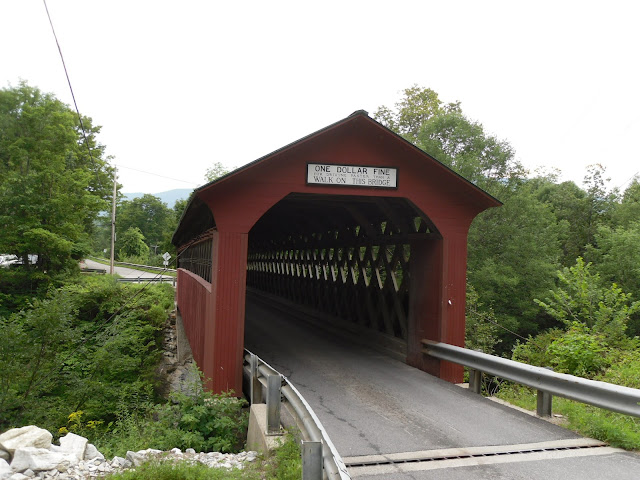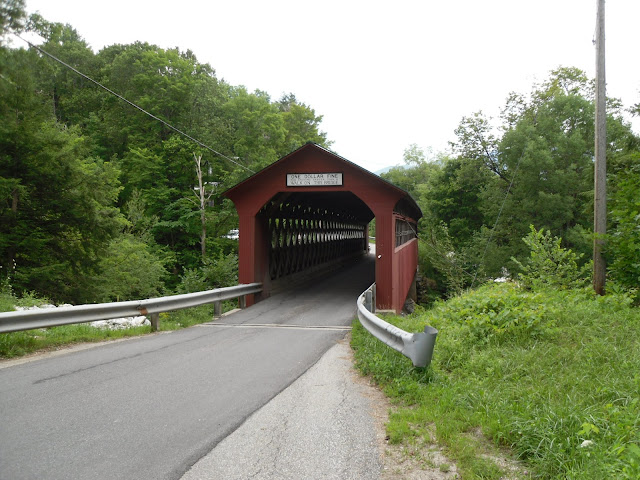
Chiselville Covered Bridge - Sunderland, Vermont


Also known as the East Arlington Covered Bridge due to its proximity to Vermont's original capital in Arlington, the Chiselville Covered Bridge was built in 1870 and spans over the Roaring Branch of the Batten Kill on Sunderland Hill Road in the Town of Sunderland, Vermont. The name of Chiselville comes from a chisel factory that was once situated in the small village that is also called Chiselville. The covered bridge was built by Daniel Oatman at a cost of $2,307.31 and he used a Town lattice truss design for the bridge's construction.

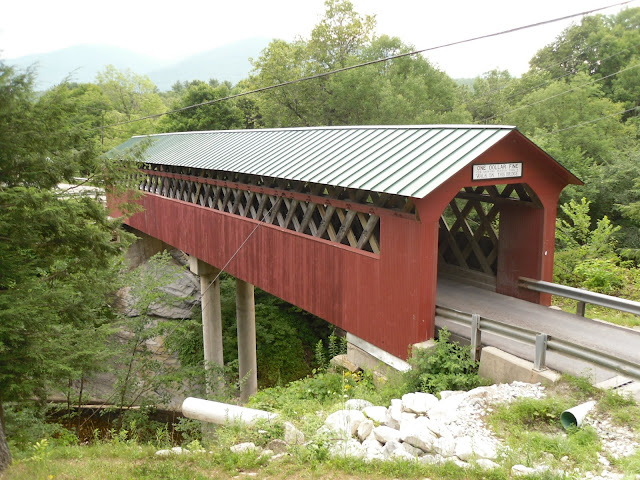
One thing that you'll notice about this 117 foot long covered bridge is that it sits very high above the river below. The bridge is about 40 feet above the Roaring Branch, lending to an alternative name as the High Bridge. This clearance above the river came in very useful during the devastating floods of November 1927, which caused much damage to covered bridges across Vermont. However, the Chiselville Covered Bridge stayed high and dry. But like many covered bridges, this bridge eventually faced some damage. In 1971, the bridge was severely damaged when two loaded gravel trucks tried to cross at the same time, causing the need for the bridge to be repaired. Supporting steel girders and a center pier were added in 1973 during the bridge's rehabilitation.

Fans of the 1987 movie "Baby Boom" may recall seeing the Chiselville Covered Bridge while watching the film. The bridge was featured in the scene when Diane Keaton’s character leaves New York to move to fictional Hadleyville, Vermont with her daughter for a more peaceful lifestyle. Today, all sorts of people can enjoy the Chiselville Covered Bridge, whether they are taking a motorcycle along scenic back roads or exploring the many covered bridges that Bennington County has to offer between and around its two shire towns.
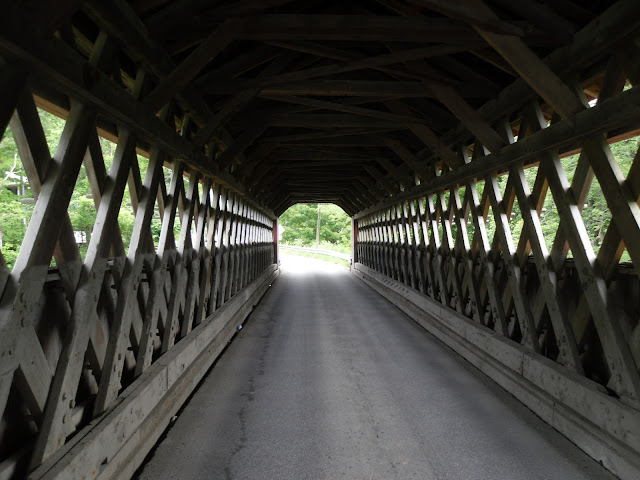
The Town lattice work inside the covered bridge.

The Chiselville Bridge accommodates one lane of traffic at a time and features a classic sign advertising not to drive faster than a walk on this bridge, or you'll face a fine of $1.

The Chiselville Covered Bridge sits high above the Roaring Branch.


How to Get There:


Sources and Links:
Vermont Covered Bridge Society - Chiselville Covered Bridge
Happy Vermont - Chiselville Covered Bridge in Sunderland
VermontBeginsHere.com - Covered Bridges of Bennington County
Manchester Vermont - Covered Bridges
Bridgehunter.com - Chiselville Covered Bridge 45-02-05
The Travels of Tug 44 - Chiselville Covered Bridge
Back of the Bike Life - Chiselville Covered Bridge-Sunderland, Vermont

Comments

Popular posts from this blog

Grand Loop Road of Yellowstone National Park

  Grand Loop Road is a 140 mile loop highway which traverses the interior of Yellowstone National Park.  Grand Loop Road connects all of the major attractions and geological features of Yellowstone National Park along with the entrance roads.  Grand Loop Road is a seasonal highway and despite some conjecture never has been part of the US Route System.   Part 1; the history of Grand Loop Road The majority of history pertaining to Grand Loop Road was taken from the below National Park Service article: Historic Roads - Yellowstone National Park (U.S. National Park Service) (nps.gov) Yellowstone was declared the first National Park of the United States on March 1st, 1872.  The first real highway to access Yellowstone National Park came in 1873 when a tolled facility was constructed from Bozeman, Montana via Yankee Jim Canyon to Mammoth Hot Springs.  Numerous attempts were made to fund construction of roadway infrastructure during the early years of Yellows...

The last 1956-63 era California Sign State Route Spade?

Along southbound California State Route 170 (the Hollywood Freeway Extension) approaching the Hollywood Freeway/Ventura Freeway interchange a white California State Route 134 Sign State Route Spade can be observed on guide sign.  These white spades were specifically used during the 1956-63 era and have become increasingly rare.  This blog is intended to serve as a brief history of the Sign State Route Spade.  We also ask you as the reader, is this last 1956-63 era Sign State Route Spade or do you know of others?  Part 1; the history of the California Sign State Route Spade Prior to the Sign State Route System, the US Route System and the Auto Trails were the only highways in California signed with reassurance markers.  The creation of the US Route System by the American Association of State Highway Officials during November 1926 brought a system of standardized reassurance shields to major highways in California.  Early efforts to create a Sign State Route ...

California State Route 70; the Feather River Highway

From 2017 through to early 2019 I drove the majority of the California State Route 70; the Feather River Highway from CA 89 southwest to CA 99. CA 70 is an approximately 178.5 mile state highway which starts at US 395 near the Nevada State Line and travels west through the Feather River Canyon to CA 99.  CA 70 is often referred to as the Feather River Highway" given it's close association with the river.  Historically CA 70 was previously signed as US 40A and CA 24.  The Legislative Routes prior to the 1964 California Highway Renumbering that made up the current route of CA 70 are as follows: -  Legislative Route Number 21 from US 395 westward to Oroville. -  LRN 87 from Oroville south to Marysville. -  LRN 232 from Marysville to the current junction with CA 99.  CA 70 was even dual signed with CA 99 into Sacramento on what was LRN 232 for a time. The change from US 40A/LRN 21/LRN 87/LRN 232 can be seen by comparing the 1963 State Highway Ma...