Former US Route 101 at Confusion Hill


Since 1949 Confusion Hill has been a major roadside attraction for travelers along US Route 101 and Redwood Highway.  Confusion Hill is located on the South Fork Eel River watershed of Mendocino County.  Confusion Hill was part of mainline US Route 101 until 2009 when the highway was shifted onto the Confusion Hill Bridges.   


Part 1; the history of US Route 101 and Redwood Highway at Confusion Hill

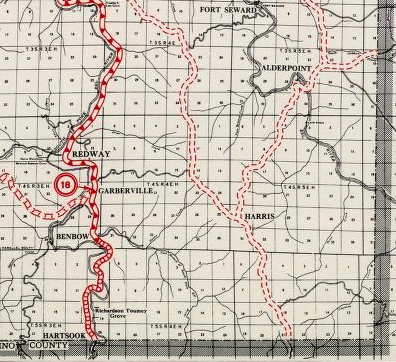
The history of what would become US Route 101 ("US 101") at Confusion Hill begins with the approval of the 1909 First State Highway Bond Act.  The First State Highway Bond Act was approved by voters during 1910 and was the genesis point of some of the most notable highways in California.  Legislative Route Number 1 ("LRN 1") as originally plotted was a new State Highway which was designated between San Francisco north to Crescent City.  The route of LRN 1 would be extended to the Oregon State Line during the 1919 Third State Highway Bond Act and was came be known as the Redwood Highway.  The planned LRN 1 can be seen aligned between Garberville of Humboldt County and Cummings of Mendocino County on the 1917 California State Automobile Association Map.

Prior to the construction of LRN 1 wagon borne traffic heading north from Cummings to Humboldt County had to ascend the treacherous Rattlesnake Grade (also known as the Bell Springs Grade).  The Rattlesnake Grade is described in the October 1912 California Highway Bulletin as being only passable during the summer months.  The initial northward climb on the Rattlesnake Grade ascended slopes as high as 20% the from Cummings to the 4,100 foot high Bell Springs Mountain.  The descent from Bell Mountain to Dyerville (on CA 254/Avenue of the Giants) is described as having grades as steep as 30% amid an elevation drop of just over 3,900 feet.  The construction of LRN 1 (then known as the Mendocino State Highway) sought to follow the South Fork Eel River watershed to bypass the Rattlesnake Grade.  Note; the Rattlesnake Grade can be seen above on the 1917 California State Automobile Association Map between Cummings and Dyerville. 


Much of the Rattlesnake Grade still exists as modern Bell Springs Road.   The Rattlesnake Grade can be seen in detail between Garberville-Cummings on the 1935 Division of Highways Maps of Humboldt County and Mendocino County


The completed Redwood Highway/LRN 1 between Cummings and Garberville can be seen on the 1920 Clason Highway Map of California.  The replacement of the Rattlesnake Grade with the new alignment of the Redwood Highway/LRN 1 was of such a scale that it rivaled the likes of other First State Highway Bond Act roads the Old Ridge Route (LRN 4). 

In November 1926 the US Route System was created.  US Route 101 from San Francisco north to Crescent City was aligned over the Redwood Highway.  Both US 101 and the Redwood Highway between Garberville and Cummings can be seen on the 1927 Rand McNally Highway Map of California.

A new segment of the Redwood Highway between Piercy and Rock Creek can be seen in the October 1926 California Highways & Public Works just prior to it becoming US 101.   

The future site of Confusion Hill can be seen south of the confluence of the South Fork Eel River and Red Mountain Creek on the 1935 Division of Highways Map of Mendocino County.  


As noted in the intro Confusion Hill was opened in 1949 as an attraction oriented towards optical illusion displays.  Confusion Hill was the creation of George Hudson who took inspiration from the Oregon Vortex and Santa Cruz Mystery Spot after returning from World War II.  More regarding the history of Confusion Hill can be found on the Confusion Hill website.  

The Gravity House of Confusion Hill can be seen in this undated vintage post card. 


During the 1964 Christmas Floods US 101 between Garberville-Cummings saw substantial damage.  The January-February 1965 California Highways & Public Works cited that US 101 near Leggett largely eroded down into the South Fork Eel River.  

The March-April 1965 California Highways & Public Works cites that slides occurred on US 101 at; Leggett, Piercy, Richardson Grove, and Cummings during the 1964 Christmas Floods. 

The Garberville-Cummings segment of US 101 initially remained mostly unchanged after the 1964 Christmas Floods which is evident on the 1967 Division of Highways State Map

US 101 is shown as an expressway south of Garberville to the vicinity of Richardson Grove State Park on the 1969 Division of Highways State Map.  US 101 is shown to have a planned bypass route of Richardson Grove State Park which shown continuing to an existing expressway segment near Cummings.  

The 1970 Division of Highways State Map shows the Richardson Grove bypass under construction, ultimately it never would be completed. 


US 101 through Confusion Hill appears to have been planned to be recycled into California State Route 271 ("CA 271").  According to CAhighways.org CA 271 was given the following somewhat vague definition by 1970 Legislative Chapter 1473:
 
“Route 101 near Cummings to Route 101 near the Humboldt-Mendocino county line.”
 
The 1977 Caltrans State Map no longer shows the planned US 101 bypass of Richardson Grove suggesting it was cancelled.  Notably the north and south segments of CA 271 are shown as being present (as evidenced by US 101 being an expressway through Piercy) along with an unbuilt planned realignment between Piercy-Leggett.  The Piercy-Leggett realignment of US 101 had it been constructed would have likely filled the gap between the north and south segments of CA 271 and would have seen Confusion Hill on an Avenue of the Giants-like scenic alternate highway.  

 
According to CAhighways.org US 101 immediately north of Confusion Hill was infamously prone to slides.  The realignment of US 101 onto a bypass of Confusion Hill required construction of two new bridges over the South Fork Eel River.  The decade long project to replace US 101 north of Confusion Hill was realized in October of 2009 when the Confusion Hill Bridges were fully opened to traffic.  Upon the opening the Confusion Hill Bridges the original alignment of US 101 was removed per FHWA guidelines.  The scar of the original alignment of US 101 north of Confusion Hill towards Red Mountain Creek is obvious on Google Satellite images.  
 

The slide zone north of Confusion Hill along with the original grade of US 101 up close. 
 
 
This image from Bridgehunter.com shows the Confusion Hill Northern Bypass Bridge from the original grade of US 101.  The Confusion Hill Northern Bypass Bridge is a 531 foot long box girder design.  


This image from Bridgehunter.com shows the Confusion Hill Southern Bypass Bridge from the original grade of US 101.  The Confusion Hill Southern Bypass Bridge is a 1,395 foot long box girder design.


Part 2; a visit to Confusion Hill

Notably Confusion Hill still shows up in the Caltrans Postmile Tool as Route 101U MEN 99.493.  The "U" suffix in the Postmile Tool denotes that the Confusion Hill lies on an unreliquished segment of US 101.  Route 101U near Confusion Hill shows with a Postmile range of MEN 99.431 to MEN 100.457.  The former alignment of US 101 is likely retained by Caltrans to mitigate the slide seen in the satellite image above and incorporates Rosewarne Road near Red Mountain Creek.  


Looking north on Route 101U in front of Confusion Hill towards the slide area shown in the satellite images in Part 1.  


Looking south on Route 101U in front of Confusion Hill towards modern US 101.  


The totem pole in front of Confusion Hill.


The Confusion Hill Shoe House.  


The traditional entrance to Confusion Hill.


The Minnie Stoddard Lilley Memorial can found at the entrance of Confusion Hill.  Minnie Stoddard Lilley and her husband William Lilley were responsible for opening The World Famous Treehouse which was built in a hollow of the 301 foot tall Fraternal Monarch Tree.


The entrance to Confusion Hill now is located in the gift shop building.  


The Chipalope's Tale can be found behind the gift shop building.  The Chipalope is something of a mascot figure to Confusion Hill.  


A statement on what to expect at Confusion Hill as written by George Hudson in 1949.  


A height variation slab display.


The entrance to the Gravity House.


My wife accidentally demonstrating the optical illusion of the Gravity House.  


The Gravity House without any visual obstructions (no people). 


Another optical illusion display.  


The highway readers of this blog will appreciate this Tsunami Evacuation route.  


The history of Confusion Hill presented on a sign which displays an Interstate shield as opposed to a US Route shield.  


The Northern Mendocino Pet Rock Prison. 


100% guaranteed to be right at least 99% of the time.  


Comments

Popular posts from this blog

Grand Loop Road of Yellowstone National Park

  Grand Loop Road is a 140 mile loop highway which traverses the interior of Yellowstone National Park.  Grand Loop Road connects all of the major attractions and geological features of Yellowstone National Park along with the entrance roads.  Grand Loop Road is a seasonal highway and despite some conjecture never has been part of the US Route System.   Part 1; the history of Grand Loop Road The majority of history pertaining to Grand Loop Road was taken from the below National Park Service article: Historic Roads - Yellowstone National Park (U.S. National Park Service) (nps.gov) Yellowstone was declared the first National Park of the United States on March 1st, 1872.  The first real highway to access Yellowstone National Park came in 1873 when a tolled facility was constructed from Bozeman, Montana via Yankee Jim Canyon to Mammoth Hot Springs.  Numerous attempts were made to fund construction of roadway infrastructure during the early years of Yellows...

The last 1956-63 era California Sign State Route Spade?

Along southbound California State Route 170 (the Hollywood Freeway Extension) approaching the Hollywood Freeway/Ventura Freeway interchange a white California State Route 134 Sign State Route Spade can be observed on guide sign.  These white spades were specifically used during the 1956-63 era and have become increasingly rare.  This blog is intended to serve as a brief history of the Sign State Route Spade.  We also ask you as the reader, is this last 1956-63 era Sign State Route Spade or do you know of others?  Part 1; the history of the California Sign State Route Spade Prior to the Sign State Route System, the US Route System and the Auto Trails were the only highways in California signed with reassurance markers.  The creation of the US Route System by the American Association of State Highway Officials during November 1926 brought a system of standardized reassurance shields to major highways in California.  Early efforts to create a Sign State Route ...

California State Route 70; the Feather River Highway

From 2017 through to early 2019 I drove the majority of the California State Route 70; the Feather River Highway from CA 89 southwest to CA 99. CA 70 is an approximately 178.5 mile state highway which starts at US 395 near the Nevada State Line and travels west through the Feather River Canyon to CA 99.  CA 70 is often referred to as the Feather River Highway" given it's close association with the river.  Historically CA 70 was previously signed as US 40A and CA 24.  The Legislative Routes prior to the 1964 California Highway Renumbering that made up the current route of CA 70 are as follows: -  Legislative Route Number 21 from US 395 westward to Oroville. -  LRN 87 from Oroville south to Marysville. -  LRN 232 from Marysville to the current junction with CA 99.  CA 70 was even dual signed with CA 99 into Sacramento on what was LRN 232 for a time. The change from US 40A/LRN 21/LRN 87/LRN 232 can be seen by comparing the 1963 State Highway Ma...