
California State Route 207 I & II

On my way home from the the San Francisco Bay Area I took California State Route 152 east over Pacheco Pass to California State Route 33 north towards Santa Nella.  This particular segment of California State Route 33 was once the original California State Route 207.  In this article we examine the history of both iterations of California State Route 207.


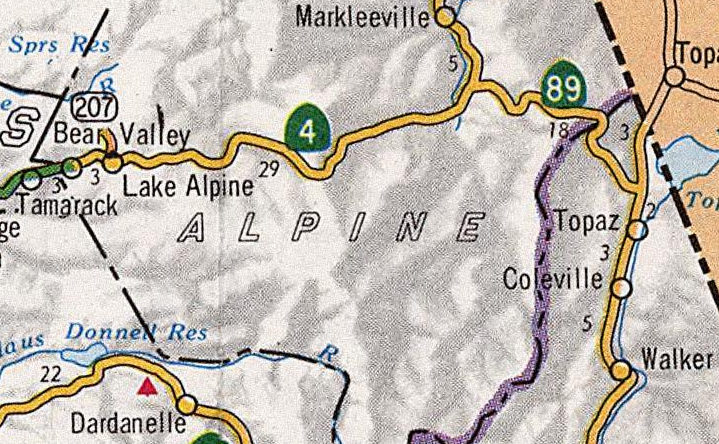
The current California State Route 207 ("CA 207") is a one mile State Highway which connects California State Route 4 near Lake Alpine to the Bear Valley Ski Area.  CA 207 is located within the Sierra Nevada Mountains of Alpine County.  


Part 1; the history of California State Route I

The original CA 207 was created during the 1964 State Highway Renumbering out of Legislative Route 121 ("LRN 121") from CA 152 north to CA 33 in Santa Nella.  The original CA 207 was a short 3 mile highway which was aligned over an important regional connecting corridor.  LRN 121 was added to the State Highway System in 1933 according to CAhighways.org.  The first CA 207 can be seen on the 1964 Division of Highways State Map


According to CAhighways.org the original CA 207 was deleted in 1972 when CA 33 was shifted onto it.  Originally CA 33 was aligned west of Los Banos to Santa Nella by way of Volta.  The new alignment of CA 33 west of Los Banos over the corridor of what was the first CA 207 can be seen on the 1975 Caltrans State Map


Part 2; a drive on what was California State Route I
 
The first CA 207 would have begun at CA 152 and run north from the expressway on Santa Nella Boulevard.


For a 3 mile route the first CA 207 had a lot going on as it would have quickly had a junction with the Medeiros Recreation Area almost immediately north of CA 152.


The first CA 207 would have crossed the O'Neill Forebay followed by Delta Mendota Canal before entering Santa Nella.


The first CA 207 would have terminated at CA 33/Henry Miller Avenue.


Part 3; the history of California State Route 207 II

According to CAhighways.org the second CA 207 was added to the State Highway System as part of 1979 Legislative Chapter 572.  The second CA 207 originally carried a definition of Lake Alpine to the Mount Reba Ski Area.  The second CA 207 first appears on the 1981 Caltrans State Highway Map.  
 

The Bear Valley Ski Area traces it's history to Harvey Blood's Toll Station on the Ebbetts Pass Road which became a tolled facility in the early 1860s.  The first written documentation referring to the area as "Bear Valley" is first cited in 1869 according to bearvalley.com.  In 1910 the Ebbetts Pass Toll Road was made a free highway as it was added to the State Highway System as Legislative Route 24 as part of the 1909 First State Highway Bond Act.  Blood's Station continued to operate until 1920 when it was sold to the Bishop Mining and Cattle Company.  

In 1952 the Orvis Family purchased 480 acres of land from the Bishop Mining and Cattle Company.  The Orvis Family later purchased 400 additional acres of Stanislaus National Forest parcels north of Bear Valley towards Mount Reba in 1963 with the intentions of building a ski resort.  The Mount Reba Ski Area opened in 1967 (along with what would become CA 207 II) for the winter ski season.  In June of 1991 the Mount Reba Ski Area was purchased and renamed to the Bear Valley Ski Area.


Part 4; a drive on California State Route 207 II

CA 4 eastbound intersects modern CA 207 at Postmile ALP R2.906.  CA 4 eastbound has two reassurance shields for CA 207 mounted above light posts approaching the actual junction.  


The 24% gradient warning for CA 4 eastbound over Ebbetts Pass can be found at the junction with modern CA 207.  The 24% grades ahead mostly apply in reality to Pacific Grade Summit but nonetheless are very real. 

Modern CA 207 travels northwest from CA 207 and has at least one reassurance shield.  Modern CA 207 is known as "Mount Reba Road" and State Maintenance ends at Postmile ALP 1.36.  CA 207 ends within view of Mount Reba.  


Comments

Popular posts from this blog

Did Caltrans just kill the G26 cutout US Route shields?

The US Route System was formally created by the American Association of State Highway Officials during November 1926.  Through the history of the system the only state to which has elected to maintain cutout US Route shields has been California.  The G26 series cutout US Route shields have become a favorite in the road enthusiast hobby and are generally considered to be much more visually pleasing than the standard Federal Highway Administration variant.  However, the G26 shield series appears to have been killed off on January 18, 2026, when Caltrans updated their Manual of Uniform Traffic Control Devices.  This blog will examine the history of the US Route shield specifications in California and what is happening with the 2026 changes.  The blog cover photo is facing towards the terminus of California State Route 136 and at a G26-2 specification US Route 395 shield.  In the background Mount Whitney can be seen in the Sierra Nevada range.   ...

May 2023 Ontario Trip (Part 3 of 3)

  Over the years, I have made plenty of trips to Ontario, crisscrossing the southern, central and eastern parts of the province. Living in Upstate New York, it's pretty easy to visit our neighbor to the north, or is that our neighbor to the west? Ottawa is one of my favorite cities to visit anywhere in the world, plus I've discovered the charm of Kingston, the waterfalls of Hamilton (which is on the same Niagara Escarpment that brings us Niagara Falls), the sheer beauty of the Bruce Peninsula, and more. But I hadn't explored much of Cottage Country. So I decided to change that, and what better time to go than over Memorial Day weekend, when the daylight is long and I have an extra day to explore. On the third and final day of my trip, I started in Huntsville and made my way through Muskoka District and Haliburton County, passing by many lakes along the way. I stopped in towns such as Dorset, Haliburton and Bancroft before making a beeline down to Belleville and then over th...

Ghost Town Tuesday; Nichols, FL

A couple years ago I spent a lot of spare time exploring phosphate mining ghost towns in the Bone Valley of Polk County, Florida.  One ghost town in particular called Nichols on Polk County Route 676 west of Mulberry caught my eye due to a relative lack of documentation on ghosttowns.com. Nichols was created in 1905 during the early phosphate mining boom in the Bone Valley region.  For the time Nichols was unusual since it had company housing in the Nichols Mine site and private residences outside the gate.  Nichols is only about two miles west of Mulberry which probably made it a somewhat reasonable commute even by the wonky standards of the early 20th Century.  Most of the Bone Valley region was relatively remote which made commuting or homesteading impractical which is why there are so many ghost towns in the area.  The company housing section of Nichols was phased out and abandoned by 1950. The Nichols town site is largely abandoned and could "possibl...