
Blenheim Covered Bridge

They say that you never forget your first. In this case, the Blenheim Covered Bridge in Schoharie County was the first covered bridge that I saw, back when I was a young boy during the 1980s. Since then, I have seen numerous covered bridges stretching from coast to coast in both the United States and Canada, but I will always have an affinity towards the Blenheim Covered Bridge and its unique design.

The old Blenheim Covered Bridge in October 2008.

The original Blenheim Bridge was built in 1855 by Nicholas Montgomery Powers, who was a prominent covered bridge builder of his day. Spanning over the Schoharie Creek, the bridge was located in the Town of Blenheim in southeastern Schoharie County on NY 30 in North Blenheim, until it was washed away during the floods caused by the remnants of Hurricane Irene on August 28, 2011. During its existence, the Blenheim Bridge was the longest single span bridge in the world at 228 feet in length and was one of only just a few remaining bridges in the world with two separated (or double barreled) lanes. The old Blenheim Bridge was open to vehicular traffic until 1932, when New York State built a new bridge for traffic about 100 feet downstream of the covered bridge. The covered bridge was supposed to removed back then, but there was enough public outcry that caused the covered bridge to remain open for sightseeing, thus allowing future generations to enjoy this local treasure.


After floods had destroyed the original bridge, efforts have been made to build a replica of the Blenheim Bridge. In 2016, funds were approved to pay for the construction of a new covered bridge using federal and state funds. Construction on the new bridge commenced in 2017, with an expected opening of the new bridge in July 2018. I'll be there as soon as I can after it opens, so I can create new memories.
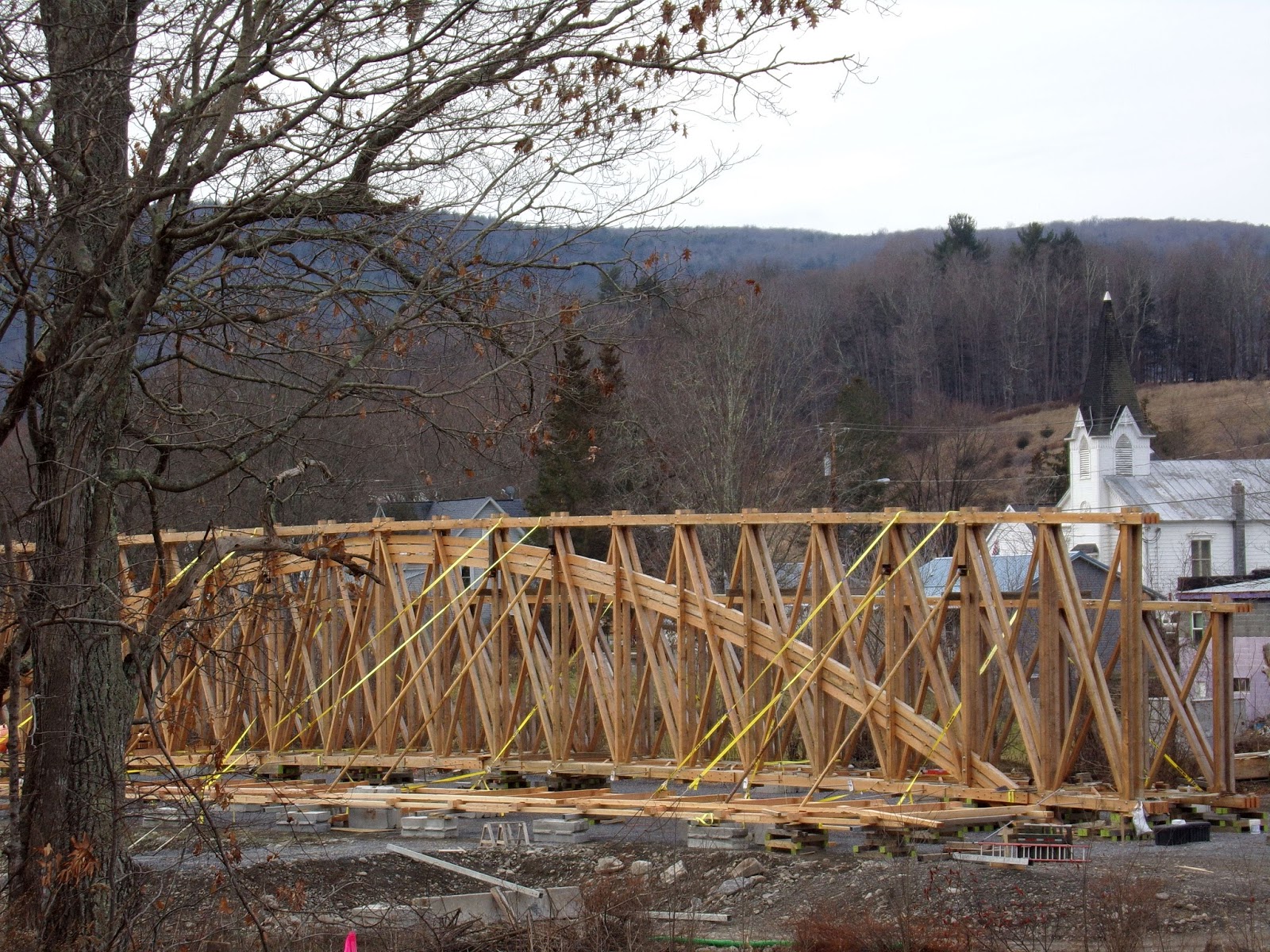

Construction of one of the sides of the new bridge in December 2017.


Sources and Links:
National Historic Landmarks Program - Old Blenheim Bridge
New York State Covered Bridge Society - Blenheim Covered Bridge
Watershed Post - Schoharie County Approves Final Design for new Blenheim Bridge 
Cobleskill Times-Journal - Work on Blenheim Bridge Starting Soon

Crossposted from my Blenheim Covered Bridge post at the Unlocking New York blog.

Comments

Popular posts from this blog

Crescent City Connection (New Orleans, LA)

The Crescent City Connection is a massive dual-span steel truss bridge that spans the lower Mississippi River at downtown New Orleans, about 95 river miles upstream from the mouth of the great river at the Head of Passes Light. If counted as a single bi-directional highway bridge, the parallel spans combine to form the single busiest bridge on the Mississippi River and its importance as a linchpin in the region’s transportation network cannot be overstated. While there have been various schemes over the years to construct bridges downriver from Algiers Point, this bridge has been the southernmost bridge on the Mississippi River since its initial construction in the 1950s. The years immediately following the end of World War II were a transformational period in the history of New Orleans. Already one of the great economic and cultural centers of the American Deep South, it was recognized at this time that major changes and improvements to the city’s transportation infrastructure would b...

Old US Route 99 through Tipton, Tulare, and Tagus Ranch

This summer I had a look into the alignment history of US Route 99 through the Tulare County communities of Tipton, Tulare, and Tagus Ranch.  While this slab below might seem like much it is one of the few remaining reminders of how US Route 99 was during the 1920s in Tulare County. This blog is part of the larger Gribblenation US Route 99 Page.  For more information pertaining to the other various segments of US Route 99 and it's three-digit child routes check out the link the below. Gribblenation US Route 99 Page Part 1; the history of US Route 99 in Tipton, Tulare, and Tagus Ranch Tipton and Tulare were both founded in 1872 as sidings of the Southern Pacific Railroad.  The Southern Pacific Railroad laid the groundwork for development of southern San Joaquin Valley.  Previous to the Southern Pacific Railroad travel via wagon or foot in Central California tended to avoid San Joaquin Valley in favor of the Stockton-Los Angeles Road.  The Stockton Los Ange...

Former US Route 101 and California State Route 41 through Paso Robles

Paso Robles is a city located on the Salinas River of San Luis Obispo County, California.  As originally configured the surface alignments of US Route 101 and California State Route 41 converged in downtown Paso Robles.  US Route 101 originally was aligned through Paso Robles via Spring Street.  California State Route 41 entered the City of Paso Robles via Union Road and 13th Street where it intersected US Route 101 at Spring Street.  US Route 101 and California State Route 41 departed Paso Robles southbound via a multiplex which split near Templeton.   Pictured above is the cover of the September/October 1957 California Highways & Public Works which features construction of the Paso Robles Bypass.  Pictured below is the 1935 Division of Highways Map of San Luis Obispo County which depicts US Route 101 and California State Route 41 intersecting in downtown Paso Robles.   Part 1; the history of US Route 101 and California State Route 41 i...