Gordie Howe Rising: Chronicling the Construction of a New Landmark Bridge in Detroit


On the south side of Detroit, MI, a new engineering landmark is steadily rising from the ground that will take its place among the great North American engineering achievements of the last 100 years upon completion.

Under construction for the last couple years, the Gordie Howe International Bridge is a massive cable-stayed bridge intended to span the Detroit River between Detroit, MI, USA and Windsor, ON, Canada. It will become the largest such bridge in North America and the world upon its completion and will feature A-shaped pylons that will stand 722 ft (220 m) tall, plus a center span of about 2,800 ft (853 m). First proposed in 2004 as a means of supplementing the already-existing Detroit River crossings in the area (the Ambassador Bridge and Detroit-Windsor Tunnel), the project has gone through years of legal challenges and environmental review. The existing Ambassador Bridge carries approximately 25% of all commercial merchandise trade between the USA and Canada, and the need for a new crossing in the area to relieve the pressure on the bridge has been apparent for several decades.

Under the guidance and ownership of the Windsor-Detroit Bridge Authority, a joint venture contracting team was selected for the project in 2018. Titled “Bridging North America”, this team consists of world-renowned engineering and construction firms such as AECOM (lead design firm), Dragados, Fluor, and Aecon (not to be confused with the above "AECOM") (construction contracting companies). The more than $4 billion USD project got underway in 2019 with significant land clearing for the Ports of Entry and bridge approach roadways and was originally expected to open to traffic in late 2024. Recent developments and progress updates have pushed that forecasted opening to 2025 as of September 2023.


Above: The American tower of the new Gordie Howe International Bridge takes shape in these August 2022 aerial photos

Above: The different one year makes! Here we see similar angles of the construction in these aerial photos from September 2023

Among the perks of this project are new and more modern Port of Entry facilities on both sides of the Detroit River, plus direct freeway-to-freeway access between Interstate 75 in Detroit and Highway 401 in Windsor. The existing crossings between the two countries currently rely on tedious local street connections in order to make the connection to the regional freeway networks on both sides of the border. By locating the new bridge where they have, officials on both sides of the border are aiming to increase the efficiency of this international crossing and remove excess commercial traffic from the local street grids of the two cities involved. Having said all of this, it is the strong opinion of the author of this article that both existing crossings should be kept open and maintained following the completion of the new bridge. The need for cross-border redundancy is necessary now more than ever, and the Ambassador Bridge especially is more than capable of serving admirably as a sort of “back-up” facility in the years ahead. (A recent deck replacement project was completed for this bridge in 2021 and the bridge is in otherwise very good condition.)

The new bridge being built here is named for long-time National Hockey League (NHL) star forward Gordie Howe, who’s illustrious Hall of Fame career included 25 years as a player for the local Detroit Red Wings. Howe led the Wings to four Stanley Cup championships during his tenure in Detroit and was a 23-time NHL All Star across a career that lasted an unequaled 32 seasons (interrupted by a brief retirement following the 1970-71 season). This, combined with his legendary career statistics and stature within North American professional hockey, earned him the nickname of “Mr. Hockey” throughout the continent. It is perhaps only fitting that a bridge of such towering dimensions be named for such a towering figure in his sport on both sides of the border.

As a civil engineer who has worked on large-scale bridge projects over the course of his career, this project in Detroit is one I’ve taken a strong interest in ever since its proposal and contract award. It’s a project that will be continued to be followed in the Dan household over the coming years and its one I look forward to see completed in due course. The following pictures of the construction were taken in August 2022 from ground level from the American side of the project. Click on each image to see a larger version.


The following pictures of the construction were taken in August 2022 from the air from the American side of the project. A DJI quadcopter drone was utilized for these images. This area of South Detroit offers ample opportunity to take in the scale of this project from the air, but please remember to do so safely and within the means of your experience and equipment level. Click on each image to see a larger version.
 

The following pictures of the construction were taken in September 2023 from ground level from the American side of the project. Click on each image to see a larger version.
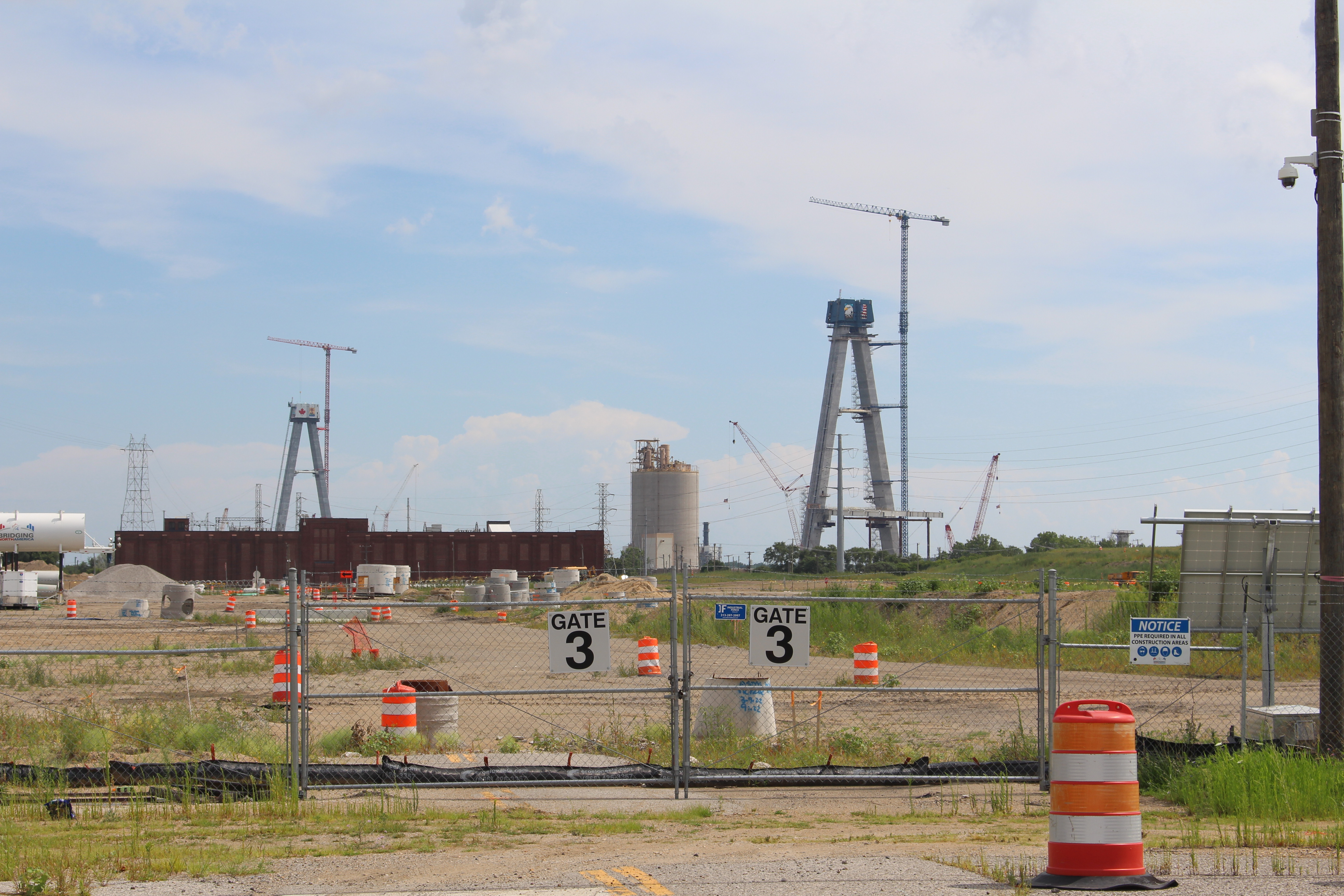

The following pictures of the construction were taken in September 2023 from the air from the American side of the project. A DJI quadcopter drone was utilized for these images. This area of South Detroit offers ample opportunity to take in the scale of this project from the air, but please remember to do so safely and within the means of your experience and equipment level. Click on each image to see a larger version.


The following pictures of the construction were taken in September 2023 from ground level from the Canadian side of the project. Click on each image to see a larger version.


The following pictures of the construction were taken in September 2023 from the air from the Canadian side of the project. A DJI quadcopter drone was utilized for these images. This area of South Windsor offers ample opportunity to take in the scale of this project from the air, but please remember to do so safely and within the means of your experience and equipment level. Click on each image to see a larger version.


Less exciting, yet just as important for the project, is the construction of new Port of Entry facilities on both sides of the bridge, plus the connecting roadways and interchanges that will connect the bridge with the freeway systems of the USA and Canada.

The following pictures of the construction were taken in September 2023 from the air from the American side of the project. Included in this set is the American Port of Entry complex and the "Michigan Interchange", connecting the bridge with Interstate 75 near mile marker 46. A DJI quadcopter drone was utilized for these images. This area of South Detroit offers ample opportunity to take in the scale of this project from the air, but please remember to do so safely and within the means of your experience and equipment level. Click on each image to see a larger version.


The following pictures of the construction were taken in September 2023 from the air from the Canadian side of the project. Included in this set is the Canadian Port of Entry complex and the roadway connection to the western terminus of Highway 401. The westernmost 7 miles (10 km) of this freeway, which connects the Detroit/Windsor area of southern Ontario with greater Toronto, was completed in 2015 as the "Herb Gray Parkway". This highway extension was a preliminary project developed as part of the larger vision for the new bridge and its connecting infrastructure network, and will be covered in a separate forthcoming blog article. A DJI quadcopter drone was utilized for these images. This area of South Windsor offers ample opportunity to take in the scale of this project from the air, but please remember to do so safely and within the means of your experience and equipment level. Click on each image to see a larger version.


How to Get There:


Comments

Popular posts from this blog

Did Caltrans just kill the G26 cutout US Route shields?

The US Route System was formally created by the American Association of State Highway Officials during November 1926.  Through the history of the system the only state to which has elected to maintain cutout US Route shields has been California.  The G26 series cutout US Route shields have become a favorite in the road enthusiast hobby and are generally considered to be much more visually pleasing than the standard Federal Highway Administration variant.  However, the G26 shield series appears to have been killed off on January 18, 2026, when Caltrans updated their Manual of Uniform Traffic Control Devices.  This blog will examine the history of the US Route shield specifications in California and what is happening with the 2026 changes.  The blog cover photo is facing towards the terminus of California State Route 136 and at a G26-2 specification US Route 395 shield.  In the background Mount Whitney can be seen in the Sierra Nevada range.   ...

May 2023 Ontario Trip (Part 3 of 3)

  Over the years, I have made plenty of trips to Ontario, crisscrossing the southern, central and eastern parts of the province. Living in Upstate New York, it's pretty easy to visit our neighbor to the north, or is that our neighbor to the west? Ottawa is one of my favorite cities to visit anywhere in the world, plus I've discovered the charm of Kingston, the waterfalls of Hamilton (which is on the same Niagara Escarpment that brings us Niagara Falls), the sheer beauty of the Bruce Peninsula, and more. But I hadn't explored much of Cottage Country. So I decided to change that, and what better time to go than over Memorial Day weekend, when the daylight is long and I have an extra day to explore. On the third and final day of my trip, I started in Huntsville and made my way through Muskoka District and Haliburton County, passing by many lakes along the way. I stopped in towns such as Dorset, Haliburton and Bancroft before making a beeline down to Belleville and then over th...

Ghost Town Tuesday; Nichols, FL

A couple years ago I spent a lot of spare time exploring phosphate mining ghost towns in the Bone Valley of Polk County, Florida.  One ghost town in particular called Nichols on Polk County Route 676 west of Mulberry caught my eye due to a relative lack of documentation on ghosttowns.com. Nichols was created in 1905 during the early phosphate mining boom in the Bone Valley region.  For the time Nichols was unusual since it had company housing in the Nichols Mine site and private residences outside the gate.  Nichols is only about two miles west of Mulberry which probably made it a somewhat reasonable commute even by the wonky standards of the early 20th Century.  Most of the Bone Valley region was relatively remote which made commuting or homesteading impractical which is why there are so many ghost towns in the area.  The company housing section of Nichols was phased out and abandoned by 1950. The Nichols town site is largely abandoned and could "possibl...