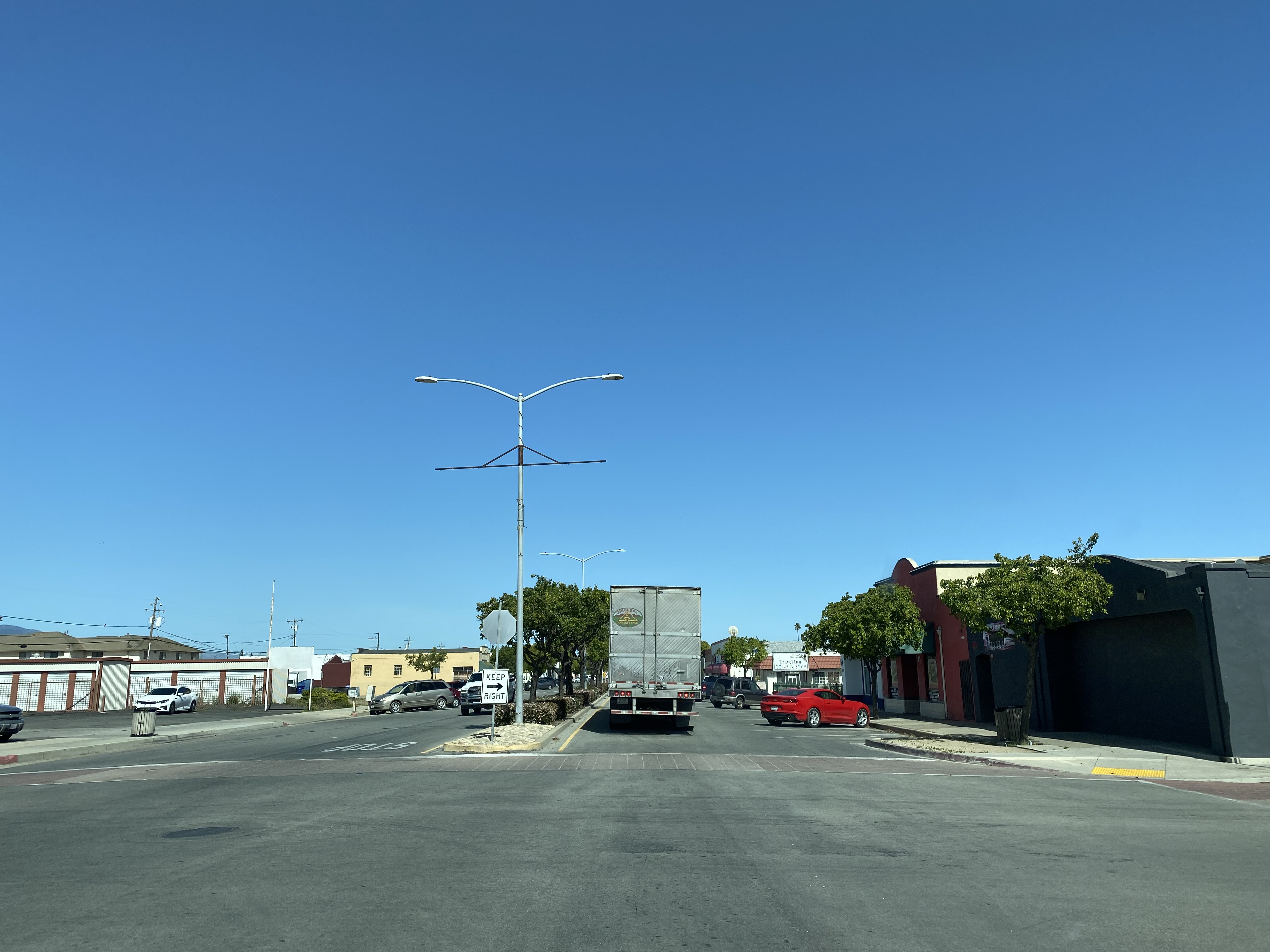
Former US Route 101 on El Camino Real in Greenfield

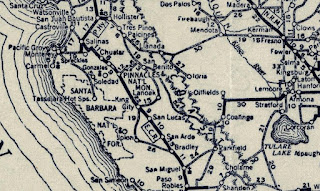
Greenfield is a city located in Salinas Valley of Monterey County, California.  Modern US Route 101 is aligned through Greenfield via a freeway bypass which opened during 1961.  The original alignment of US Route 101 in Greenfield was aligned directly through the community on El Camino Real.  Above the cover photo of this blog features a view of former US Route 101 in Greenfield facing north on El Camino Real.  Below Greenfield can be seen along US Route 101 on the 1935 Division of Highways Map of Monterey County


Part 1; the history of US Route 101 in Greenfield

During 1902 the California Home Extension Association purchased 4,000 acres of land about the Southern Pacific Railroad in Salinas Valley at what had been Rancho Arroyo Seco.  The land was put to sale in Los Angeles during 1905 which led to the plotting of a town which was originally to known as "Clark City" in honor of then California Home Extension Association founder John S. Clark.  Ultimately the town site was named "Greenfield" in honor of then California Home Extension Association President Edward Greenfield. 

Salinas Valley was ultimately part of the American El Camino Real which began being signed as an Auto Trail starting in 1906.  The era of State Highway Maintenance through Salinas Valley would ultimately begin with the 1909 First State Highway Bond Act which was approved by voters in 1910.  One of the highways approved through the 1909 First State Highway Bond Act was a 481.8-mile highway originating at the City Limits of San Francisco which terminated in San Diego.  This highway would ultimately come to be known in time as Legislative Route Number 2 ("LRN 2").  Within Salinas Valley much of LRN 2 would follow the existing corridor along the frontage roads of the Southern Pacific Railroad which included the community of Greenfield.  

The July 1914 California Highway Bulletin notes surveys for the location of LRN 2 from Greenfield to Camphora were complete.  LRN 2 between Greenfield and King City had been laid out as a 15-foot-wide highway during October 1912.  


Greenfield can be seen on the 1917 California State Automobile Association Map along LRN 2.  LRN 2 is displayed to be aligned on what is now El Camino Real through the community.  
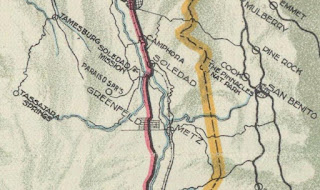

The 1920 Rand McNally Highway Map of California shows El Camino Real and the Pacific Highway following LRN 2 through Greenfield.  


The 1924 Rand McNally Map of California shows the California Banff Bee-Line Highway co-signed with the Pacific Highway through Greenfield. 


The initial draft of the US Route System was approved by the Secretary of Agriculture during November of 1925.  The US Route System within California was approved by California Highway Commission with no changes recommended by January 1926.  The initial alignment of US Route 101 ("US 101") was planned to follow LRN 2 from San Francisco to San Diego via Salinas Valley.  US 101 is shown on a map published in the 1926 California Highways & Public Works following LRN 2 south from San Francisco towards San Diego.


During November of 1926 the US Route System was approved by the ASSHO.  US Route 101 can be seen aligned through Greenfield on the 1926 Rand McNally Junior Map of California.  


The January/February 1929 California Highways & Public Works noted part of US Route 101/LRN 2 between Greenfield and King City was in the process of being widened to 30-feet.


The January/February 1933 California Highways & Public Works announced the full widening of US Route 101/LRN 2 between Greenfield and King City as part of the 1933-35 budget.  The existing 15-foot-wide surface between Greenfield and King City is noted to be failing.


The July 1934 California Highways & Public Works announced the widening of US Route 101/LRN 2 between Greenfield and King City to a 36-foot-wide roadbed as being complete.  

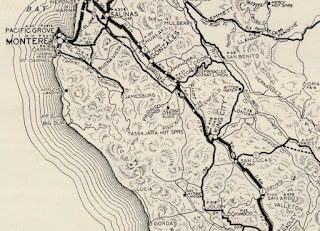
Below Greenfield can be seen along US Route 101/LRN 2 on the 1935 Division of Highways Map of Monterey County


The January 1940 California Highways & Public Works announced the resurfacing of US Route 101/LRN 2 through Greenfield had been awarded via contract.  


Greenfield would incorporate as a city on January 7, 1947.  The November/December 1956 California Highways & Public Works announced the widening of US Route 101/LRN 2 to four-lane expressway standards from 1.8 miles north of the Salinas River to 2 miles south of Greenfield as being budgeted for the 1957-58 Fiscal Year.  A second expressway project is listed as beginning 1 mile north of Greenfield to the Salinas River near Soledad.  


The May/June 1957 California Highways & Public Works notes the expressway expansion of US Route 101/LRN 2 between Greenfield and Soledad was underway.  The expressway expansion of US Route 101/LRN 2 between Greenfield and King City is noted to have been completed the previous February.  


The July/August 1958 California Highways & Public Works features the completed US Route 101/LRN 2 expressway between Greenfield and Soledad.  An attached project map notes a freeway agreement between the Division of Highways and the city of Greenfield had been reached.  


The October/November 1959 California Highways & Public Works announced the design and right-of-way acquisition of the US Route 101/LRN 2 freeway bypass of Greenfield were complete.  


The November/December 1959 California Highways & Public Works announced construction of the US Route 101/LRN 2 freeway bypass of Greenfield was budgeted for the 1960-61 Fiscal Year.  


The November/December 1961 California Highways & Public Works announced US Route 101/LRN 2 in Greenfield had been shifted to a new freeway bypass.  


The 1964 State Highway Renumbering all the Legislative Routes Numbers were dropped.  This measure left US Route 101 as the sole State Highway designation through Greenfield.  


Part 2; a drive on former US Route 101 in Greenfield on El Camino Real

From modern US Route 101 northbound traffic can access the original alignment through Greenfield on El Camino Real via Exit 297.


El Camino Real northbound enters downtown Greenfield and intersects Monterey County Route G16 at Elm Avenue.


El Camino Real northbound passes through downtown Greenfield and loops back to modern US Route 101. 


Comments

Popular posts from this blog

Did Caltrans just kill the G26 cutout US Route shields?

The US Route System was formally created by the American Association of State Highway Officials during November 1926.  Through the history of the system the only state to which has elected to maintain cutout US Route shields has been California.  The G26 series cutout US Route shields have become a favorite in the road enthusiast hobby and are generally considered to be much more visually pleasing than the standard Federal Highway Administration variant.  However, the G26 shield series appears to have been killed off on January 18, 2026, when Caltrans updated their Manual of Uniform Traffic Control Devices.  This blog will examine the history of the US Route shield specifications in California and what is happening with the 2026 changes.  The blog cover photo is facing towards the terminus of California State Route 136 and at a G26-2 specification US Route 395 shield.  In the background Mount Whitney can be seen in the Sierra Nevada range.   ...

May 2023 Ontario Trip (Part 3 of 3)

  Over the years, I have made plenty of trips to Ontario, crisscrossing the southern, central and eastern parts of the province. Living in Upstate New York, it's pretty easy to visit our neighbor to the north, or is that our neighbor to the west? Ottawa is one of my favorite cities to visit anywhere in the world, plus I've discovered the charm of Kingston, the waterfalls of Hamilton (which is on the same Niagara Escarpment that brings us Niagara Falls), the sheer beauty of the Bruce Peninsula, and more. But I hadn't explored much of Cottage Country. So I decided to change that, and what better time to go than over Memorial Day weekend, when the daylight is long and I have an extra day to explore. On the third and final day of my trip, I started in Huntsville and made my way through Muskoka District and Haliburton County, passing by many lakes along the way. I stopped in towns such as Dorset, Haliburton and Bancroft before making a beeline down to Belleville and then over th...

Ghost Town Tuesday; Nichols, FL

A couple years ago I spent a lot of spare time exploring phosphate mining ghost towns in the Bone Valley of Polk County, Florida.  One ghost town in particular called Nichols on Polk County Route 676 west of Mulberry caught my eye due to a relative lack of documentation on ghosttowns.com. Nichols was created in 1905 during the early phosphate mining boom in the Bone Valley region.  For the time Nichols was unusual since it had company housing in the Nichols Mine site and private residences outside the gate.  Nichols is only about two miles west of Mulberry which probably made it a somewhat reasonable commute even by the wonky standards of the early 20th Century.  Most of the Bone Valley region was relatively remote which made commuting or homesteading impractical which is why there are so many ghost towns in the area.  The company housing section of Nichols was phased out and abandoned by 1950. The Nichols town site is largely abandoned and could "possibl...