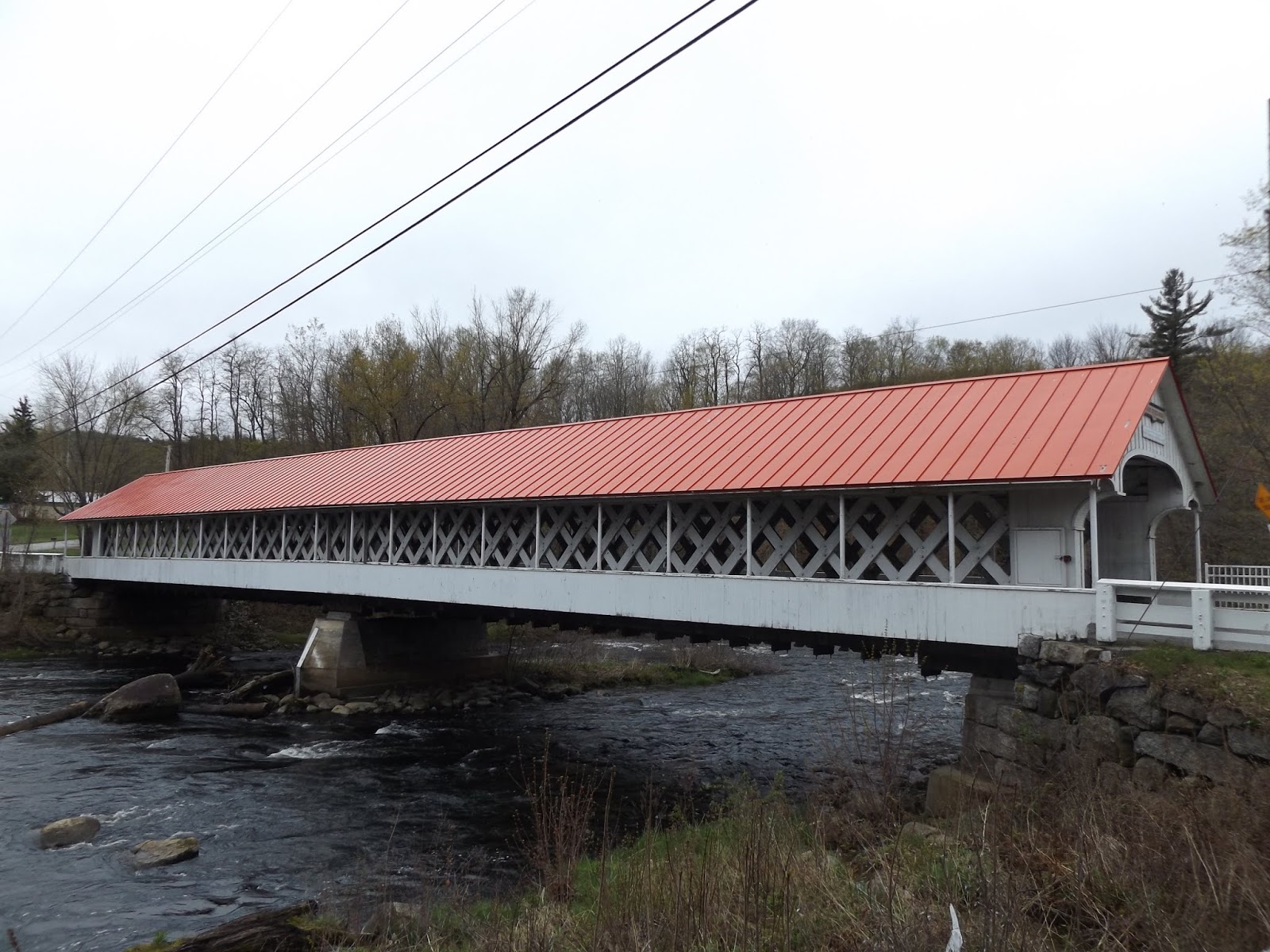
Ashuelot Covered Bridge - New Hampshire


New Hampshire has dozens of covered bridges that grace their presence throughout the Granite State. One such covered bridge is the Ashuelot Covered Bridge, which spans over the Ashuelot River in the Cheshire County community of Ashuelot. Built by master covered bridge builder Nicholas Powers in 1864 at a length of 169 feet, the bridge is designed in the Town lattice style of covered bridges developed by Ithiel Town in 1820 and was rehabilitated in 1999. The bridge was built of the Ashuelot Covered Bridge is considered by local historians to be one of New Hampshire's most elaborate covered bridges. The original purpose of the bridge was to transport wood across the river for use by the Ashuelot Railroad, as the railroad had a station in the upper village of Ashuelot. Eventually, the bridge was converted for use by motor vehicles. At times. this covered bridge has also been called the Village Bridge or Village Station Bridge.


The beauty of the Ashuelot Covered Bridge, as of other covered bridges, is that it is still carrying out its original purpose, to get people and goods from Point A to Point B. There are covered walkways on each end of the bridge, so pedestrians and the occasional vehicle (the bridge sees an average of 510 vehicles a day) don't have to intermingle. At times, special events take place on the bridge, such as an annual dinner event that takes place. But in the end, the covered bridge is about bridging together the community, both now and then.


How to Get There:


Sources and Links:
Ashuelot Bridge - New Hampshire Covered Bridges
Ashuelot Covered Bridge - Bridgehunter.com
New England: True Northeast; Covered Bridge; Ashuelot, N.H. - New York Times  (June 3, 2001)

Comments

Anonymous said…
The Ashuelot covered bridge was NOT built to carry wood across the river for the Ashuelot Railroad. There was plenty of wood on both sides of the railroad. It was built during the Civil War to bring raw materials to the Ashuelot Manufacturing Company that was located on the opposite side of the river and to bring the finished woolen cloths to the railroad. The legend of the "carrying wood" began in the early 1950s when someone speculated in a newspaper article. That legend refuses to die.

Popular posts from this blog

Crescent City Connection (New Orleans, LA)

The Crescent City Connection is a massive dual-span steel truss bridge that spans the lower Mississippi River at downtown New Orleans, about 95 river miles upstream from the mouth of the great river at the Head of Passes Light. If counted as a single bi-directional highway bridge, the parallel spans combine to form the single busiest bridge on the Mississippi River and its importance as a linchpin in the region’s transportation network cannot be overstated. While there have been various schemes over the years to construct bridges downriver from Algiers Point, this bridge has been the southernmost bridge on the Mississippi River since its initial construction in the 1950s. The years immediately following the end of World War II were a transformational period in the history of New Orleans. Already one of the great economic and cultural centers of the American Deep South, it was recognized at this time that major changes and improvements to the city’s transportation infrastructure would b...

Old US Route 99 through Tipton, Tulare, and Tagus Ranch

This summer I had a look into the alignment history of US Route 99 through the Tulare County communities of Tipton, Tulare, and Tagus Ranch.  While this slab below might seem like much it is one of the few remaining reminders of how US Route 99 was during the 1920s in Tulare County. This blog is part of the larger Gribblenation US Route 99 Page.  For more information pertaining to the other various segments of US Route 99 and it's three-digit child routes check out the link the below. Gribblenation US Route 99 Page Part 1; the history of US Route 99 in Tipton, Tulare, and Tagus Ranch Tipton and Tulare were both founded in 1872 as sidings of the Southern Pacific Railroad.  The Southern Pacific Railroad laid the groundwork for development of southern San Joaquin Valley.  Previous to the Southern Pacific Railroad travel via wagon or foot in Central California tended to avoid San Joaquin Valley in favor of the Stockton-Los Angeles Road.  The Stockton Los Ange...

Former US Route 101 and California State Route 41 through Paso Robles

Paso Robles is a city located on the Salinas River of San Luis Obispo County, California.  As originally configured the surface alignments of US Route 101 and California State Route 41 converged in downtown Paso Robles.  US Route 101 originally was aligned through Paso Robles via Spring Street.  California State Route 41 entered the City of Paso Robles via Union Road and 13th Street where it intersected US Route 101 at Spring Street.  US Route 101 and California State Route 41 departed Paso Robles southbound via a multiplex which split near Templeton.   Pictured above is the cover of the September/October 1957 California Highways & Public Works which features construction of the Paso Robles Bypass.  Pictured below is the 1935 Division of Highways Map of San Luis Obispo County which depicts US Route 101 and California State Route 41 intersecting in downtown Paso Robles.   Part 1; the history of US Route 101 and California State Route 41 i...