
While recently in the Stockton Area of San Joaquin County I drove a portion of what was the original alignment of US Route 99 on modern day Signed County Route J9/French Camp Road.
The original alignment of US Route 99 and County Route J9
Specifically, the original alignment of US Route 99 ("US 99") ran from the California State Route 99 ("CA 99") Freeway west Frontage Road westward on Sign County Route J9 ("CR J9") via French Camp Road to El Dorado Street in French Camp. Originally US 99 had an elongated alignment south of Stockton. US 99
southbound entered Stockton on Wilson Way where turned west on Charter
Way and south on McKinley Avenue. US 99 continued south to French Camp
via El Dorado Road and onto French Camp Road where it met US 48 at Harlan Road. US 99
continued southeast on French Camp Road to Main Street in Manteca. This alignment endpoint of US 48 can be viewed on USends.com.
USends.com on US 48 (i)
Early US 99 from Stockton en route to Manteca by way of French Camp can be seen on the 1927 Rand McNally Map of California.

In 1928 State Maintenance of Legislative Route 4 ("LRN 4") out of Stockton shifted to Mariposa Road. This eventually led to a request by the State of California to the AASHO to extend the east terminus of US 48 to Stockton and create a US 48N to Oakland. The request was for US 48 was borne out of US 99 moving out of French Camp to the new direct alignment between Stockton-Manteca. The AASHO rejected this concept but offered an alternative which truncated US 48 from San Jose to Hayward and from French Camp to Mossdale. This alternative conceptualized US 101E and the US 99W/US 99E split from Stockton-Manteca. The truncation of US 48, creation of US 101E, and the US 99W/US 99E Stockton-Manteca split was approved in April of 1929 by the AASHO.


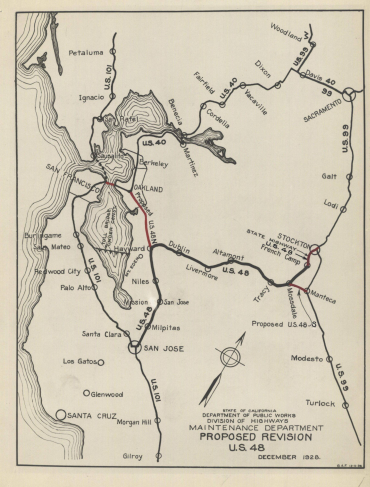



US 99E largely followed the current CA 99 freeway south to Manteca. US
99W followed McKinley Avenue, El Dorado Street and French Camp Road south to French Camp.
From French Camp US 99W continued south to Lanthrop on Harlan Road and
Manthey Road where it met the new terminus with US 48. At Yosemite
Avenue/LRN 66 the route of US 99W turned eastward towards US 99E in Manteca. The split in
US 99W and US 99E in Stockton can be observed on the 1930 Division of Highways State Map.
1930 Division of Highways State Map

1930 Division of Highways State Map City Insert

The map I prepared below shows how US 99 was aligned in the French Camp Area compared to the original route of US 48 and the early Lincoln Highway.

My approach to CR J9 on French Camp was on CA 99 northbound from Exit 246.


From the exit ramp of CA 99 I turned west on CR J9/French Camp Road.


After crossing west under the CA 99 Freeway the route of CR J9/French Camp Road picks up the original alignment of US 99. US 99 would have come in from the left in the second picture heading north out of Manteca on the west CA 99 Frontage Road.


Unlike many of the J band County Routes the path of CR J9 is somewhat well signed on French Camp Road.

As a route CR J9 is a 44.05 mile highway which begins at CR J17 in Stanislaus County. CR J9 traverses northwest and terminated at I-5 in French Camp. According to CAhighways.org CR J9 was created in 1960.
CAhighways.org on CR J9
CR J9/French Camp Road crosses over a set of railroad tracks westbound and meets CR J3 on Airport Way on the outskirts of French Camp.


CR J9/French Camp Road enters French Camp proper west of CR J3 and crosses another set of railroad tracks.


French Camp is the oldest community in modern day San Joaquin County having been settled in 1832. French Camp was the southern terminus of a trail used by trappers bound for Oregon who were employed by the Hudson Bay Company. By the American Gold Rush period French Camp and French Camp Road became an important winter alternate to the Stockton-Los Angeles Road which was on a better grade than the mainline Mariposa Road grade out of Stockton. French Camp was along the original 1913 route of the Lincoln Highway which passes through the community westbound via; McKinley Avenue, French Camp Road, Ash Street and Harlan Road.

CR J9/French Camp Road is signed as the Historic Lincoln Highway Ash Street likely west to I-5. Much of the original alignment of the Lincoln Highway north of French Camp to Stockton has been consumed by I-5.

The Lincoln Highway appears to have bypassed most of French Camp via El Dorado Street, French Camp Road and Harlan Road by 1918. This can be seen by comparing the 1917 CSAA State Map to the 1918 State Highway Map. The 1918 route of the Lincoln Highway essentially was the same as early US 99 and US 48.
1917 CSAA Map
1918 State Highway Map
CR J9/French Camp Road crosses another set of rails and meets Harlan Road. Harlan Road was the original terminus of US Route 48 at US 99 in French Camp and was part of the post 1918 alignment of the Lincoln Highway. US 99 would have continued right from the traffic light in the second photo northbound to Stockton via El Dorado Street. US 48 in French Camp was later replaced by US 99W likely in 1929 and by US 50 likely by 1935. By 1928 the Lincoln Highway had been realigned to follow US 40 to the San Francisco Bay Area west from Sacramento which bypassed the former route through French Camp.


Interest in French Camp Road becoming a State Highway was renewed in 1959 when Legislative Route Number 261 was created by the Legislature. LRN 261 was slated to be French Camp Road between was US 99 and US 50. During the 1964 State Highway Renumbering LRN 261 was reassigned CA 234 but the route was never assumed under State Maintenance.
CAhighways.org on CA 234
Comments