
California State Route 77; the real "Shortest Signed" State Highway


Over the last two weeks I visited almost every State Highway in the San Francisco Bay Area.  The shortest State Highway by a large margin in the Bay Area is California State Route 77.

CA 77 is presently only 0.45 miles in length and is located entirely within the City of Oakland.  CA 77 begins at Interstate 880 and heads eastward on 42nd Avenue to CA 185 on 14th Street.

 
As presently completed CA 77 would rank as the fourth shortest State Highway only behind CA 225, CA 275 and CA 283.

CAhighways.org list of Shortest State Highways

CA 77 presently has a 13.4 mile portion that has not been constructed.  CA 77 as originally envisioned would have continued northeast towards Concord and would have junctions with; I-580, unbuilt CA 93, CA 24, I-680 and CA 242.  According to CAhighways.org the present route of CA 77 was designated as Legislative Route Number 233 which was approved by the State Legislature in 1953.  The legislative description of LRN 233 was changed to LRN 235 by 1957.

CAhighways.org on CA 77

CAhighways.org on LRN 235

The path of LRN 233 first appears on the 1954 State Highway Map City Insert.


The designation of LRN 235 replaces LRN 233 on the 1958 State Highway Map City Insert.


By 1963 the portion of LRN 235 between CA 17 on the Nimitz Freeway (current I-880) and LRN 105 (present CA 185) is shown completed.


During the 1964 State Highway Renumbering LRN 235 was reassigned as CA 77.


According to CA 77 the planned route of CA 77 was cut back to CA 24 in Layayette by 1975.  This is reflected on the 1977 State Highway Map City Insert.


Note; as completed in 1963 the configuration of LRN 235/CA 77 was a freeway with free flowing ramps to/from CA 17/I-880 northbound.  Said ramps were reconfigured in 2012 into the at-grade ramps present at the western terminus of CA 77.

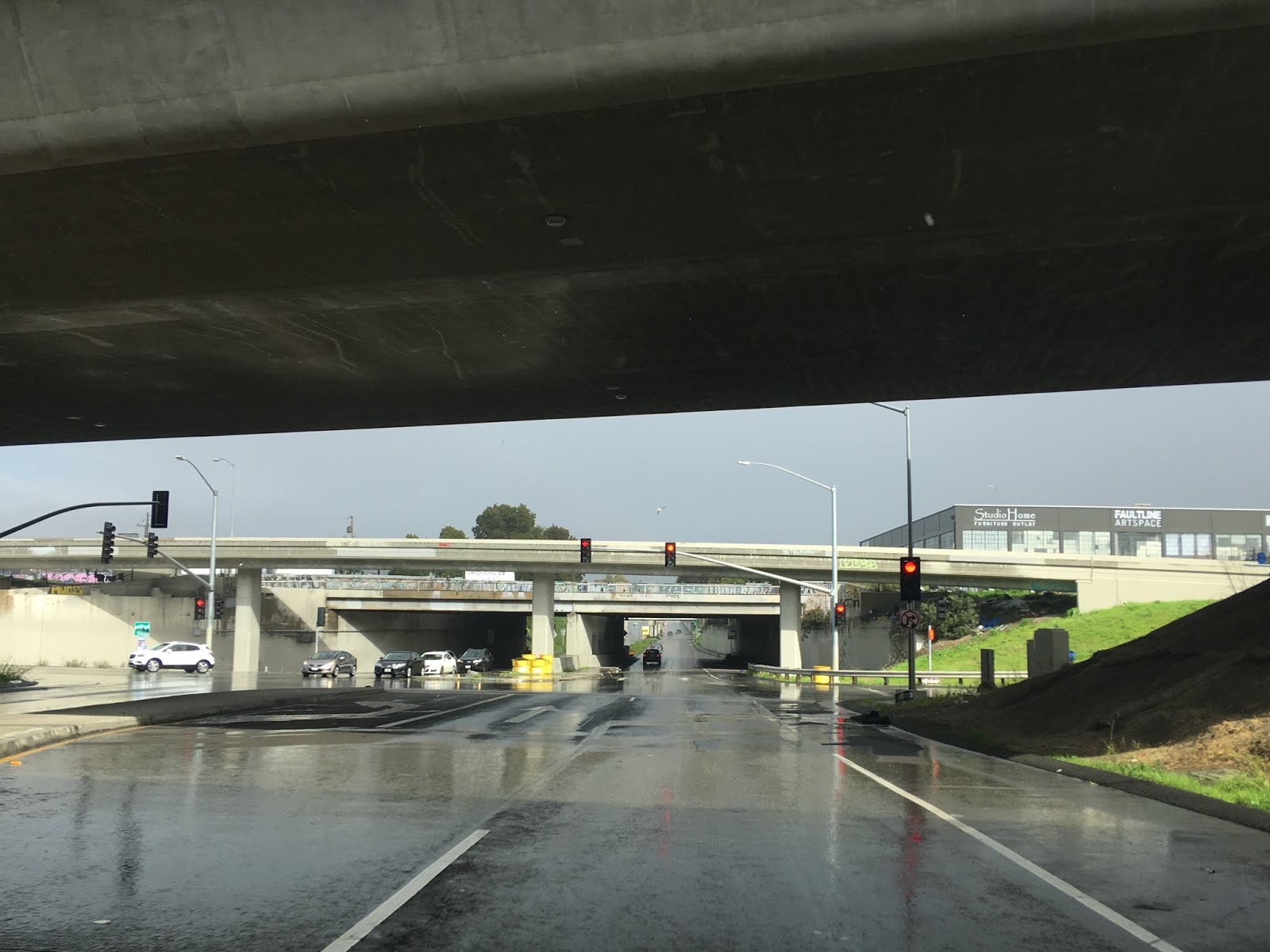
Access to CA 77 can be obtained from I-880 via Exit 38.  Oddly High Street is signed from I-880 and not 42nd Avenue even though that is the direct connection.  From I-880 there is not CA 77 signage, the downpour was about as miserable as it looks.


From the exit ramp CA 77 begins with a left hand turn onto 42nd Avenue.  Again there is no CA 77 shields to be found.


CA 77 east travels under both travel lanes of I-880 and essentially is limited access (albeit not a freeway).


Between the northbound lanes of I-880 and on-ramp from Coliseum Way the first CA 77 reassurance shield appears.   CA 77 east even features an off-ramp to 12th Street which can be seen in the second photo below.


The CA 77 reassurance shield makes it the real "shortest" signed State Highway and not CA 153 which is often proclaimed as such.  My previous blog entry on CA 153 can be found below.

California State Route 153; the supposedly shortest State Highway

CA 77 east even has a second reassurance shield before it terminates at CA 185 at 14th Street.


Comments

Littledots said…
Hi, I was researching the 42nd Ave freeway entrance for my blog and came across your page. Great photos. I am writing a page on the "Bancroft Parkway" which began at the San Leandro border on Bancroft and ended at 42nd Ave with entrance to the Nimitz (880) Freeway. Bancroft Parkway - Oakland Tribune November 25, 1956 -https://www.newspapers.com/clip/67723058/bancroft-parkway-nov-25-1956/
Littledots@yahoo.com

Popular posts from this blog

Crescent City Connection (New Orleans, LA)

The Crescent City Connection is a massive dual-span steel truss bridge that spans the lower Mississippi River at downtown New Orleans, about 95 river miles upstream from the mouth of the great river at the Head of Passes Light. If counted as a single bi-directional highway bridge, the parallel spans combine to form the single busiest bridge on the Mississippi River and its importance as a linchpin in the region’s transportation network cannot be overstated. While there have been various schemes over the years to construct bridges downriver from Algiers Point, this bridge has been the southernmost bridge on the Mississippi River since its initial construction in the 1950s. The years immediately following the end of World War II were a transformational period in the history of New Orleans. Already one of the great economic and cultural centers of the American Deep South, it was recognized at this time that major changes and improvements to the city’s transportation infrastructure would b...

Old US Route 99 through Tipton, Tulare, and Tagus Ranch

This summer I had a look into the alignment history of US Route 99 through the Tulare County communities of Tipton, Tulare, and Tagus Ranch.  While this slab below might seem like much it is one of the few remaining reminders of how US Route 99 was during the 1920s in Tulare County. This blog is part of the larger Gribblenation US Route 99 Page.  For more information pertaining to the other various segments of US Route 99 and it's three-digit child routes check out the link the below. Gribblenation US Route 99 Page Part 1; the history of US Route 99 in Tipton, Tulare, and Tagus Ranch Tipton and Tulare were both founded in 1872 as sidings of the Southern Pacific Railroad.  The Southern Pacific Railroad laid the groundwork for development of southern San Joaquin Valley.  Previous to the Southern Pacific Railroad travel via wagon or foot in Central California tended to avoid San Joaquin Valley in favor of the Stockton-Los Angeles Road.  The Stockton Los Ange...

Former US Route 101 and California State Route 41 through Paso Robles

Paso Robles is a city located on the Salinas River of San Luis Obispo County, California.  As originally configured the surface alignments of US Route 101 and California State Route 41 converged in downtown Paso Robles.  US Route 101 originally was aligned through Paso Robles via Spring Street.  California State Route 41 entered the City of Paso Robles via Union Road and 13th Street where it intersected US Route 101 at Spring Street.  US Route 101 and California State Route 41 departed Paso Robles southbound via a multiplex which split near Templeton.   Pictured above is the cover of the September/October 1957 California Highways & Public Works which features construction of the Paso Robles Bypass.  Pictured below is the 1935 Division of Highways Map of San Luis Obispo County which depicts US Route 101 and California State Route 41 intersecting in downtown Paso Robles.   Part 1; the history of US Route 101 and California State Route 41 i...