
California State Route 77; the real "Shortest Signed" State Highway


Over the last two weeks I visited almost every State Highway in the San Francisco Bay Area.  The shortest State Highway by a large margin in the Bay Area is California State Route 77.

CA 77 is presently only 0.45 miles in length and is located entirely within the City of Oakland.  CA 77 begins at Interstate 880 and heads eastward on 42nd Avenue to CA 185 on 14th Street.

 
As presently completed CA 77 would rank as the fourth shortest State Highway only behind CA 225, CA 275 and CA 283.

CAhighways.org list of Shortest State Highways

CA 77 presently has a 13.4 mile portion that has not been constructed.  CA 77 as originally envisioned would have continued northeast towards Concord and would have junctions with; I-580, unbuilt CA 93, CA 24, I-680 and CA 242.  According to CAhighways.org the present route of CA 77 was designated as Legislative Route Number 233 which was approved by the State Legislature in 1953.  The legislative description of LRN 233 was changed to LRN 235 by 1957.

CAhighways.org on CA 77

CAhighways.org on LRN 235

The path of LRN 233 first appears on the 1954 State Highway Map City Insert.


The designation of LRN 235 replaces LRN 233 on the 1958 State Highway Map City Insert.


By 1963 the portion of LRN 235 between CA 17 on the Nimitz Freeway (current I-880) and LRN 105 (present CA 185) is shown completed.


During the 1964 State Highway Renumbering LRN 235 was reassigned as CA 77.


According to CA 77 the planned route of CA 77 was cut back to CA 24 in Layayette by 1975.  This is reflected on the 1977 State Highway Map City Insert.


Note; as completed in 1963 the configuration of LRN 235/CA 77 was a freeway with free flowing ramps to/from CA 17/I-880 northbound.  Said ramps were reconfigured in 2012 into the at-grade ramps present at the western terminus of CA 77.

Access to CA 77 can be obtained from I-880 via Exit 38.  Oddly High Street is signed from I-880 and not 42nd Avenue even though that is the direct connection.  From I-880 there is not CA 77 signage, the downpour was about as miserable as it looks.


From the exit ramp CA 77 begins with a left hand turn onto 42nd Avenue.  Again there is no CA 77 shields to be found.


CA 77 east travels under both travel lanes of I-880 and essentially is limited access (albeit not a freeway).
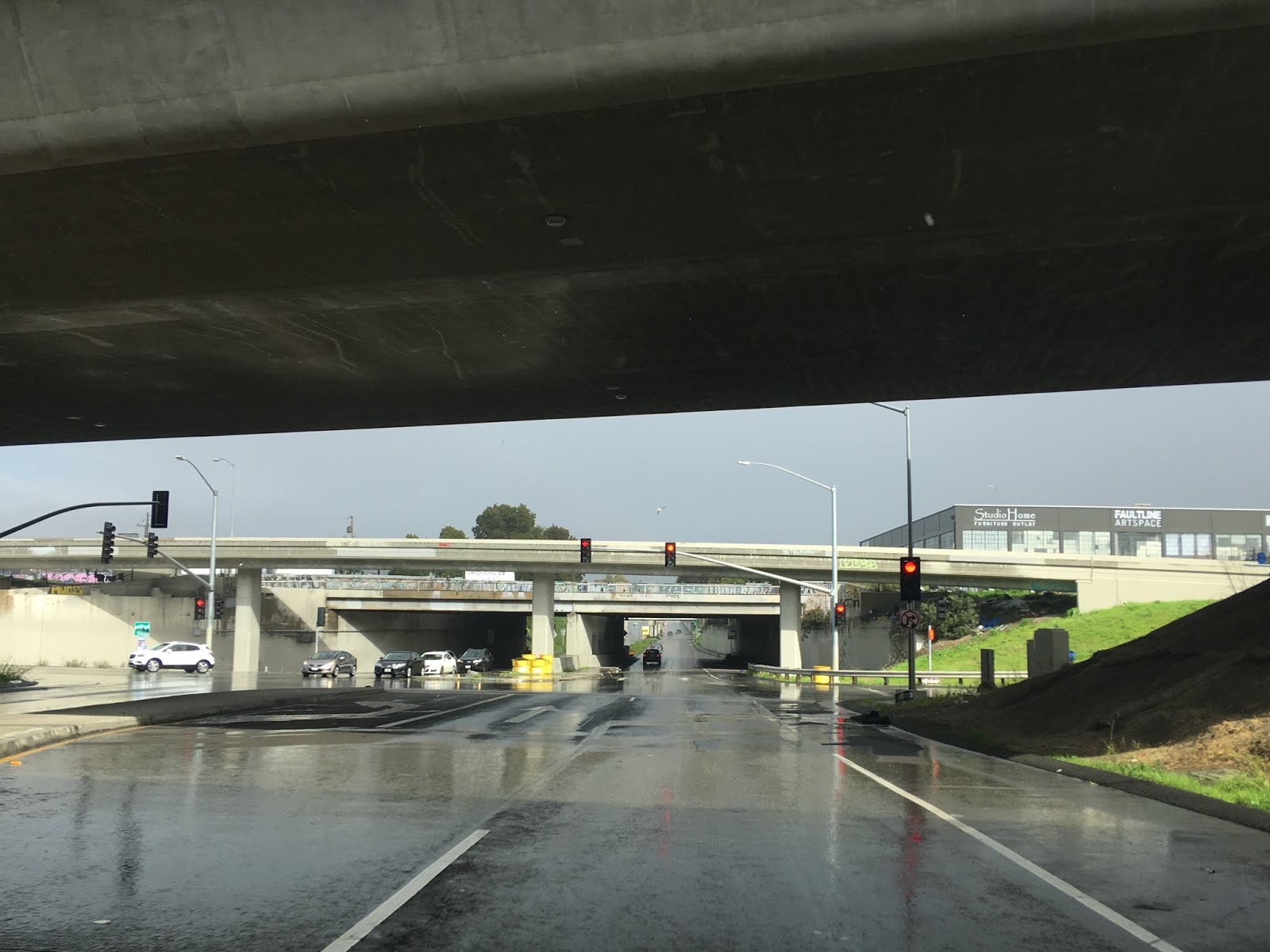


Between the northbound lanes of I-880 and on-ramp from Coliseum Way the first CA 77 reassurance shield appears.   CA 77 east even features an off-ramp to 12th Street which can be seen in the second photo below.


The CA 77 reassurance shield makes it the real "shortest" signed State Highway and not CA 153 which is often proclaimed as such.  My previous blog entry on CA 153 can be found below.

California State Route 153; the supposedly shortest State Highway

CA 77 east even has a second reassurance shield before it terminates at CA 185 at 14th Street.


Comments

Littledots said…
Hi, I was researching the 42nd Ave freeway entrance for my blog and came across your page. Great photos. I am writing a page on the "Bancroft Parkway" which began at the San Leandro border on Bancroft and ended at 42nd Ave with entrance to the Nimitz (880) Freeway. Bancroft Parkway - Oakland Tribune November 25, 1956 -https://www.newspapers.com/clip/67723058/bancroft-parkway-nov-25-1956/
Littledots@yahoo.com

Popular posts from this blog

Did Caltrans just kill the G26 cutout US Route shields?

The US Route System was formally created by the American Association of State Highway Officials during November 1926.  Through the history of the system the only state to which has elected to maintain cutout US Route shields has been California.  The G26 series cutout US Route shields have become a favorite in the road enthusiast hobby and are generally considered to be much more visually pleasing than the standard Federal Highway Administration variant.  However, the G26 shield series appears to have been killed off on January 18, 2026, when Caltrans updated their Manual of Uniform Traffic Control Devices.  This blog will examine the history of the US Route shield specifications in California and what is happening with the 2026 changes.  The blog cover photo is facing towards the terminus of California State Route 136 and at a G26-2 specification US Route 395 shield.  In the background Mount Whitney can be seen in the Sierra Nevada range.   ...

May 2023 Ontario Trip (Part 3 of 3)

  Over the years, I have made plenty of trips to Ontario, crisscrossing the southern, central and eastern parts of the province. Living in Upstate New York, it's pretty easy to visit our neighbor to the north, or is that our neighbor to the west? Ottawa is one of my favorite cities to visit anywhere in the world, plus I've discovered the charm of Kingston, the waterfalls of Hamilton (which is on the same Niagara Escarpment that brings us Niagara Falls), the sheer beauty of the Bruce Peninsula, and more. But I hadn't explored much of Cottage Country. So I decided to change that, and what better time to go than over Memorial Day weekend, when the daylight is long and I have an extra day to explore. On the third and final day of my trip, I started in Huntsville and made my way through Muskoka District and Haliburton County, passing by many lakes along the way. I stopped in towns such as Dorset, Haliburton and Bancroft before making a beeline down to Belleville and then over th...

Ghost Town Tuesday; Nichols, FL

A couple years ago I spent a lot of spare time exploring phosphate mining ghost towns in the Bone Valley of Polk County, Florida.  One ghost town in particular called Nichols on Polk County Route 676 west of Mulberry caught my eye due to a relative lack of documentation on ghosttowns.com. Nichols was created in 1905 during the early phosphate mining boom in the Bone Valley region.  For the time Nichols was unusual since it had company housing in the Nichols Mine site and private residences outside the gate.  Nichols is only about two miles west of Mulberry which probably made it a somewhat reasonable commute even by the wonky standards of the early 20th Century.  Most of the Bone Valley region was relatively remote which made commuting or homesteading impractical which is why there are so many ghost towns in the area.  The company housing section of Nichols was phased out and abandoned by 1950. The Nichols town site is largely abandoned and could "possibl...