Kingston, NY's New Roundabout Intersection Gets High Marks from Travelers


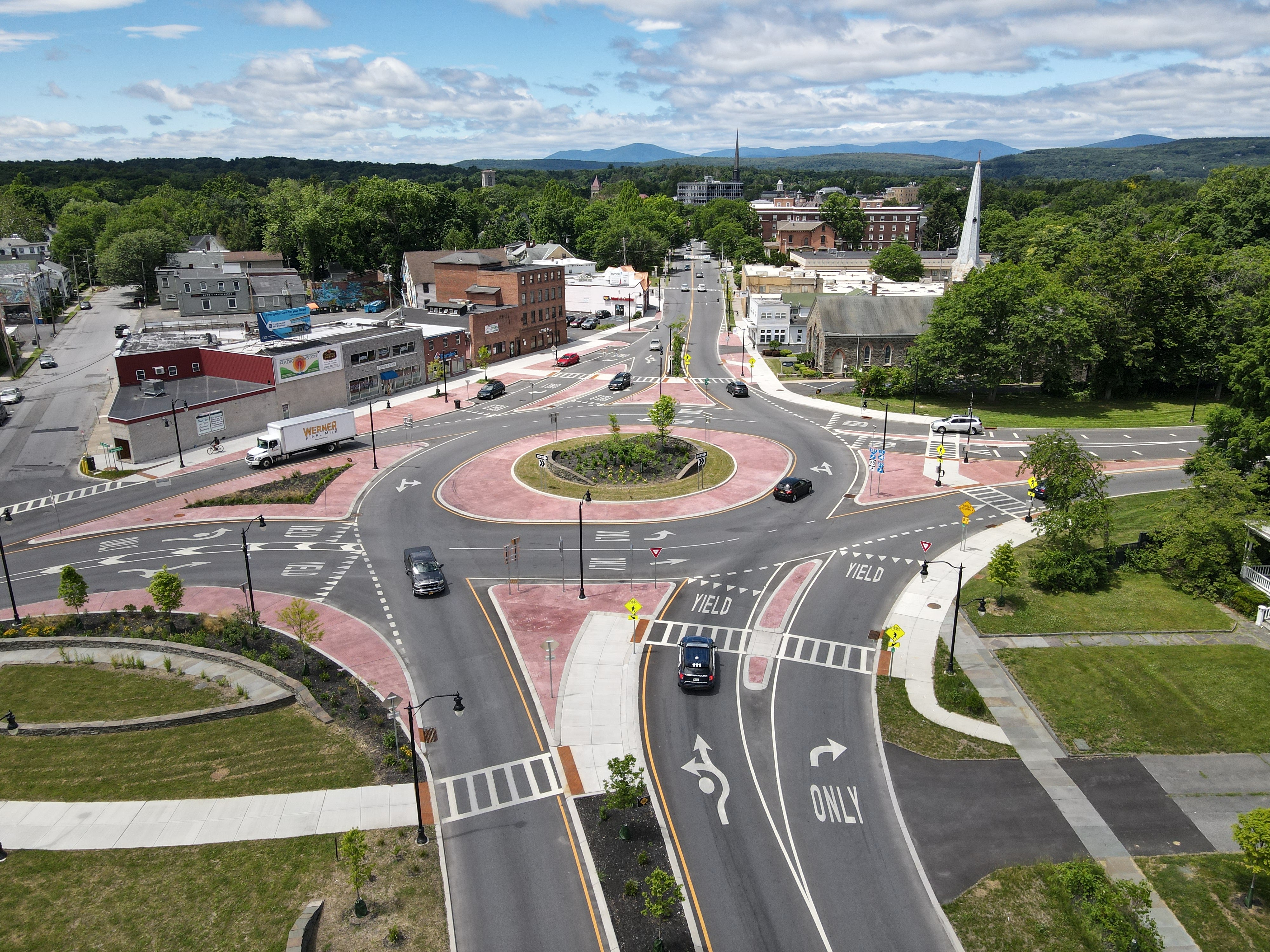
In what turned out to be a $12 million investment from the New York State Department of Transportation and the City of Kingston, NY, the four-way intersection connecting Broadway, Albany Avenue, and Interstate 587 was transformed into a much more efficient transfer point for traffic traversing western Kingston in all directions. The original four-way intersection here dated to the 1950s and its traffic signals were notoriously inefficient. Additionally, safe passage for pedestrians and other non-motorized traffic was no guarantee as those movements were not safely accounted for in the original design.


Above: The new Albany Avenue/Broadway Roundabout project increases efficiency of traffic movements across west Kingston while also improving motorist & pedestrian safety at one of the city's busiest intersections.

Construction of this $12 million project began in early 2020 and persevered throughout the COVID-19 Pandemic. Substantial completion status was attained at the end of 2021, with physical completion status being reached in Spring 2022. The new-look intersection has already had a significant impact on  travelers of all methods and has been a much needed investment for what had previously been one of Kingston's most outdated traffic transfer points.

The following pictures were taken by the author of this post using a DJI quadcopter drone. Always use proper judgment and situational awareness when flying in areas such as this. Click on each photo to see a larger version.


The following pictures were taken by the author of this post and detail some of the new traffic patterns and signage now in place at the new intersection:


Comments

Stephen Taylor said…
In Texas they're called traffic circles, and they're making a comeback. Austin is beginning to use them all over the city, including at a troublesome intersection near our home. The intersection has a large amount of north/south traffic, a steady amount of east traffic and very little from the west. Nasty intersection, controlled only by four stop signs. The COA installed the new traffic circle, and the intersection is now a joy to navigate. The traffic backups from the north continue, but traffic continues to flow and the backups move very quickly. The circle is very small, but it works very, very well. A good use of taxpayer money. Austin is also placing small circles in neighborhoods around town. My wife, who moved to Texas from Chicago, had never seen one and had to be taught how to use them. )She also had to be taught about low-water crossings and flash floods, but that's another story.)

My hometown had a large one where one east/west highway forked to the southwest and the northwest. TxDot installed a circle there back in the '50. Kids growing up in that town learned to navigate "The Circle" as it was called, very early on. It worked very well for my hometown, but when traffic circles fell out of favor with TxDot, the circle was replaced by a very awkwardly designed intersection with traffic signals. The locals hate that intersection with the white-hot heat of a thousand burning suns and wish they had their old circle back. They were all over Southeast Texas, and even today, in places where the circles have been replaced, businesses will still advertise their location as being "on the circle".

Popular posts from this blog

Crescent City Connection (New Orleans, LA)

The Crescent City Connection is a massive dual-span steel truss bridge that spans the lower Mississippi River at downtown New Orleans, about 95 river miles upstream from the mouth of the great river at the Head of Passes Light. If counted as a single bi-directional highway bridge, the parallel spans combine to form the single busiest bridge on the Mississippi River and its importance as a linchpin in the region’s transportation network cannot be overstated. While there have been various schemes over the years to construct bridges downriver from Algiers Point, this bridge has been the southernmost bridge on the Mississippi River since its initial construction in the 1950s. The years immediately following the end of World War II were a transformational period in the history of New Orleans. Already one of the great economic and cultural centers of the American Deep South, it was recognized at this time that major changes and improvements to the city’s transportation infrastructure would b...

Old US Route 99 through Tipton, Tulare, and Tagus Ranch

This summer I had a look into the alignment history of US Route 99 through the Tulare County communities of Tipton, Tulare, and Tagus Ranch.  While this slab below might seem like much it is one of the few remaining reminders of how US Route 99 was during the 1920s in Tulare County. This blog is part of the larger Gribblenation US Route 99 Page.  For more information pertaining to the other various segments of US Route 99 and it's three-digit child routes check out the link the below. Gribblenation US Route 99 Page Part 1; the history of US Route 99 in Tipton, Tulare, and Tagus Ranch Tipton and Tulare were both founded in 1872 as sidings of the Southern Pacific Railroad.  The Southern Pacific Railroad laid the groundwork for development of southern San Joaquin Valley.  Previous to the Southern Pacific Railroad travel via wagon or foot in Central California tended to avoid San Joaquin Valley in favor of the Stockton-Los Angeles Road.  The Stockton Los Ange...

Former US Route 101 and California State Route 41 through Paso Robles

Paso Robles is a city located on the Salinas River of San Luis Obispo County, California.  As originally configured the surface alignments of US Route 101 and California State Route 41 converged in downtown Paso Robles.  US Route 101 originally was aligned through Paso Robles via Spring Street.  California State Route 41 entered the City of Paso Robles via Union Road and 13th Street where it intersected US Route 101 at Spring Street.  US Route 101 and California State Route 41 departed Paso Robles southbound via a multiplex which split near Templeton.   Pictured above is the cover of the September/October 1957 California Highways & Public Works which features construction of the Paso Robles Bypass.  Pictured below is the 1935 Division of Highways Map of San Luis Obispo County which depicts US Route 101 and California State Route 41 intersecting in downtown Paso Robles.   Part 1; the history of US Route 101 and California State Route 41 i...