Kingston, NY's New Roundabout Intersection Gets High Marks from Travelers


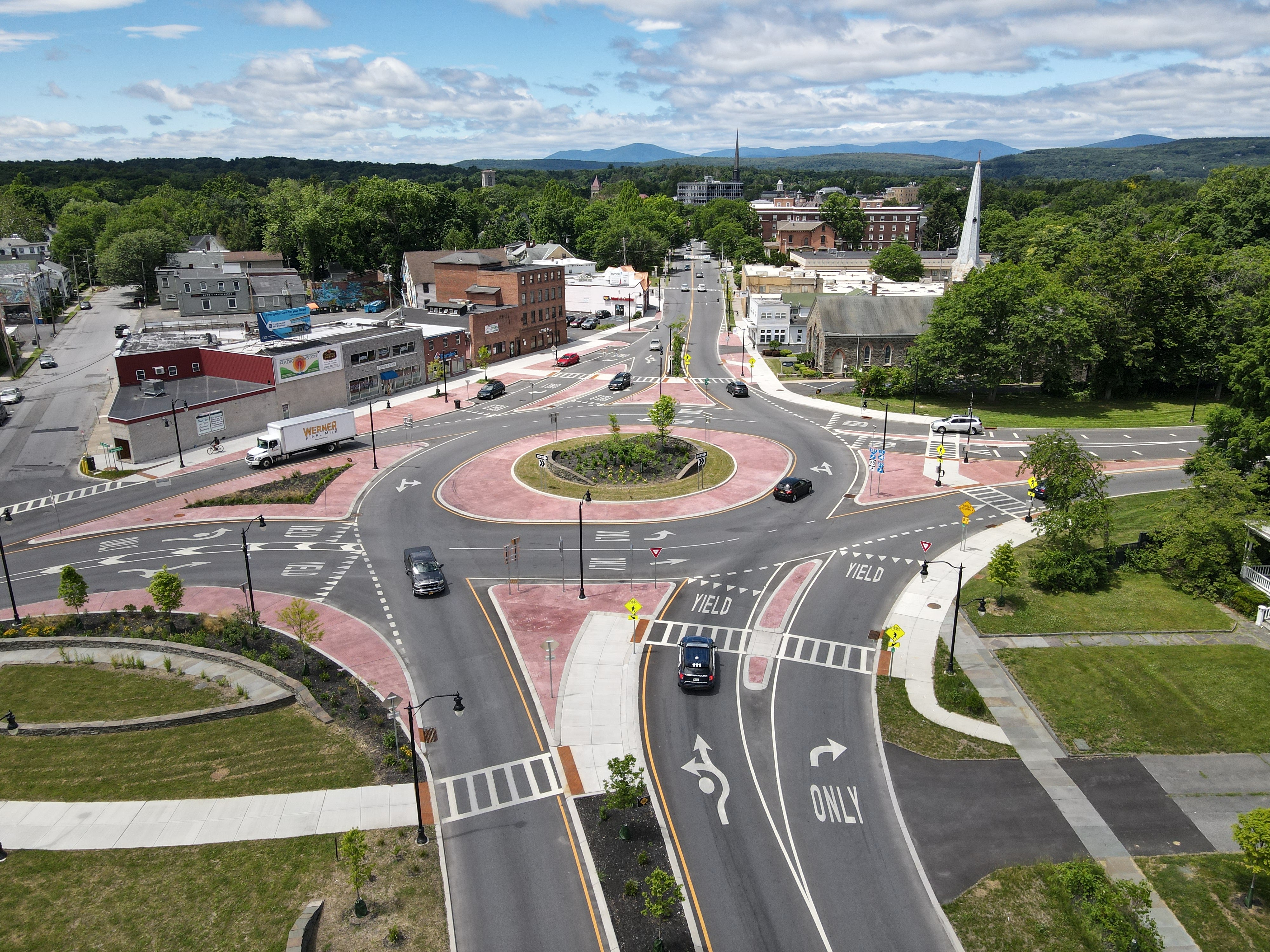
In what turned out to be a $12 million investment from the New York State Department of Transportation and the City of Kingston, NY, the four-way intersection connecting Broadway, Albany Avenue, and Interstate 587 was transformed into a much more efficient transfer point for traffic traversing western Kingston in all directions. The original four-way intersection here dated to the 1950s and its traffic signals were notoriously inefficient. Additionally, safe passage for pedestrians and other non-motorized traffic was no guarantee as those movements were not safely accounted for in the original design.


Above: The new Albany Avenue/Broadway Roundabout project increases efficiency of traffic movements across west Kingston while also improving motorist & pedestrian safety at one of the city's busiest intersections.

Construction of this $12 million project began in early 2020 and persevered throughout the COVID-19 Pandemic. Substantial completion status was attained at the end of 2021, with physical completion status being reached in Spring 2022. The new-look intersection has already had a significant impact on  travelers of all methods and has been a much needed investment for what had previously been one of Kingston's most outdated traffic transfer points.

The following pictures were taken by the author of this post using a DJI quadcopter drone. Always use proper judgment and situational awareness when flying in areas such as this. Click on each photo to see a larger version.


The following pictures were taken by the author of this post and detail some of the new traffic patterns and signage now in place at the new intersection:


Comments

Stephen Taylor said…
In Texas they're called traffic circles, and they're making a comeback. Austin is beginning to use them all over the city, including at a troublesome intersection near our home. The intersection has a large amount of north/south traffic, a steady amount of east traffic and very little from the west. Nasty intersection, controlled only by four stop signs. The COA installed the new traffic circle, and the intersection is now a joy to navigate. The traffic backups from the north continue, but traffic continues to flow and the backups move very quickly. The circle is very small, but it works very, very well. A good use of taxpayer money. Austin is also placing small circles in neighborhoods around town. My wife, who moved to Texas from Chicago, had never seen one and had to be taught how to use them. )She also had to be taught about low-water crossings and flash floods, but that's another story.)

My hometown had a large one where one east/west highway forked to the southwest and the northwest. TxDot installed a circle there back in the '50. Kids growing up in that town learned to navigate "The Circle" as it was called, very early on. It worked very well for my hometown, but when traffic circles fell out of favor with TxDot, the circle was replaced by a very awkwardly designed intersection with traffic signals. The locals hate that intersection with the white-hot heat of a thousand burning suns and wish they had their old circle back. They were all over Southeast Texas, and even today, in places where the circles have been replaced, businesses will still advertise their location as being "on the circle".

Popular posts from this blog

Did Caltrans just kill the G26 cutout US Route shields?

The US Route System was formally created by the American Association of State Highway Officials during November 1926.  Through the history of the system the only state to which has elected to maintain cutout US Route shields has been California.  The G26 series cutout US Route shields have become a favorite in the road enthusiast hobby and are generally considered to be much more visually pleasing than the standard Federal Highway Administration variant.  However, the G26 shield series appears to have been killed off on January 18, 2026, when Caltrans updated their Manual of Uniform Traffic Control Devices.  This blog will examine the history of the US Route shield specifications in California and what is happening with the 2026 changes.  The blog cover photo is facing towards the terminus of California State Route 136 and at a G26-2 specification US Route 395 shield.  In the background Mount Whitney can be seen in the Sierra Nevada range.   ...

May 2023 Ontario Trip (Part 3 of 3)

  Over the years, I have made plenty of trips to Ontario, crisscrossing the southern, central and eastern parts of the province. Living in Upstate New York, it's pretty easy to visit our neighbor to the north, or is that our neighbor to the west? Ottawa is one of my favorite cities to visit anywhere in the world, plus I've discovered the charm of Kingston, the waterfalls of Hamilton (which is on the same Niagara Escarpment that brings us Niagara Falls), the sheer beauty of the Bruce Peninsula, and more. But I hadn't explored much of Cottage Country. So I decided to change that, and what better time to go than over Memorial Day weekend, when the daylight is long and I have an extra day to explore. On the third and final day of my trip, I started in Huntsville and made my way through Muskoka District and Haliburton County, passing by many lakes along the way. I stopped in towns such as Dorset, Haliburton and Bancroft before making a beeline down to Belleville and then over th...

Ghost Town Tuesday; Nichols, FL

A couple years ago I spent a lot of spare time exploring phosphate mining ghost towns in the Bone Valley of Polk County, Florida.  One ghost town in particular called Nichols on Polk County Route 676 west of Mulberry caught my eye due to a relative lack of documentation on ghosttowns.com. Nichols was created in 1905 during the early phosphate mining boom in the Bone Valley region.  For the time Nichols was unusual since it had company housing in the Nichols Mine site and private residences outside the gate.  Nichols is only about two miles west of Mulberry which probably made it a somewhat reasonable commute even by the wonky standards of the early 20th Century.  Most of the Bone Valley region was relatively remote which made commuting or homesteading impractical which is why there are so many ghost towns in the area.  The company housing section of Nichols was phased out and abandoned by 1950. The Nichols town site is largely abandoned and could "possibl...