A Few Thoughts on Binghamton's "SNOWVID Emergency"


The icy confluence of the Chenango (left) and Susquehanna (right) Rivers in downtown Binghamton

In a typical winter season, the city of Binghamton, NY (located at the confluence of Interstates 81, 86, and 88 in New York State's Southern Tier region) receives around 60 inches of snowfall on average and is among the "Snow Capitals" of the state. It is not the “flagship” location for big snowfall in New York (see places such as Buffalo, Oswego, and Watertown), but this part of the state is no stranger to large-scale snowstorms, thanks to both Lake Effect and Nor’easter-type storm systems. During the Nor’easter of December 16-17, 2020, Binghamton and its surrounding communities recorded well in excess of three feet of snow within a 48-hour period, setting an all-time record for a two-day snowfall total. The locals immediately began cleverly calling this storm the “SNOWVID Emergency” and its immediate impact was to effectively paralyze travel across the region, both on the local street grid and on the major freeways of the area. Snow removal crews descended upon the region in the days after the storm – crews from New York State DOT responded in full force, as did an auxiliary set of crews offered to the area by the New York State Thruway Authority. Crews worked around the clock for days to make the streets and highways of the area passable again in an effort to reopen the city in time for the final days of the Christmas shopping season.

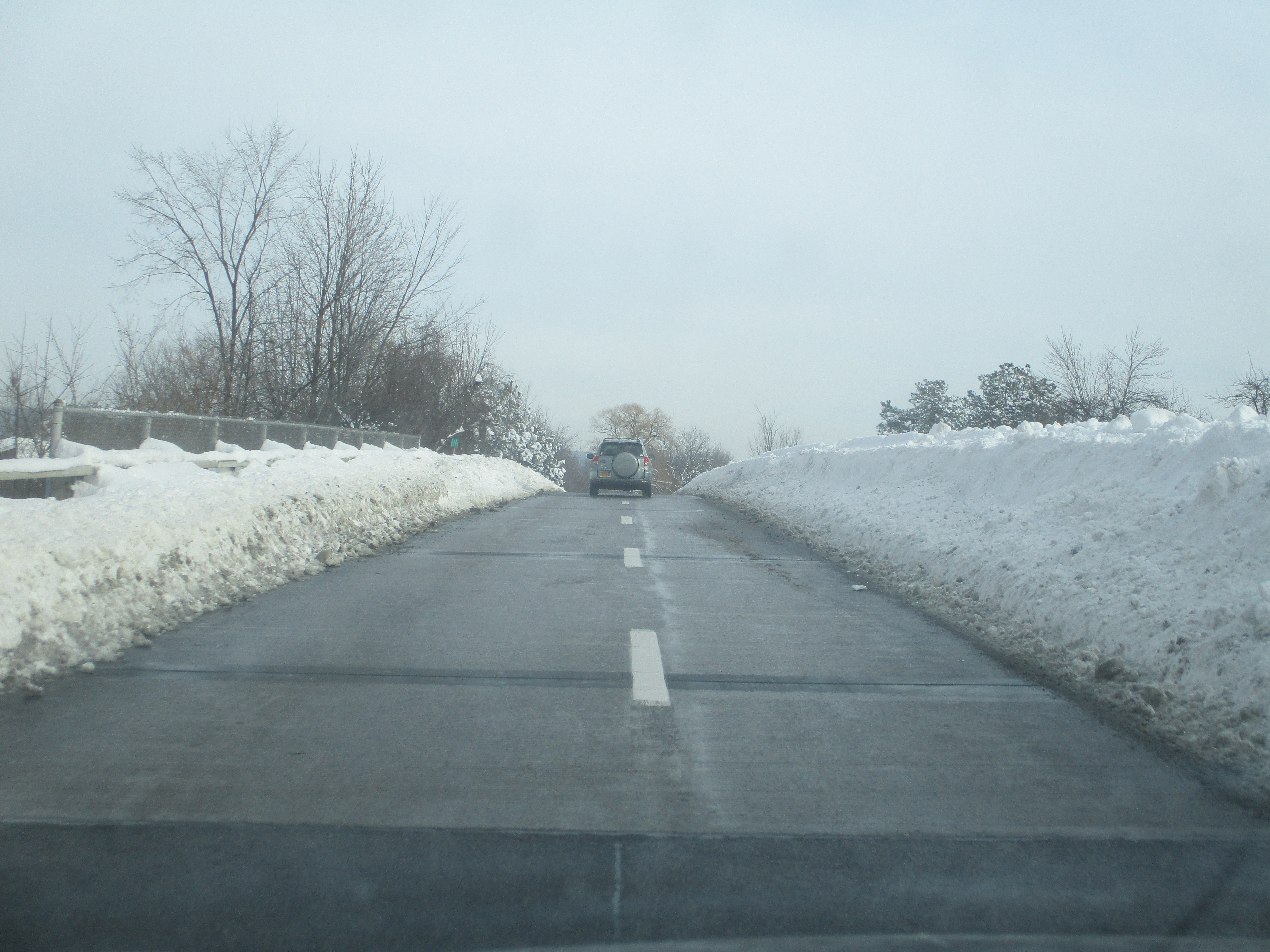
In the aftermath of this storm, I decided to make the 2+ hour journey up Route 17 to check out the big snowfall for myself. Having attended the University at Buffalo’s School of Engineering & Applied Sciences, I am no stranger to witnessing enormous snowfalls in New York’s “Snow Belt”, but it had been several years since I had seen one quite this big. I was very impressed with the progress that had been made in the snow removal category by the date of my visit (Saturday, 12/19). In general, shoulder lanes and auxiliary travel lanes were not always completely clear, and areas along on/off ramps were problematic due to lack of snow-clearing and overall lack of visibility due to the tall mounds of snow working to block typical sight lines at interchanges. However, considering that these scenes were captured about 48 hours after the storm’s conclusion, the major roads and streets across the area were in fairly good shape and generally open to traffic. It was great to see folks out and about doing their part to get things open again – this is the kind of event that folks around this corner of the world are typically better prepared for than most.

What follows is a pictorial guide to the “Triple Cities” area of the Southern Tier (referring to the area around neighboring Binghamton, Johnson City, and Endicott) as we take a look at the impressive aftermath of one of the area’s biggest snowfall events in recorded history. The story of this storm will be told by residents and travelers of this area for many years to come.

 
Entering the city of Binghamton from the east on Route 17/I-81/I-86 westbound

Ground-level views of the Prospect Mountain Interchange - where I-81 & I-86/NY 17 meet north of downtown

Aerial views of the Prospect Mountain Interchange, which was recently reconstructed to improve connections between the two highways and the surrounding local streets

Scenes along the State Street Bridge & North Shore Drive/NY 363 in/near downtown

A snow-covered Washington Street Bridge spanning the Susquehanna downtown

Ground level views of partially-cleared Binghamton city streets

Aerial views of Binghamton's bridges and city streets

Johnson City Circle & Johnson City Flyover on NY 201, viewed from the air

Johnson City neighborhoods and the NY 201 Expressway viewed from the air

Susquehanna River Railroad Bridge in Johnson City viewed from the air


Ground-level views of Johnson City Circle & the NY 201 Expressway through Johnson City

A Gateway to Johnson City... and Winter 2020 - get out there and enjoy it if you can!

Comments

Unknown said…
Impressive although we often see deeper snow near Donner Summit, CA https://youtu.be/OKE_XJDw2zc

Popular posts from this blog

Did Caltrans just kill the G26 cutout US Route shields?

The US Route System was formally created by the American Association of State Highway Officials during November 1926.  Through the history of the system the only state to which has elected to maintain cutout US Route shields has been California.  The G26 series cutout US Route shields have become a favorite in the road enthusiast hobby and are generally considered to be much more visually pleasing than the standard Federal Highway Administration variant.  However, the G26 shield series appears to have been killed off on January 18, 2026, when Caltrans updated their Manual of Uniform Traffic Control Devices.  This blog will examine the history of the US Route shield specifications in California and what is happening with the 2026 changes.  The blog cover photo is facing towards the terminus of California State Route 136 and at a G26-2 specification US Route 395 shield.  In the background Mount Whitney can be seen in the Sierra Nevada range.   ...

May 2023 Ontario Trip (Part 3 of 3)

  Over the years, I have made plenty of trips to Ontario, crisscrossing the southern, central and eastern parts of the province. Living in Upstate New York, it's pretty easy to visit our neighbor to the north, or is that our neighbor to the west? Ottawa is one of my favorite cities to visit anywhere in the world, plus I've discovered the charm of Kingston, the waterfalls of Hamilton (which is on the same Niagara Escarpment that brings us Niagara Falls), the sheer beauty of the Bruce Peninsula, and more. But I hadn't explored much of Cottage Country. So I decided to change that, and what better time to go than over Memorial Day weekend, when the daylight is long and I have an extra day to explore. On the third and final day of my trip, I started in Huntsville and made my way through Muskoka District and Haliburton County, passing by many lakes along the way. I stopped in towns such as Dorset, Haliburton and Bancroft before making a beeline down to Belleville and then over th...

Ghost Town Tuesday; Nichols, FL

A couple years ago I spent a lot of spare time exploring phosphate mining ghost towns in the Bone Valley of Polk County, Florida.  One ghost town in particular called Nichols on Polk County Route 676 west of Mulberry caught my eye due to a relative lack of documentation on ghosttowns.com. Nichols was created in 1905 during the early phosphate mining boom in the Bone Valley region.  For the time Nichols was unusual since it had company housing in the Nichols Mine site and private residences outside the gate.  Nichols is only about two miles west of Mulberry which probably made it a somewhat reasonable commute even by the wonky standards of the early 20th Century.  Most of the Bone Valley region was relatively remote which made commuting or homesteading impractical which is why there are so many ghost towns in the area.  The company housing section of Nichols was phased out and abandoned by 1950. The Nichols town site is largely abandoned and could "possibl...