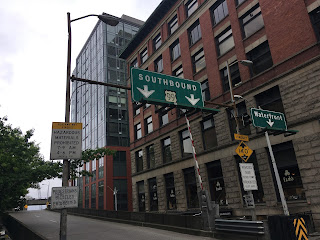
Alaskan Way Viaduct Legacy Part 1; Railroad Avenue


Long before US Route 99 and the Alaskan Way Viaduct the Seattle Waterfront along Elliott Bay was served by Railroad Avenue.  The corridor of Railroad Avenue had been commissioned by the Seattle city council in 1887 as planked roadway which carried not just rail traffic but pedestrians and carriages.  During the automotive era the corridor would become clogged with a mess of competing traffic attempting to negotiate the increasingly obsolete planked roadway.  Between 1934-1936 Railroad Avenue was modernized via installation of a seawall and was rechristened as "Alaskan Way."  

Part 1 of the Alaskan Way Viaduct Legacy series covers the history of Railroad Avenue.  The blog cover photo is of Railroad Avenue facing north from Marion Street on the Seattle Waterfront in 1934. 

Railroad Avenue can be seen below as it was displayed on the 1901 Cram's Seattle and Environs map


This blog is part of the larger Gribblenation US Route 99 Page.  For more information pertaining to the other various segments of US Route 99 and its three-digit child routes check out the link the below.


Part 1; the history of Railroad Avenue

The corridor of Railroad Avenue is tied to the history of the original town plot of Seattle at Duwamish Head.  Duwamish Head is the northern tip a peninsula west of downtown Seattle over the waters of Elliott Bay (part of the larger Puget Sound).  The area around Duwamish Head is part of the Alki neighborhood of West Seattle which extends to Alki Point.  Alki Point and the Alki neighborhood were the origin point for the city of Seattle having been settled in November of 1851 by the American Denny Party.  

Originally the settlement at Duwamish Head was known as "New York Alki."  The terrain ultimately proved unfavorable and was largely vacated by April 1852.  Most of the settlers relocated east over Elliott Bay for what is now Pioneer Square.  Despite most of the settlers leaving New York Alki it would never be totally abandoned and would eventually incorporate as West Seattle in 1902. 

The idea for a "Railroad Avenue" in Seattle as a concept was borne amid the construction of the Seattle, Lake Shore & Eastern Railway (SLS&E).  Said railroad line had been incorporated on April 15, 1885.  Much of the early construction along the SLS&E was focused on building a line away branching east from Seattle towards Snoqualmie Pass.  

In 1887 the city of Seattle passed an ordinance which established the creation of Railroad Avenue.  Railroad Avenue was a planked roadway which began at near Duwamish Head.  From Duwamish Head the corridor crossed the open tidal waters of Elliott Bay where Harbor Island now located.  Railroad Avenue upon crossing Elliott Bay turned north into downtown Seattle.  Railroad Avenue was built with the purpose of accommodating all transportation needs from anything as large as railroads to as small as pedestrian traffic.  

Railroad Avenue can be seen crossing the tide flats of Elliott Bay on the 1890 Whitney's Seattle and Environs map

This view on Railroad Avenue was taken facing southeast from Marion Street in 1900.  This public domain photo was sourced from the 1900 book titled "Seattle and the Orient."


Railroad Avenue can be seen in great detail on the 1901 Cram's Seattle and Environs map.  The Railroad Avenue corridor can be seen beginning near Duwamish Head in West Seattle.  Upon crossing the Elliott Bay tidal flats, the corridor is shown turning north along the Seattle Waterfront towards the SLS&E ocean docks.


During 1903-1906 the Great Northern Railroad constructed a tunnel under downtown Seattle.  This tunnel served to relieve much of the freight congestion along Railroad Avenue. 

West Seattle was annexed by the city of Seattle in 1907.  In 1909 Harbor Island was dredged in the tidal flats of Eliott Bay.  Railroad Avenue as a corridor was subsequently truncated to running as a north/south orientation out of downtown Seattle.  Despite being a major local roadway Railroad Avenue north of Jackson Street was not annexed into the Pacific Highway when it as codified by the State Legislature in 1913.  The Pacific Highway corridor instead shifted onto 1st Avenue (see Part 2 for more detail).

During the early automobile era Railroad Avenue was reported to be a chaotic mess of pedestrians, cars and trains all trying to access the Seattle Waterfront.  Between 1911 and 1916 a concrete seawall was put in place along Railroad Avenue between Washington Street and Madison Street.  The seawall had been commissioned as part of the first comprehensive city planning guide called "The of Seattle" which had been written by engineer Virgil Boque

The corridor of Railroad Avenue can be seen fronting Seattle Waterfront on a 1917 Lowman & Hanford Company panoramic of downtown Seattle.


A similar panoramic view of downtown Seattle can be seen in a photo by Gribblenation's Tom Fearer during May 2018.  At the time the Alaskan Way Viaduct was still present on the Seattle Waterfront.


This view is from Railroad Avenue in 1925 (Seattle Municipal Archives photo).  US Route 99 would be overlaid atop the Pacific Highway in downtown Seattle when the US Route System was commissioned in November 1926. 


In 1933 a maintenance plan for Railroad Avenue was blocked by then Seattle Mayor John F. Dore.  Dore wrote the following regarding the conditions present along the corridor during the early 1930s:

"This Railroad Avenue is a death trap. It is a menace to the life of all that use it. The improvement [a seawall and new street] should be made because daily the hazard is run of taking human life by inaction"

In 1934 the city of Seattle received funding contributions to rebuild Railroad Avenue via the Washington State Emergency Relief Fund.  Between 1934 and 1936 the planked Railroad Avenue was completely rebuilt.  A seawall was installed to render the previous planking unnecessary.  Four lanes of roadway traffic were separated from the railroad grade.  

This photo from the Seattle Municipal Archives along Railroad Avenue was taken in 1934 and faces north from Marion Street.


During 1936 the seawall along Railroad Avenue was extended north to Bay Street.  On July 6, 1936, the Seattle city council renamed the corridor as "Alaskan Way."  The name had been suggested by the Alaska-Yukon Pioneers Association as a way to honor members of the Klondike Gold Rush.  

Traffic along Alaskan Way can be seen in a 1939-era photo from the Seattle Municipal Archives


This series continues in Alaskan Way Viaduct Legacy Part 2 which can be found here:


Revision history

First released on 5/12/2018.
-  First updated on 9/9/2025.

Comments

Popular posts from this blog

Did Caltrans just kill the G26 cutout US Route shields?

The US Route System was formally created by the American Association of State Highway Officials during November 1926.  Through the history of the system the only state to which has elected to maintain cutout US Route shields has been California.  The G26 series cutout US Route shields have become a favorite in the road enthusiast hobby and are generally considered to be much more visually pleasing than the standard Federal Highway Administration variant.  However, the G26 shield series appears to have been killed off on January 18, 2026, when Caltrans updated their Manual of Uniform Traffic Control Devices.  This blog will examine the history of the US Route shield specifications in California and what is happening with the 2026 changes.  The blog cover photo is facing towards the terminus of California State Route 136 and at a G26-2 specification US Route 395 shield.  In the background Mount Whitney can be seen in the Sierra Nevada range.   ...

May 2023 Ontario Trip (Part 3 of 3)

  Over the years, I have made plenty of trips to Ontario, crisscrossing the southern, central and eastern parts of the province. Living in Upstate New York, it's pretty easy to visit our neighbor to the north, or is that our neighbor to the west? Ottawa is one of my favorite cities to visit anywhere in the world, plus I've discovered the charm of Kingston, the waterfalls of Hamilton (which is on the same Niagara Escarpment that brings us Niagara Falls), the sheer beauty of the Bruce Peninsula, and more. But I hadn't explored much of Cottage Country. So I decided to change that, and what better time to go than over Memorial Day weekend, when the daylight is long and I have an extra day to explore. On the third and final day of my trip, I started in Huntsville and made my way through Muskoka District and Haliburton County, passing by many lakes along the way. I stopped in towns such as Dorset, Haliburton and Bancroft before making a beeline down to Belleville and then over th...

Ghost Town Tuesday; Nichols, FL

A couple years ago I spent a lot of spare time exploring phosphate mining ghost towns in the Bone Valley of Polk County, Florida.  One ghost town in particular called Nichols on Polk County Route 676 west of Mulberry caught my eye due to a relative lack of documentation on ghosttowns.com. Nichols was created in 1905 during the early phosphate mining boom in the Bone Valley region.  For the time Nichols was unusual since it had company housing in the Nichols Mine site and private residences outside the gate.  Nichols is only about two miles west of Mulberry which probably made it a somewhat reasonable commute even by the wonky standards of the early 20th Century.  Most of the Bone Valley region was relatively remote which made commuting or homesteading impractical which is why there are so many ghost towns in the area.  The company housing section of Nichols was phased out and abandoned by 1950. The Nichols town site is largely abandoned and could "possibl...